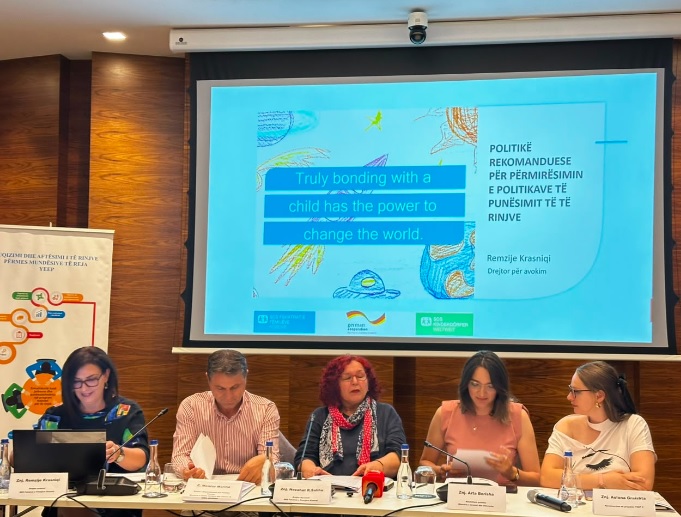
Lack of experience and unpaid internships are some of the challenges young people in Kosovo face today. In this regard, to improve youth employment, the organization SOS Children’s Villages in Kosovo has presented policy recommendations for improving youth employment in Kosovo, KosovaPress reports.
Through an event held in Pristina, as part of the project “YEEP II – Empowerment and Employability of Youth through New Opportunities”, the need for better career guidance, increased opportunities for professional internships, and greater inclusion of young people in the labour market was highlighted.
The National Director of SOS Children’s Villages in Kosovo, Nezahate R. Salihu, said that the project started in 2020 and aimed to improve employment opportunities for young people in vulnerable situations.
She stressed that beyond statistics, the project has had a direct impact on increasing young people’s self-confidence and skills, offering them better prospects for the future. According to her, the presented recommendations are the result of practical experiences of young people and consultations with institutions, the private sector, and civil society.
“The event today is the result of many years of work that SOS Children’s Villages in Kosovo has been carrying out for the economic and social empowerment of young people. The YEP project started in 2020 and is funded by the German Federal Ministry for Economic Cooperation and Development and the International Office of SOS Children’s Villages, while it is implemented by SOS Children’s Villages in Kosovo. This is a regional project and aims to improve employment opportunities and labour market inclusion for vulnerable young people… Over these years we have trained hundreds of young people in life skills, employment and entrepreneurship. Thousands of mentoring and career counselling sessions have been conducted, new business initiatives have been supported, internship opportunities have been created, and hundreds of young people are now active in the labour market,” said Salihu.
The political advisor at the Ministry of Education, Science, Technology and Innovation, Arta Berisha, assessed that career guidance should be treated as a fundamental right of every young person.
Meanwhile, the Director of the Department for Social Policies at the Ministry of Labour, Family and Veterans’ Affairs, Mentor Morina, said that institutions are working on new legislation aimed at shifting from passive financial support towards activating beneficiaries in the labour market.
“What is important from an institutional perspective is that currently as a ministry we are focused on creating social welfare legislation and social protection programmes… so that we can have a holistic approach, not only seeing the person, family, or individual as financial support but also providing other components in terms of services, integration into the labour market, and moving from passivity to activation. This is also the aim of the new legislation, as practice has shown, especially for a number of families who are beneficiaries of the social assistance scheme, where young men and women are also part of them, have in fact remained passive in terms of labour market activation for years,” said Morina.
Representing the young participants in the project, psychology student at the University of Pristina, Aulona Grashita, raised concerns about the lack of work experience and unpaid internships.
Meanwhile, at this event it was emphasized that cooperation between institutions, non-governmental organizations, the private sector, and young people themselves remains key to creating effective policies that facilitate the transition from education to employment and increase opportunities for youth integration into the labour market.