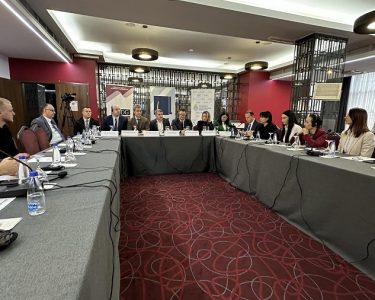

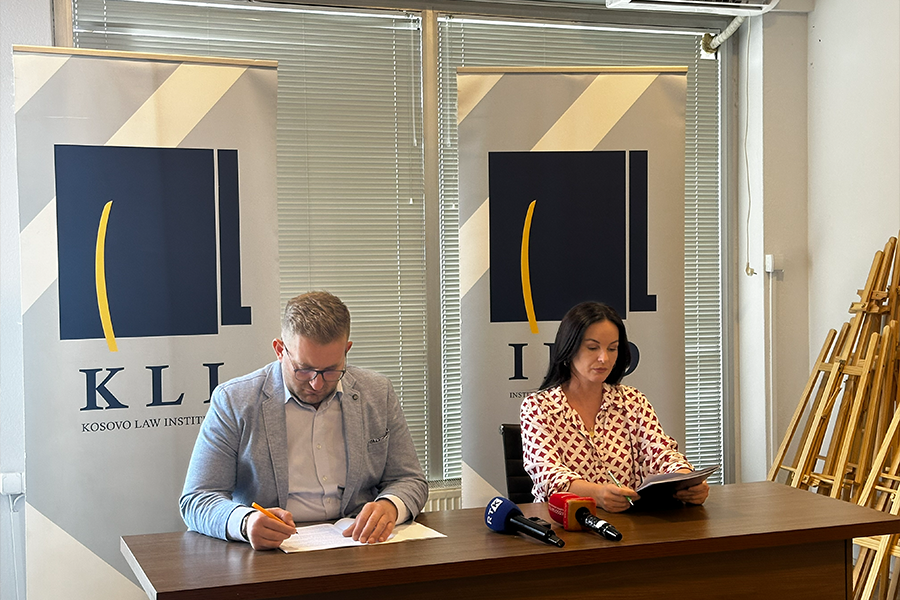
The Kosovo Law Institute (KLI) has assessed that the draft law on the State Bureau for the Verification and Confiscation of Unjustifiable Wealth has made progress compared to previous versions, but still contains shortcomings that need to be addressed before its approval.
Presenting the report “Unjustifiable Wealth, Justifiable Justice,” KLI senior researcher Gëzim Shala said that the draft law has been under discussion for six years and has been rejected twice by the Constitutional Court.
He said that although some of the Constitutional Court’s findings have been reflected, serious issues still remain that require further review.
“The findings show that there are still open issues regarding this draft law. Despite the fact that the goal may be legitimate, it is also legitimate for this draft law to guarantee legal certainty and protection from arbitrariness, so that it serves as a tool for the rule of law in combating unjustifiable wealth and under no circumstances becomes an arbitrary tool against the subjects covered by this law. Initially, the Kosovo Law Institute assesses the progress made in this draft compared to the previous version, particularly in terms of incorporating the Constitutional Court’s findings. However, serious open issues remain, requiring a review of the draft law before it is adopted. The Bureau will have an important mandate, and therefore its procedures and mandate must be clear, precise and designed in a way that does not create sufficient space for arbitrariness,” Shala said.
Shala further stated that the draft law should ensure greater independence for the Bureau, recommending that the director and members of the supervisory commission be elected with at least 61 votes in the Assembly.
He also raised concerns over unclear definitions of the term “property to the highest extent” and the lack of a specialized division within the Court of Appeals to handle such cases.
According to him, the draft law has also improved the definition of the verification period, an issue on which the Constitutional Court had previously identified problems.