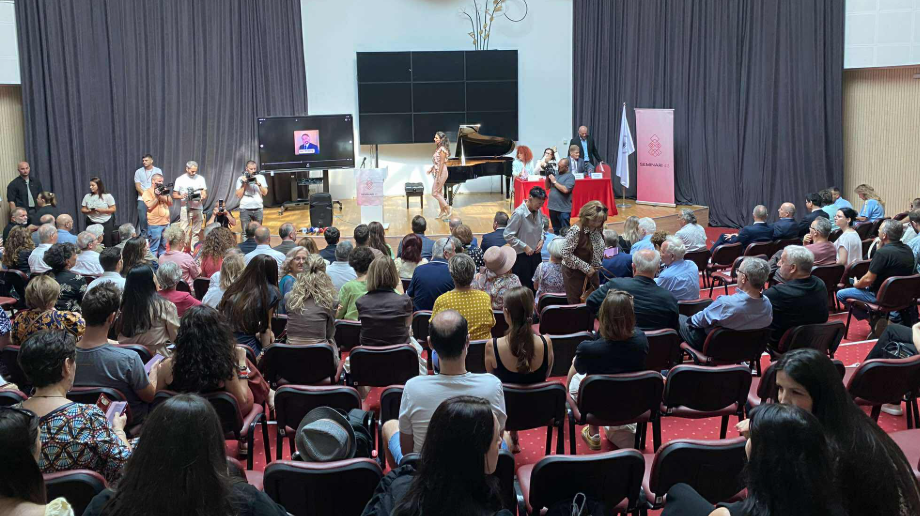
43rd edition of the Language Seminar opens, around 200 scholars participate
Today in Prishtina, the 43rd edition of the International Seminar on Albanian Language, Literature, and Culture was opened, which will continue until August 29. Around 200 scholars from various countries will participate in this seminar.
The acting Prime Minister, Albin Kurti, stated that this seminar is one of the longest-standing events in Kosovo’s cultural life.
Kurti said that enthusiasm for the Albanian language, art, and culture should be increased, and he expressed support for all institutions tasked with this mission.
“Language is not only the communication of needs but, above all, the communication of subjectivity, memory, imagination, and culture; in other words, it is essential communication. In the context of rapid development of Artificial Intelligence, language is the most solid foundation for preserving human and natural intelligence and imagination… Regardless of our social and state wealth, our enthusiasm for the Albanian language in our culture, art, and sciences should only grow. As Prime Minister, I express my willingness to support institutions directly connected to this noble purpose and historical duty,” Kurti emphasized.
The Rector of the University of Prishtina, Hasan Prishtina, Arben Hajrullahu, said that around 200 scholars and enthusiasts of the Albanian language and culture will participate in the 43rd edition of this seminar.
He emphasized that the aim of this seminar is to preserve the roots of the Albanian language and culture.
“As the University of Prishtina, we are extremely proud to host this seminar, such a major and important event. This year, in the 43rd edition, around 200 scholars and enthusiasts of Albanian language, literature, and culture are expected to participate. The seminar is the longest-standing event of its kind at the University of Prishtina, and I learned that it even began a year before the creation of the Academy of Sciences and Arts of Kosovo… When we see the structure and pillars that make up this seminar, we observe that it consistently brings new scientific developments, activities, promotion of Albanian language teaching, and cultivation of the Albanian language culture—not only for those of us who were born and speak it as a mother tongue, but also for all interested people. I am very pleased that this year 34 hours of Albanian language courses will be organized at all three levels. So, this promotes, cultivates, and even internationalizes the Albanian language,” he said.
The Chairman of the Academy of Sciences and Arts of Kosovo, Mehmet Kraja, also wished a successful start to this edition of the seminar, stating that the International Seminar on Albanian Language, Literature, and Culture is the longest-standing cultural event across all Albanian territories.
“The main cultural event with the longest longevity, not only in Kosovo but throughout the Albanian-speaking space. There are still witnesses, like me and others, of the early days in 1974 when the Center for Foreign Studies adopted the seminar’s name, a name it still bears today… We are aware that in organizing the seminar, teaching, and lecturing, structural changes will be necessary, and Albanological knowledge, including linguistic and literary studies, will need to move away from positivism and develop critical thinking. On the other hand, I am confident that, as always, you will leave with the best impressions of hospitality and friendship,” Kraja emphasized.
The Dean of the Faculty of Philology, Abdullah Rexhepi, stated that this seminar is being organized this year in accordance with the highest academic and cultural standards.
“Being aware of the high ideals of the seminar’s founders, we continue to feel the obligation to ensure that the organization meets the highest academic and cultural standards, as well as current infrastructural needs… During these two weeks, in addition to Albanian language courses for participants coming from different countries, there will be 11 lectures by prominent local and foreign Albanologists, 84 presentations in various fields of Albanology, and 50 scientific papers within the core topics of this seminar,” Rexhepi declared.
The Ambassador of Albania to Kosovo, Petrit Malaj, said that this seminar is not just an academic activity but a platform where the Albanian language is taught as one of the oldest languages in Europe.
“A valuable academic tradition, which since 1974 has turned Prishtina into an international center for expertise and scientific cooperation in Albanology. The history of this seminar itself is a narrative of the resilience of knowledge in the face of challenges. During the years of Albania’s isolation, this seminar in Prishtina was a window through which foreign scholars could get to know our language and culture up close,” said the Albanian ambassador to Kosovo.
The Director of the International Seminar on Albanian Language, Literature, and Culture, Lindita Sejdiu, said that the seminar is the strongest concept for internationalizing Albanology worldwide.
“The seminar institution is the strongest concept of internationalizing Albanology in the world. It is the most valuable presentation of local science from a global perspective, but also the presentation of global science for Albanology within a common medium… The seminar represents Prishtina and Tirana together on the international scientific map,” said Director Sejdiu.
Also present at the opening of the 43rd edition was the co-director of the seminar in Tirana, Shezair Rrokaj.
The International Seminar on Albanian Language, Literature, and Culture was founded in 1974 at the Faculty of Philology (then: Faculty of Philosophy) of the University of Prishtina. This seminar is organized for students and scholars engaged in Albanian language, literature, and culture, as well as Albanology in general. So far, the seminar has held a total of 42 sessions.