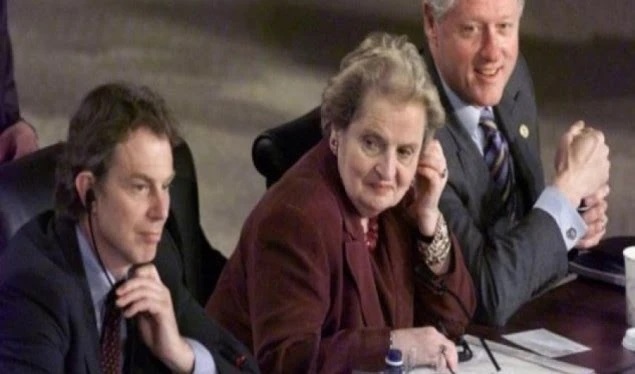
27 years since the historic declaration of the Contact Group in London
The Racak massacre definitively ruled out the possibility of a peace agreement through direct Albanian–Serbian talks, as had been proposed for several years.
After this massacre, diplomatic activity intensified along the Washington–NATO–Brussels–Contact Group axis, where all parties reached agreement that the idea of organizing a conference should take priority over a policy of ultimatums.
On January 29, 1999, the Contact Group, meeting in London at Lancaster House near St. James’s Palace, issued the historic declaration on holding the Rambouillet Conference and approved the non-negotiable principles on which the Interim Agreement for Kosovo was to be built.
On January 30, the NATO Council renewed the decision taken in October of the previous year, thereby establishing a diplomatic framework for the Conference.
The spirit of the Contact Group’s declaration left no doubt about the determination to find a solution and to negotiate before spring. “It is almost an ultimatum,” Pascal Milo would write in his book.
In Belgrade, naturally, the Contact Group’s declaration was not well received. Official Albania, through its ambassador to France, Luan Rama, had requested from Védrine’s special adviser, the envoy for Kosovo, that Albania be granted observer status, a request that was not accepted.
As justification, adviser Foucher stated that there would be no other observers from the Balkans and that there would be no international conference in Rambouillet like the one held in Paris for Bosnia.
Determination for military intervention had now become part of the equation, with the Contact Group, supported by the UN Security Council, together with NATO.
The U.S. government in particular had begun to exert pressure for possible military action to stop repression in Kosovo.
The threat of using force in relation to Kosovo by the United States had existed since 1992.
“In the event of a conflict in Kosovo, which would be caused by Serbia’s actions, the United States would be prepared to use military force against the Serbs in Kosovo and in Serbia itself,” then-President George Bush had written to Slobodan Milošević—a threat later reiterated by the Bill Clinton administration.
Meanwhile, Javier Solana, NATO Secretary General, declared that the Alliance, in its efforts to support the international community in achieving a negotiated agreement, had “...reviewed its military planning for options to halt the violence and create conditions for negotiations. These include the use of ground and air forces, and in particular a wide range of options for the use of air power alone. These ensure that NATO would be able to act quickly and effectively should the need arise.”
The UN Security Council had also adopted Resolutions 1160 (1998), under which Belgrade was required to halt all combat operations, and 1199 (1998), both based on Chapter VII of the UN Charter. A resolution adopted under Chapter VII of the UN Charter is regarded as a first step toward tougher measures by the Security Council, which may go as far as military intervention.
On the basis of Chapter VII of the UN Charter, the deterioration of the situation in Kosovo was assessed as a “threat to peace and security in the region.” Even Russian Foreign Minister Ivanov voted in favor of Resolution 1199, implying a retreat from Russia’s previously strong position in support of Belgrade.
Before public opinion, the Russians justified this by emphasizing that the resolution would serve as an impetus for direct dialogue between Belgrade and Kosovo.