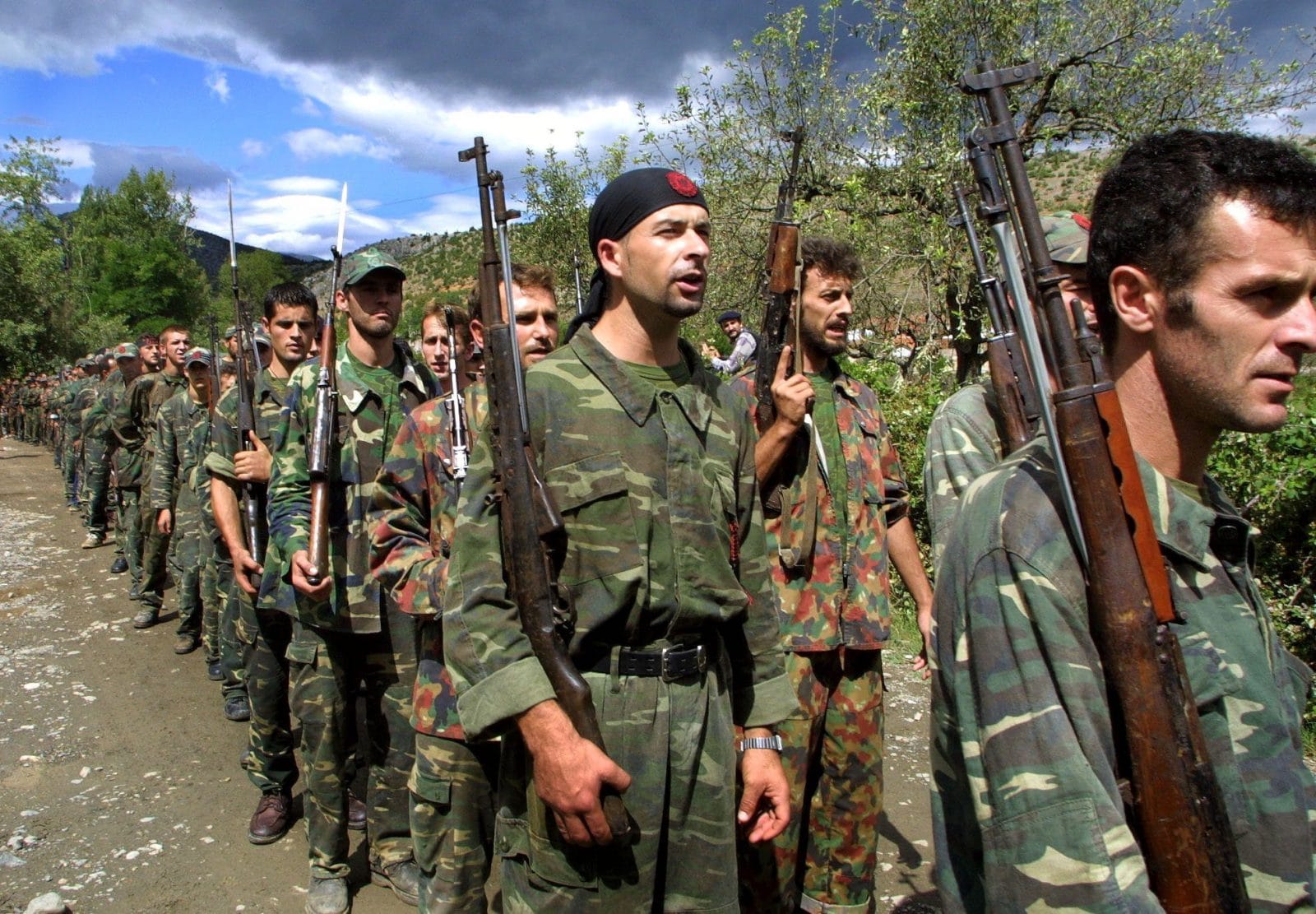
25 years since the first shots of the KLA in what was then Macedonia, stories from the beginning of the war
Mid-March marks the beginning of the war in the former Yugoslav Republic of Macedonia – today North Macedonia.
On March 14, 2001, the first gunshots of the National Liberation Army were heard, which nearly six months later led to the Ohrid Agreement. This was sparked by the ongoing discrimination against Albanians in the country.
Two years after the liberation of Kosovo, many fighters from there joined the ranks in North Macedonia, almost following the same design and symbols as the Kosovo Liberation Army.
Throughout these months, correspondent Seladin Xhezairi reported from the scene for the international media outlet BBC.
Twenty-five years later, he recalls for KosovaPress how the gunfire was heard in the city, coming from Tetovo Fortress.
“I remember clearly there was a protest in Tetovo in support of Tetovo University, which the then Macedonian political leader firmly opposed. While the speakers were addressing the crowd in Tetovo Square, about 150–200 meters away in a straight line, bursts of gunfire were heard from Tetovo Fortress. In short, when I reflect on that moment, I remember that the then leader of the Democratic Prosperity Party, Abdurrahman Aliti, a well-known lawyer and member of the constitutional commission that drafted North Macedonia’s first independent constitution, saw that all Albanian proposals were being rejected and did not hesitate to call the newly adopted document a generator of crisis. Ten years later, the first gunshots occurred, leading to the Ohrid Agreement, a compromise between the Albanian and Macedonian sides,” Xhezairi told KosovaPress.
These gunshots also marked the beginning of the several-month-long conflict between Macedonian military-police forces and the National Liberation Army led by Ali Ahmeti.
Seladin Xhezairi says that at that time he reported on all developments from Likova, Kumanovo, the Polog plain, and Haraçina in Skopje.
“The armed conflict lasted six to seven months as I recall, and until the signing of the Ohrid Agreement, there were sporadic clashes with roughly equal casualties on both sides, from both Macedonian and Albanian forces, with fighting taking place from Likova to the Polog plain and up to the Shar Mountains. Meanwhile, the KLA headquarters was located in the Tetovo highlands, specifically in the village of Shipkovica,” he explains.
This war was fueled by the continued discrimination against Albanians there, says historian and university professor Nuri Bexheti.
“The political elite among Albanians only needs to be united, not to attack each other. They should recognize the successes of any Albanian party that achieves results, and if it fails to do so, it should not be criticized. Since you have received the people’s verdict and represent Albanians in institutions, if your brother hasn’t done it, do it yourself and receive recognition for it, and we will vote for you as long as you live. It’s very simple. Unfortunately, we are witnessing a strange phenomenon: in their inability to implement an agenda in the interest of all citizens, specifically for Albanians in Macedonia, they have chosen to criticize their own representatives in central or local power,” he concludes.
The language issue is among the most discussed topics in North Macedonia when it comes to Albanian rights in the multiethnic state.
Recently, the president of the Constitutional Court of North Macedonia, Darko Kostadinovski, sparked a wave of reactions from Albanian parties. This occurred while discussing the constitutionality of the “Safe City” system, which stated that SMS messages must be sent to citizens in Macedonian and English, but not in Albanian. He further said that the constitution obliges every citizen to know the Macedonian language.
The Law on the Use of Languages in North Macedonia requires state institutions to allow the official use of languages spoken by at least 20% of the population, including Albanian. In North Macedonia, with a population of around 2 million, Albanians make up nearly 30% of the population.