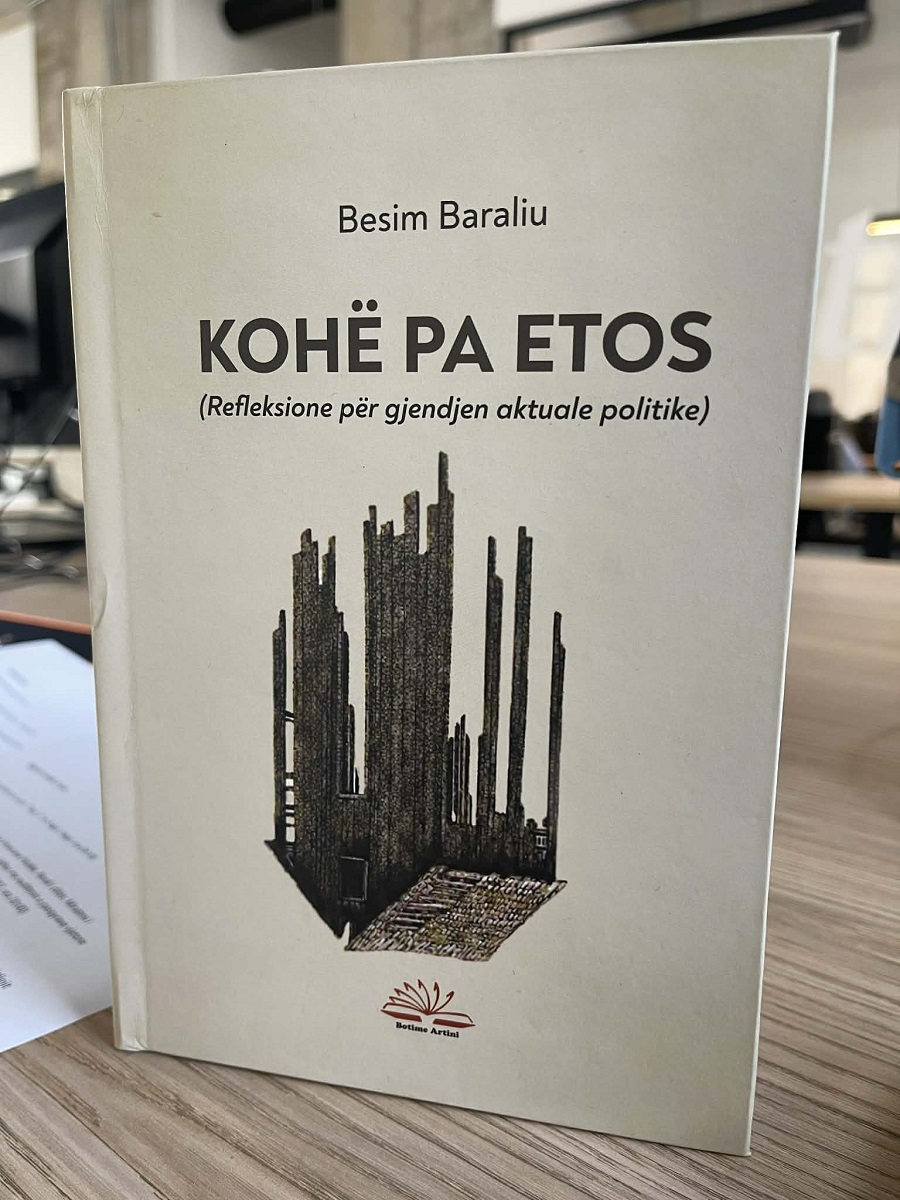
“Time Without Ethos,” a call for political morality and responsibility
From a physics professor to a highly influential voice on the country’s current political landscape, Besim Baraliu comes with the book “Time Without Ethos”, a work grounded in the political thought and philosophy of Adem Demaci.
Through 21 adaptations and reflections, the book addresses phenomena that the author considers signs of a time without ethos — a reality where, according to him, political morality and responsibility are lacking.
In an interview with KosovaPress, the author emphasized that the book is dedicated to Demaci on the occasion of the 90th anniversary of his birth, clearly explaining the spirit of the work.
According to him, forgetfulness is one of the greatest flaws of our society, where values are being forgotten merely to prolong political power.
The book calls for changing the current period the country is going through, urging the return of morality and responsibility in politics.
“This is dedicated to Demaci in honor of his 90th birthday, but these are only political reflections in light of Adem Demaci’s thought... This is a kind of rebellion of thought, seeing the events unfolding today and the shortcomings of our society. I have addressed several topics that explain these reflections on certain occurrences, such as forgetfulness, which is among the greatest flaws of our society today — values are forgotten, pseudo-values have come to the forefront merely to prolong power, and they simply pretend to be doing something while doing nothing. These are entirely political reflections. This book is called ‘Time Without Ethos,’ which means a time without political morality, without political responsibility, so there is a need to change this time, a need to bring morality into politics, responsibility into politics, and so on,” Baraliu said.
He aims to stir critical thinking and challenge the current approach to social and political developments in the country.
“This is not a book to calm anyone, but a book to stir thought, to contribute to expressing the reality of today and to propose something for the future — a new ethos... His lesson is to preserve freedom and not allow only falsehoods to be spread in our public space, but to fight to promote the truth. In other words, the purpose of this book is to place the truth in our public space, to explain that we are living in a time without ethos, without morality, without political responsibility, and to fight to create a time with a new ethos, with politics grounded in morality,” he added.
Meanwhile, the book’s editor, Arben Veselaj, sees the work as a continuation of the spirit of the freedom-making and state-building generation, to which the author himself belongs.
“
Besim Baraliu is one of Adem Demaci’s disciples, one of his students, in whom — as the author calls it — the freedom-making and state-building generation managed to instill the conviction that this generation, which embarked on the path toward freedom and the building of the state of Kosovo, must maintain its coherence, its continuity, and never tire at any stage of historical developments. In the years after freedom and after independence, the author in this book has identified several phenomena that he calls without ethos, which precisely violate these values, these standards that this freedom-making generation built with extraordinary effort and great sacrifices. In a way, through these 21 adaptations he has written, he calls for their protection. There is a case where the author says: today the institutions of freedom are attacked by government offices. According to the author, this is an extraordinary disappointment for the generation that created freedom and independence,” Veselaj said.
According to him, the book is a direct call to the current political class, raising concerns about narratives that, in the author’s view, distort the post-war and post-independence reality.
The book, he says, carries Demaci’s message to safeguard freedom and independence.
“I would prefer that especially today’s political class read it — the one that has built deceptive narratives. The author feels horrified when he hears others say that in these 25–26 years everything has been destroyed... This book calls for the protection of the two foundations of this war and sacrifice, of which the author Besim Baraliu himself is a part, with almost half a century of activity since his high school days. And by preserving this coherence, by preserving this continuity, as a message of Adem Demaci,” Veselaj added.
“Time Without Ethos” is not merely a collection of political reflections, but an appeal for the restoration of morality and responsibility in public life. Through Demaçi’s spirit, the author seeks to encourage debate, awareness, and a new political approach that would restore ethos as the foundation of institutional action.