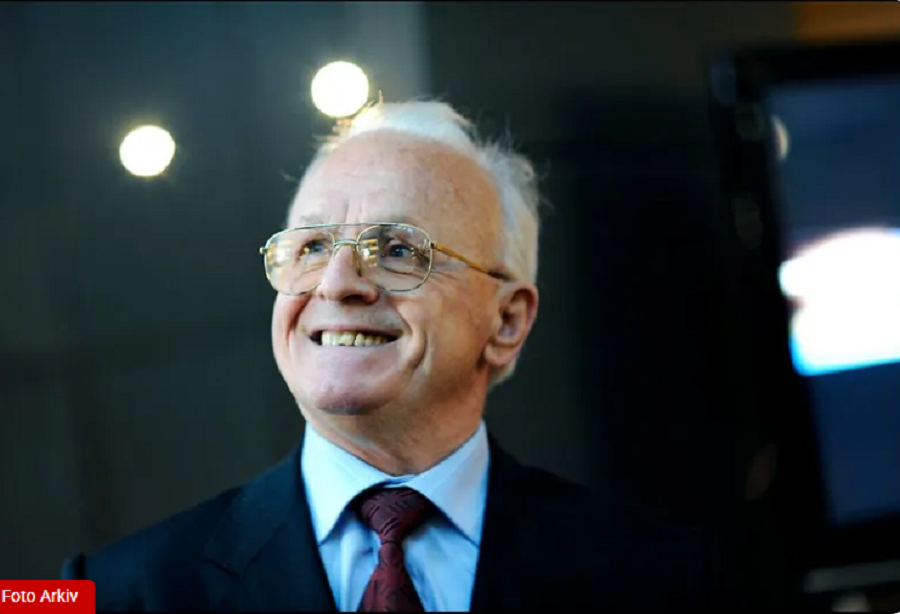
The European Parliament honored Adem Demaçi with the Sakharov Prize 34 years ago
On 4 December 1991, the European Parliament awarded the Sakharov Prize to the activist Adem Demaçi, considering him an indefatigable fighter for freedom of thought and a defender of human rights and freedoms.
Accepting the prize as a tribute to the people of Kosovo, Demaçi said that “freedom of speech is the first, decisive step towards democracy. Without freedom of speech there is no dialogue, without dialogue the truth cannot be established, and without truth progress is impossible.”
Up to that time, the prize had been awarded to people such as Sakharov, whose name it bears, Dubček, Nelson Mandela, Marchenko and Aung San Suu Kyi, some of whom (Mandela and Aung San Suu Kyi) later also became Nobel Prize laureates. On that occasion in the European Parliament, Demaçi stated that “by honoring me, you have honored my much-suffering people, but one that has always loved freedom, peace, and pride.”
The Sakharov Prize for Freedom of Thought, named after the Soviet dissident and scientist Andrei Sakharov, was established in December 1988 by the European Parliament to honor individuals or organizations who have dedicated their lives to the defense of human rights and freedoms. The Sakharov Prize is awarded every year around 10 December, the day on which the UN General Assembly adopted the Universal Declaration of Human Rights in 1948, which is also known as Human Rights Day.
In 1993, the Club of University Rectors in Madrid awarded him the Special Peace Prize against racism and xenophobia, for his peaceful and tolerant stance and for his efforts to build a future based on human rights and cultural diversity, and this happened precisely at a time when Serbian circles were accusing him of inciting war.
In February 1994, five members of the Norwegian Parliament nominated the writer Adem Demaçi for the Nobel Prize in Literature. In September 1994 he was nominated again, this time for the Nobel Peace Prize, on which occasion he stated that “this is an honor for me and a recognition for the Albanian people.”
Meanwhile, on 14 December 1995, Adem Demaçi was awarded the Human Rights Prize of the University of Oslo. Expressing his thanks for this award, Demaçi said: I understand this recognition not only as appreciation of my work and struggle for the rights of my people, but also as the desire of the Norwegian government and peace-loving intelligentsia to draw the attention of the broader international opinion to the problem of Kosovo.
Adem Demaçi was born in Pristina on 26 February 1936. He was originally from the village of Lupq in Podujeva.
Demaçi is among the most important names in Kosovo in the peaceful efforts for freedom and for the rights of the Albanians of Kosovo within the former Socialist Federal Republic of Yugoslavia. He had become known from childhood as a rebellious voice in the school benches. Demaçi never hesitated to condemn the numerous injustices of the Serbian regime.
In 1958 he was sentenced to five years in prison because of his writings and his political and patriotic beliefs. In 1963 he founded in Pristina an organization called the “Revolutionary Movement for the Unification of Albanians,” with a unique national program for the liberation and unification of Albanian lands into a single state. This movement had managed to expand to many centers in Kosovo, as well as to other Albanian territories under Yugoslav occupation. Because of the continuation of his patriotic activity, Adem Demaçi was sentenced to 15 years in prison.
In 1975 the Yugoslav regime again sentenced him to 15 years in prison. Demaçi spent about 28 years in prison, some of them in solitary confinement, during the time of the harsh regime of the SFRY. After his release from prison in 1990, Adem Demaçi led the Council for the Defense of Human Rights and Freedoms until 1995.
During the period 1998–1999, he was the political spokesperson of the KLA in his office in Pristina.
After the war, he engaged in advocating for the respect of the rights of non-Albanian minorities in Kosovo and for the improvement of their situation. Demaçi was regarded by Albanians as a symbol of national resistance. In 2010, he was decorated with the Order “Hero of Kosovo.”
He was the author of several books: Fërkime, Blood Snakes, Book on Self-Denial, Heli and Mimoza, Mother Shegë and the Five Girls, Dear Ashes, Quantitative Love of Filan, Albanian Prometheus, Politics, The Rifle and And My Verse Goes On. Demaçi passed away on 26 July 2018.