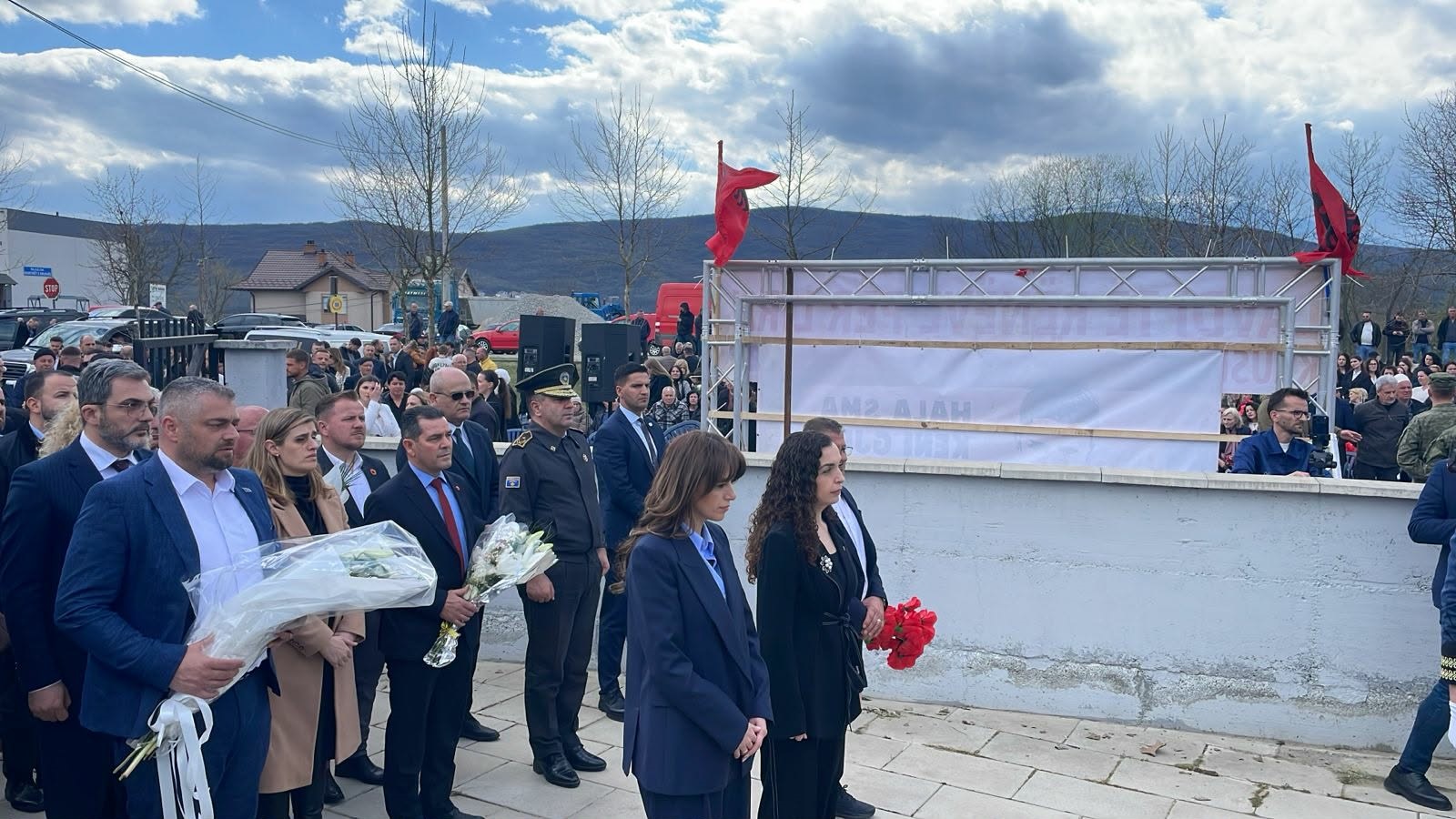
“The crime continues”: a powerful message from the reburial of Ajvaz Shehu
On the 27th anniversary of the massacre in Krushë e Vogël, Ajvaz Shehu—who was killed by Serbian forces on March 26, 1999, at the age of 16—was reburied today.
During the reburial ceremony, Kosovo President Vjosa Osmani said that life rose in this place from the ashes of tragedy. She stressed that none of the names of those still missing should be reduced to mere numbers.
Osmani emphasized that this reburial is proof of a crime that continues even today by Serbia.
“On March 26, 1999, one of the darkest acts took place here, a crime that shook the conscience of the world. The Serbian regime brutally killed 113 men, boys, and children. This story does not end here; it remains open. Their absence is not only pain, but a void for our entire state and society. Today he would have been 43 years old. For years, he was on the list of forcibly disappeared persons, a long wait for his family. Today he returns to rest in his land, but not as he should have. This reburial is proof of a crime that continues, a daily crime that Serbia commits against Kosovo,” Osmani said.
Kosovo Assembly Speaker Albulena Haxhiu said that the fate of over 60 forcibly disappeared persons still weighs heavily, as their whereabouts remain unknown.
“Our memory will not disappear; it lives in the stories of the women of Krusha, of Kosovo, in the long wait to learn the fate of loved ones, in the open wound awaiting justice. The fate of over 60 forcibly disappeared persons still weighs heavily, for whom there are still no answers. Today, after 27 years of long and painful waiting, Ajvaz Shehu—then 15 years old—has been identified. Today he returned to his place, to his land, to be reburied with the dignity that was denied to him for so long,” she said.
Meanwhile, the Minister for Labour, Family and War Veterans’ Affairs, Andin Hoti said that 27 years ago, in this village, the difference between humanity and barbarity was clearly seen.
Hoti also noted that four years ago seven martyrs were reburied, and today another martyr is being added.
“In this place, on March 26, the difference between humanity and barbarity was clearly seen. Serbian forces massacred men, the elderly, and children, and tried to erase every trace of the crime. Moreover, Krusha e Vogël continues to carry its pain, further deepened by the absence of 60 missing family members. Four years ago, we reburied seven martyrs of the nation, and today we are adding another martyr of Kosovo. The case of the family of Nuredin Shehu clearly shows the scale of this tragedy. Ajvaz Nuredin Shehu was only 15 years old—a child who saw with his own eyes the horror of that day,” he said.
The Mayor of Rahovec, Smajl Latifi added that Ajvaz’s remains will rest in land soaked with Albanian blood.
“Today we are reburying the previously missing Ajvaz Shehu, which shows that memory is returning, along with great pain and anxiety about the fate of the 60 missing persons from this village. His lifeless body, his remains, will rest in the land of his ancestors, on soil washed with Albanian blood,” he said.
From the Government Commission on Missing Persons, Kushtrim Gara mentioned Ajvaz’s mother, Zeba Shehu, who passed away believing her son was still alive.
“Today, after a long and painful wait, his remains return to his land, to the place where he belongs with dignity. This is more than a reburial ceremony—it is a confrontation with a 27-year-long history of pain. This story cannot be told without mentioning his mother, Zeba Shehu. She lost everything in one day—her husband, her son, and seven other family members. An entire world was extinguished in a moment, yet she never gave up. With a strength only a mother’s heart can know, she lived with the hope that Ajvaz was alive and would return one day. Even when the truth emerged, she could not accept it. For her, Ajvaz remained alive until her last breath. She lived between his photograph and his memory,” Gara said.
Finally, family member and former teacher Shpresa Shehu recalled Ajvaz as a student.
“They were just children, with dreams and life ahead of them, full of smiles. But their lives were brutally cut short, and the pain did not end that day—it continued after the war. Today, after 27 years of waiting, Ajvaz, my dear student, rests in his homeland. He once sat in school desks, and his childlike face remains in memory—kind, gentle, intelligent, with eyes full of life and curiosity. Today, after so many years, we are not simply burying a student, but a part of our soul,” she said.
Ajvaz Shehu’s remains were discovered eight years ago in Shiroka, but his mother had refused to allow his reburial, not accepting that they belonged to her son.
On the 27th anniversary of the massacre in Krushë e Vogël, he was finally reburied amid grief and tears.
On March 26, 1999, 113 men, boys, and children were killed in Krushë e Vogël.