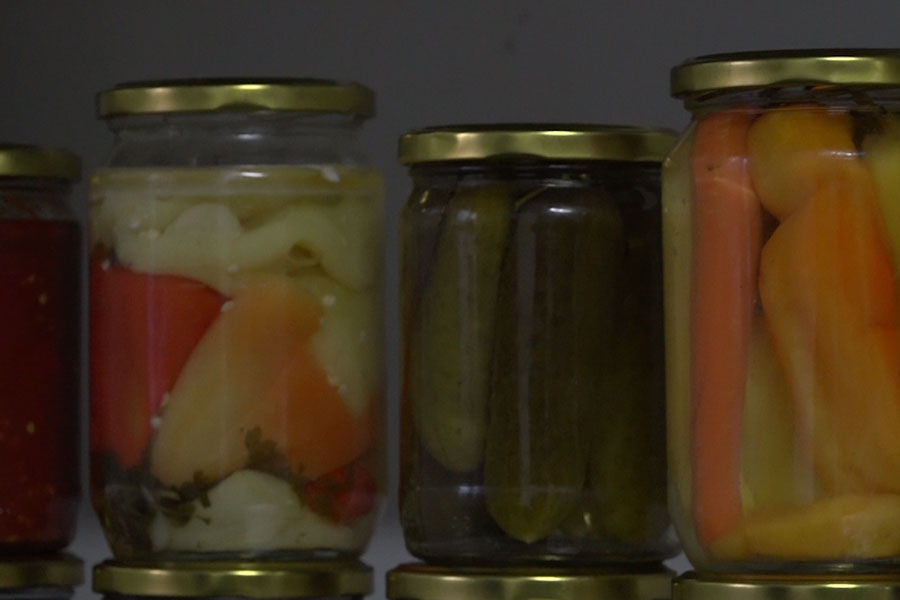
The business of pickles, women who succeeded in the international market with their own strength
Read in: 7 min.
3 year ago
Link copied
Women entrepreneurs from Kosovo are producing thousands of products a year. From small businesses, the name of their companies is already known in many markets at home and abroad. They have turned the passion of processing and producing food products into employment opportunities for the women of the communities. The will to work of Valdete, Remzije and Sllobodanka is not being diminished by the institutions' disinterest in support. They talk for KosovaPress about their challenges and difficulties over the years to keep the businesses they founded afloat.
For five years now, Valdete Sahiti from Vitia has been selling more than ten vegetable products. The main products that the "Loel" company has on the market are pickles and “ajvar” (a relish made from peppers).
"In general, almost all types of vegetables are found
here in our company, mainly we have started the activity with homemade “ajvar”,
seeing that there is demand for other products as well, e.g. if a customer came
here to the workshop and asked 'do you have this product, do you have that
product?' we saw that the demand was for these products, thus we have also
started with these other products by attending trainings, consulting with food
technologists, i.e. we attended a lot of trainings", says Sahiti.
Sahiti confesses that she did not take this business
seriously from the beginning.
"One of the biggest challenges in the beginning was for
example, how can a woman
know these things, let alone thinking about export was just a dream, but
gradually by working we have seen that even a woman can achieve it, for me now
that topic it is taboo", she emphasizes.
The name of her business is present in several markets of
the Gjilan region.
"At the moment we have ten products, all of which are
from vegetables, except for one from fruits which is the plum jam... At the
moment we are only in the region of Gjilan, in Anamorava mainly. These products are in the
markets in Vitia, in the markets here in the village, as well as in three
markets in Gjilan. We managed to succeed because this was the first year
we had the biggest work, and for that reason we are working gradually because
maybe we could not reach the capacity for more in the first year", she
says.
She asks the institutions for support, as she fears that the
products will be damaged due to the small facility.
"We make all these products with great pleasure and
with great will, but the facility is a bit small for the equipment we have. Our
only request, not the only one because we have a lot requests until all our requests are
fulfilled, is that we need a bigger facility. Then the number of workers would
also increase, customer demands are for our products. For all these types of
products, for each of them there are special requirements, it is interesting
that there is a person who only wants one product in bulk. But in order to
increase the number of workers and the production capacity, we have recently
seen that the space is small and there is a possibility that not only the
products but also ourselves to be damaged", concludes Sahiti.
"From seeds to glass jars", is the name of
Sllobodanka Kostiq's business from the village of Livagja in Graqanica. Since
2010, she has been involved in the production of fruits and vegetables and
their conservation in jars.
"In the beginning it was very difficult because we all were
without jobs. We all had families, we had children whom we had to educate.
Then, I thought a lot about how to contribute to our family's income and then,
I started thinking about picking peppers.... I started with a greenhouse and
when I saw that it was worth doing that, then I expanded to larger areas. Now I
have three greenhouses, I have gardens/yards. I also employed some women from
the surrounding area, who wanted to work together and we cooperated, we sold
the products and in that way we paid for the education of our children",
she said KosovaPress.
Sllobodanka, from the Serbian community in Kosovo, shows
that they have a wide circle of consumers, who are clients. She has kept the
recipes from her mother and adds that she finds it difficult to collaborate
with others.
"We have not received any kind of help from the state,
no one has contacted us. I constantly went to the municipality of Graqanica.
There are so many unemployed people, so many lands in Kosovo... My products are
sold in Belgrade, in Serbia. Anyone who has tried it, believe me I have had
offers to work for Zlatibor and Kopaonik, but because we need labels, we need a
lot of things for export at the border and thus we are blocked. It's not a problem that can't
be dealt with. On this occasion, I want to say to the women who cannot find
work, they should do this job and then they will see how they can make a living
from this job", adds Kostiq.
Even Remzije Taç from Mamusha, who belongs to the Turkish
community, has been managing to employ dozens of women from different
communities in the "Taç Product" pickle factory for two years now.
"It was more my idea, I was staying at home and I was
saying to my husband ‘since you are working at the collection center, I also
would like to get a job or to get employed somewhere’. Then he said to me that
he will discuss with the boys and create a small factory… Now we have 30
employees per season, 30-35”, she says.
Despite the lack of support, the Turkish owner of this
business shows that she is enthusiastic to continue with this work.
"We didn't have any support, only I wanted to start
this job. I told my husband there won’t be a problem, we had a little (money), and
we got into a little debt, so here we go. I was thinking to start with about
20-30 barrels, just for the beginning, because you cannot start with much from
the beginning. Then God provided
us, we worked for many years and we had a very good time", she
says.
For a woman, she says, it is very difficult to deal with
such a business.
"The beginning was very difficult. But I said God first, then I will
not stop, I want to keep going forward. It was a little difficult when
we didn’t have support, it was difficult, because if we had the machines, just
some in order to start the work, but we didn’t even know where to start because
we also had to buy the barrels ourselves, and everything else what we needed",
she adds.
Its products are not present in the markets of the country, but Taç adds that it is exporting to many European countries. She also tells about the difficulties they have because of the weak electricity. "We put cornichons in bulk, four thousand, five thousand barrels when we fill them with peppers. We cannot waste them and only sell them in Kosovo. If someone would help and support us by telling us ‘you can contact this company or that company’ then when the payment is done it would be better even for us as well… From the municipality of Mamusha, they promised us a transformer, because the electricity it is weak, they said that they will bring the transformer. We are also waiting for the Ministry of Agriculture, maybe they will help us... There is a need for newer, more modern tools for the lids, we have done all this ourselves, we have had no help at all", she concludes.
Note: This article was made in the framework of the project: “Promotion of women’s businesses producing healthy food”, which is implemented by the Center for Innovations and Development/CFID and financed by: Slovak Agency for Development and International Cooperation/SlovakAid.