SBASHK warns of strike if there is no dialogue with MESTI by September
The United Trade Union of Education, Science and Culture (SBASHK), on the eve of the new school year, has warned of a strike and other union actions if by September 20 this year dialogue does not begin with the Ministry of Education, Science, and Technology and Innovation (MESTI).
Among SBASHK’s main demands are the negotiation and signing of a new collective agreement, an increase in the value of the coefficient, as well as the implementation of the Constitutional Court’s decision on compensation for years of work experience, along with other issues related to the rights and working conditions of education workers.
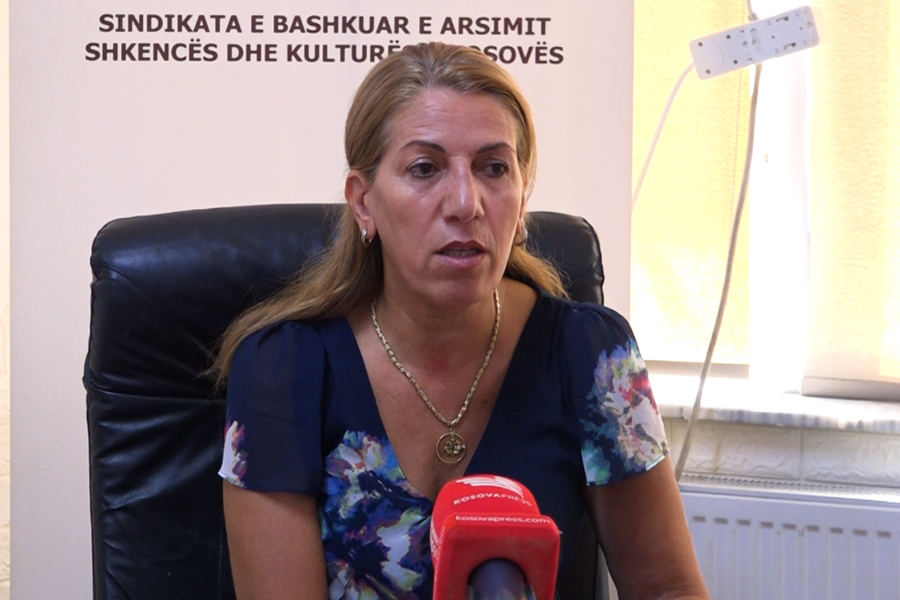
The Vice President of SBASHK, Vjollca Shala, told KosovaPress that if by September 20 dialogue with MESTI does not begin, the union will convene its steering council to review the situation and may undertake union actions, including a strike.
“When we talk about the issue of teachers and SBASHK’s demands, earlier we held an extraordinary congress, the ninth congress. At the congress, a decision was taken as the highest body of SBASHK that if by September 20 dialogue with the Ministry of Education does not begin, then the steering council, as the highest body of SBASHK between two congresses, will convene to analyze the situation, and union actions may follow, not excluding a strike,” Shala said.
While listing SBASHK’s main demands, Shala stressed that the €55 salary increase is symbolic compared to the enormous rise in prices.
“SBASHK’s demands are… the negotiation and signing of the new collective agreement. Also, an increase in the value of the coefficient is a demand. It has already been two years since the coefficient value in the Law on Salaries has not been increased, despite rising inflation. There has been an increase in the coefficient ranking that amounts to €55, which is very symbolic compared to the enormous increase in prices of basic living products. There is also the implementation of the Constitutional Court’s decision, which from July 2024 should have been applied, regarding work experience for the first 15 years, which is currently paid at 0.25 percent, while the court decision is that it should be paid at 0.5 percent,” Shala said.
Shala pointed out that SBASHK has submitted a citizens’ legislative initiative to amend the law on state-financed pension schemes. This initiative, she said, aims for the years of service of teachers during 1990–1999, which are currently not counted as contributory years, to be recognized as such.
She also mentioned the difficult working conditions in Kosovo’s schools, highlighting the lack of digitalization in many of them, unlike neighboring countries where this process has advanced further.
The Vice President of SBASHK, Vjollca Shala, said that since 2022 they have not had productive meetings with the Ministry of Education and particularly with Minister Nagavci.
“With the Ministry of Education, and especially with Minister Nagavci, since 2022 we have only had one meeting when the vice president of the U.S. teachers’ union visited — and that was just a formal 15-minute meeting, without the opportunity to present the demands of education workers. We also had one meeting on the day a protest was held… Otherwise, regarding the requests that we continuously make to sit down and talk with the aim of solving the problems and demands that education workers have, we have not had such a meeting since 2022", Shala said.
Among other issues, Shala also spoke about the way schoolbooks have been subsidized for students, saying that in the past two years this has not been the right approach. She assessed that the previous method, when books were provided in advance for students, was more effective and cheaper.
"It has been seen in the past two years that this was not the right way, because students may not have been provided with textbooks for months. The method where they were provided in advance was much better and cheaper… There have been cases when such a subsidy was made to families, considering that we also have poor families, perhaps such families have taken the money that they were entitled to for buying books for their children. But, such a thing, perhaps having a lack of even basic products for living, or they have spent the means for living. Meanwhile, the student may have gone the whole year without textbooks", Shala said.
SBASHK held its most recent protest on December 4, 2024, demanding salary increases and the signing of the Collective Agreement.