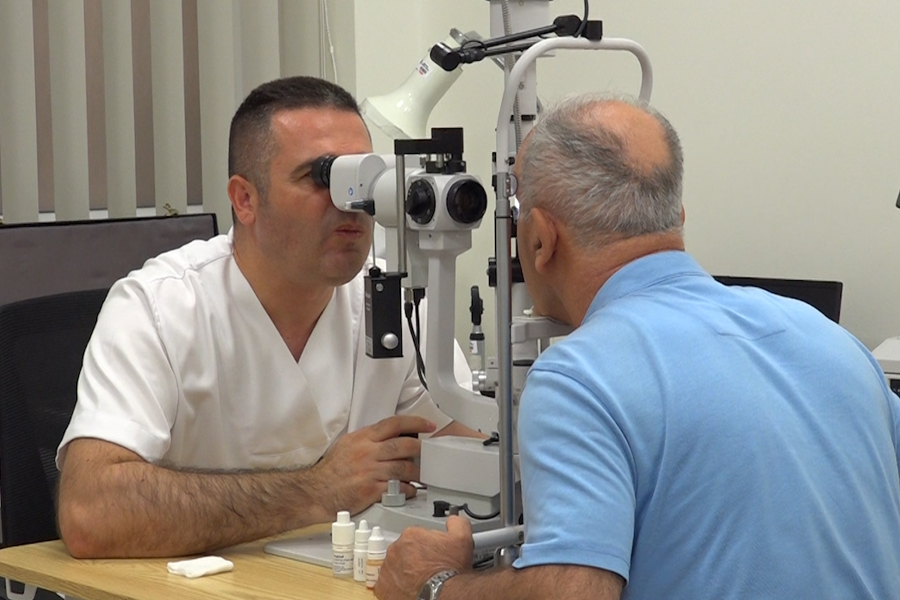
Renovation at the Eye Clinic in UCCK improves quality and access to ophthalmological services
The Diagnostics Department at the Eye Clinic in the University Clinical Center of Kosovo (UCCK) has received a new look. The renovation is considered particularly important for improving the quality and access to ophthalmological services in the country.
The head of the department, Mentor Gorani, told KosovaPress that besides investments in infrastructure, advanced equipment has also been purchased for diagnosing and treating eye diseases.
Statistics for the first six months of the year show a significant increase in surgical activities and advanced treatments within the clinic. In this period alone, more than 1,200 cataract surgeries have been performed.
Gorani mentioned to KosovaPress the new equipment and their functions, which have enabled an increase in the number of services and the improvement of diagnostic quality at the Eye Clinic.
“This renovation went hand in hand with the purchase of necessary equipment for ophthalmological examinations carried out here, as well as some of the newest examinations that we have managed to introduce in the clinic such as corneal topography, examination of retinopathy in premature babies with more modern equipment including redcam with indirect ophthalmoscopes, anterior and posterior OCT. All of these have enabled, on one hand, an increase in the number of new services and on the other hand, an increase in the number of services under responsibility and an improvement in the quality of diagnostics at the Eye Clinic,” said Gorani.
Besides the improvement in service quality, Gorani also spoke about the improvement in managing waiting lists for some ophthalmological pathologies.
For cataracts, the waiting list is around six hundred cases, while for strabismus it is ten to fifteen people.
Another major result, according to the clinic’s director, is the reduction in the number of patients sent for treatment outside public health institutions — from 500 to 700 cases in 2019, to about 100 cases today.
“We have managed to reduce the waiting list for only two pathologies: for cataracts, where the waiting list is approximately 600 cases waiting for five to six months, while for strabismus, the list is significantly reduced to around ten to fifteen patients who are treated within two months. For other pathologies, there are no waiting lists… We have also achieved another great result over the years; until 2019, there were around five hundred to seven hundred patients whom we referred for treatment outside public health institutions, which had an extremely high cost, and this number has decreased over the years — now it is approximately around one hundred cases,” Gorani said.
Gorani describes the operations performed in this six-month period at the Eye Clinic.
“In the first six months of this year, more than one thousand two hundred cataract surgeries were performed at the Eye Clinic, using phacoemulsification, commonly known as laser. Then there are cases of vitrectomy, about two hundred different cases. We can mention treatments like cross-linking, where we have about more than forty cases, and it is worth noting the intravitreal injections, where we have several medications that we have been applying for twelve years at the Eye Clinic. This year, the number is more than two thousand cases that have received injections of various medications such as bevacizumab, brolucizumab, faricimab,” he added.
The clinic has a capacity of 58 beds and continues to meet the growing demand for ophthalmological health services.
“Our clinic has fifty-eight beds, with around two thousand patients admitted, about nine thousand days of treatment, and the number of surgeries and outpatient services has been one thousand seven hundred seventy-four. I would add anti-glaucoma surgeries, which number around forty, done with different methods and with the use of other elements, such as shunts and so on. Strabismus surgeries exceed twenty, lacrimal duct surgeries, laser-assisted dacryocystorhinostomy number sixty-five, and outpatient and consultation visits are around nineteen thousand, which were performed during this five-month period at the Eye Clinic,” he said.
The clinic employs around 27 specialist doctors in various departments and fifty nurses, for which Gorani says that due to the large number of cases treated, new staff is needed.