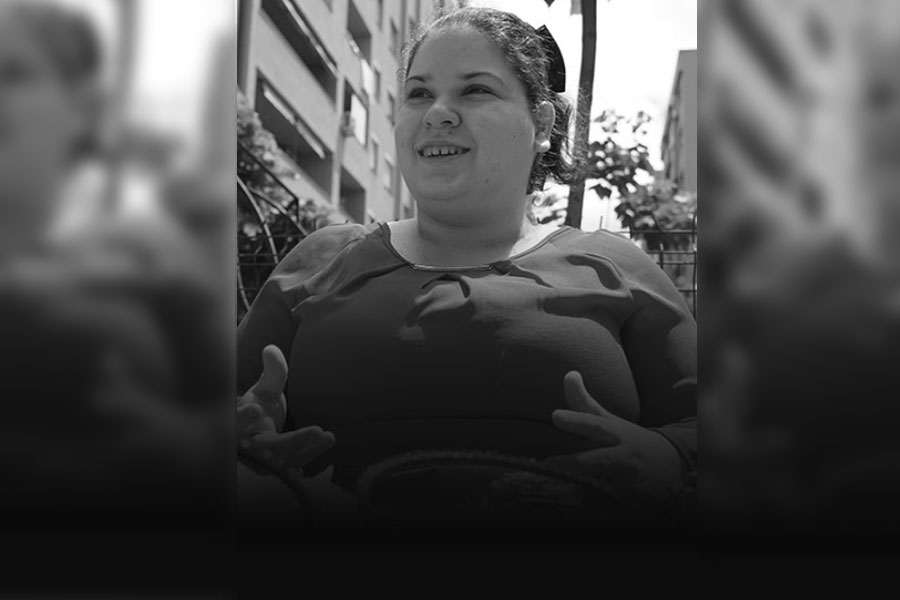
In every one of her colorful creations, a silent message is hidden.
"Don’t judge us by our appearance; we are very capable,’" says Ardita Bilalli, who has transformed boredom and despair into creativity.
Every detail she works on with her own hands is almost a story of her inner world. Not only a small source of income for the family, but for her, artisanal creations are a unique form of therapy and hope.
Barriers, difficulties, and many dreams left unfinished… These are the memories of the 26-year-old from Fushë Kosova, who is trying to challenge every obstacle with the help of her wheelchair.
Since birth, she was diagnosed with
spina bifida, a congenital spinal problem that has completely prevented her from walking.
“At school, I had difficulties because during elementary school I needed help from my peers, for which I am very grateful, to continue lessons on the second floor. Since childhood, I have been very affectionate with people, wanting to hug them, spend time with them, communicate. I had difficulty accessing many buildings because there were no opportunities for us, people with disabilities. In many buildings, there is no access for us with disabilities, which prevents us from going anywhere, and we always need to have an assistant with us, but I always have my mother next to me to help.”
“Not only those who walk and run love life,” says Ardita, who had to interrupt her schooling due to financial constraints and inaccessible buildings.
Even though she gave up many dreams, she learned to live in a difficult reality but with boundless imagination.
“Unfortunately, I couldn’t continue schooling due to inaccessible buildings. I wanted to become a teacher. That remained a dream and a regret. Also, I needed a companion nearby, and I was told, ‘If you want to continue schooling, you must have a companion and pay for her yourself.’ How could I pay 150 or 180 euros for a companion? The state and our institutions need to understand that they should provide someone so we can continue life like others who walk and move. Because we also have dreams, we also have our goals. People need to know that we also love life, not just those who run, walk, and move. We can succeed if we have just a little support from someone.”
Day by day, week by week, month by month, her world was confined within four walls and in darkness. Despite her strong desire to have friends around, she learned to stay alone.
“I even went through depression, two years I didn’t want to leave the house, it seemed to me that everything was dark for me, nothing had value. Gradually, I received medical – psychological help, which helped me a lot to come out of that darkness because I was afraid I wouldn’t get out. I was afraid that whatever I did, it had no value, no one appreciated me. I didn’t want to leave the house or be with people.”
From her inner darkness, Ardita found her light in handicrafts. Even then, she was hurt by her surroundings because, she says, she received no support.
“The words that hurt me the most were when I started doing handicrafts to undoubtedly help my family, also for my own needs and for my mother who is a bit sick. I heard people say, ‘You are disabled, why are you doing this work?’ It’s very hard for me to hear these words, but I always took it with a smile, with my positivity, and I said, ‘Whatever God has tested me with, I will manage.’ I have been doing this work for ten years and I have succeeded.”
The dream of becoming a teacher never materialized, but today she hopes to one day open a workshop for children with disabilities. With the income from her handicrafts, the 26-year-old manages to cover medicine costs and support her family.
“Since childhood and even today, it has been my dream to have my own workshop and employ people with special needs, to show others that we can succeed, that we love life, that we love work. I make pendants for children’s pacifiers, keychains and crowns, bracelets, ribbons for little girls. I do this work to also help my family. I try to use that money to buy medicines for myself and my parent.”
Ardita Bilalli, the eldest child in the family, does not work. Her mother also cannot work as she must always stay with her. The only support the state provides for the 26-year-old is 150 euros, which is almost nothing.
“The state helps me with 150 euros, what can I do with 150 euros? What can a person with disabilities cover with 150 euros? Medicines, other needs, healthcare, food. The state should ensure that we can also be employed somewhere, that we can access buildings. We can work, not just be given 150 euros and told to live with it. 150 euros for us, people with disabilities, is not enough.”
The girl, who has left many dreams unfinished, asks people not to judge her abilities by her appearance.
“By our appearance, it may seem that we are incapable as some think, but we are very capable,” says Ardita, who asks for support from the state and prays for a better life.
Ardita Bilalli
July 2025