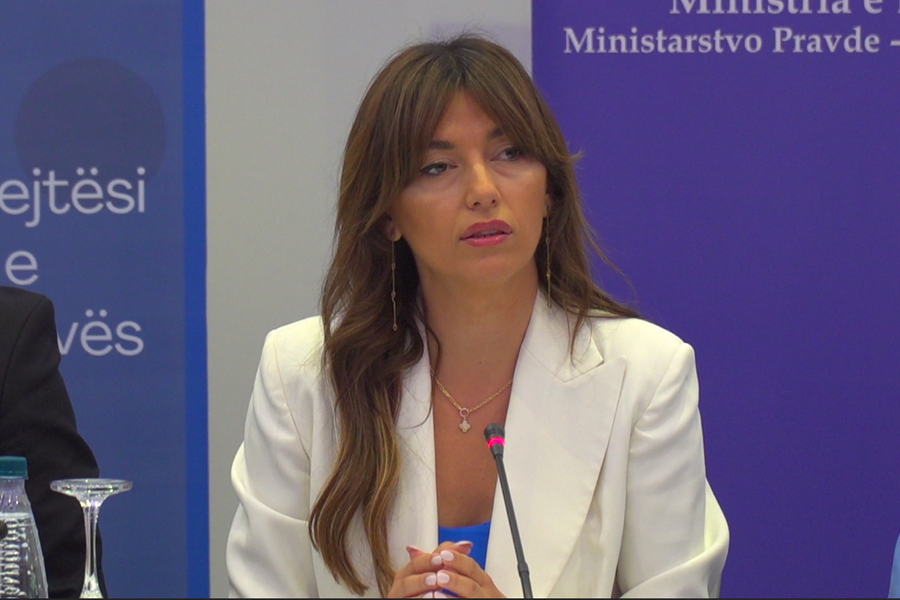
Haxhiu: Kosovo is at a key moment where the challenges of the transitional justice process must be addressed
Kosovo is at a key moment where the challenges and opportunities of the Transitional Justice process must be addressed. This is what the Minister of Justice, Albulena Haxhiu, stated at the roundtable with donors for the "Strategy for Transitional Justice" that was held in Prishtina.
During the discussions, it was emphasized that this strategy outlines ambitious goals ranging from addressing past atrocities and ensuring accountability to supporting victims and strengthening democratic institutions.
The Minister of Justice, Albulena Haxhiu said that with the approval of this strategy, an important framework has been created for Kosovo to deal with massive violations of human rights and war crimes.
In addition, Haxhiu said that this strategy represents an important social and institutional moment in efforts to protect human rights, promote social dialogue, and strengthen sustainable peace.
Meanwhile, the head of the division from the Ministry of Justice, Baki Svirca presented the Strategy Action Plan for Transitional Justice. He said that 15 million euros have been allocated for this strategy and that this strategy is focused on four strategic objectives which are divided into 18 specific objectives, for which 112 activities are planned.
He emphasized that the strategy aimed to enable the establishment of social dialogue about the past through restorative justice, to ensure the necessary conditions for achieving justice for all victims, to ensure the implementation of a comprehensive, transparent, material support process, symbolic, psychosocial for all victims.
Regarding the Action Plan for the "Strategy for Transitional Justice", the executive director of the civil organization based in North Mitrovica, the New Social Initiative (NSI), Jovana Radosavljevic said that it is essential to emphasize the possible abuse related to the document and undertaking the process with the Ministry of Justice and the Government of Kosovo.
She said that the document prepared by the MoJ fails in all the principles it claims to support, especially the victim-centered approach and involvement.
According to her, this strategy focuses exclusively on the suffering of a single ethnic community, completely neglecting the suffering experiences of other ethnic groups.
Meanwhile, Radosavljevic left the hall after her speech, not waiting for the answers given by Minister Haxhiu and the head of the division of the Ministry of Justice, Svirca.
Regarding her criticisms, Baki Svrica said that all the consultations with the focus groups are recorded and for reasons of correctness he is not allowed to present all the attitudes of the people who participated from the different categories.
In addition, regarding the process of reparations, he said that there are no concrete data in the strategic document because they plan to do activities that increase inclusiveness.
On June 13, the Government of Kosovo approved the Strategy for Transitional Justice, the first in the Republic of Kosovo since the last war. /Z. Zeneli/