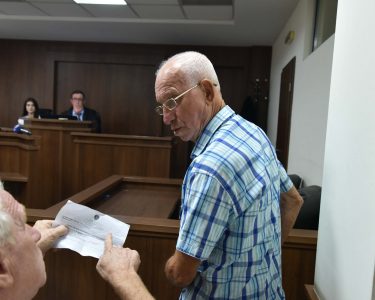

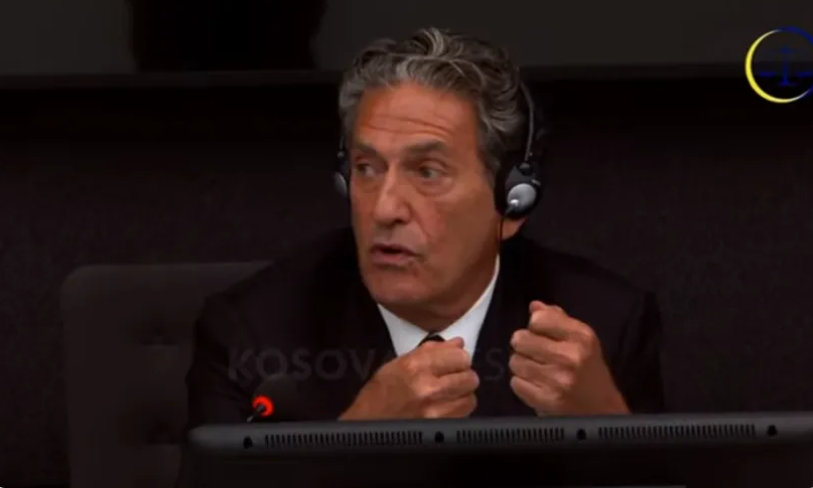
Former U.S. Assistant Secretary of State James Rubin has expressed his concern about the judicial process in The Hague. “This is an unusual way to treat a head of state who voluntarily surrendered,” Rubin declared in court during his testimony in defense of former President Hashim Thaçi.
On the second day of his testimony, Rubin shared his views on the five-year-long judicial process against the former leaders of the Kosovo Liberation Army (KLA), stating that he was concerned that the KLA’s top four leaders had been held in pre-trial detention for so long. “This is not justice,” Rubin emphasized, noting that he had closely observed the developments within the KLA and its leaders during the war.
His opinions regarding this trial were given in response to questions from the specialized prosecutor, James Pace, who previously remarked that “Thaçi’s defense, on August 25, stated that you had refused to be questioned by the SPO.”
“The fact that the accused have been in detention in The Hague for over five years, that they voluntarily surrendered, and that they have been held for such a long time concerns me. I think this relates to politics and the rule of law. It worries me that someone would be held in detention for five years before a criminal case is even pursued, while these individuals voluntarily surrendered and were highly cooperative with the court. In this case, I do not understand why the accused had to remain in prison for five years,” Rubin declared in The Hague.
He stated that he had spent hundreds of hours preparing to be a defense witness and noted that “Secretary Albright did not intend this kind of justice when she initiated the International Criminal Tribunal for the former Yugoslavia.”
“Secretary Albright did not have this type of justice in mind when she initiated prosecutions at the Hague Tribunal against Yugoslavia. So, to me, this seems simply like collective blame because the accused was a leader of the KLA. Having seen the KLA leaders firsthand in the mountains, I believe no one outside the KLA had such insight into how it operated. For three consecutive days, I observed how they behaved, who was responsible, who commanded, and who supported; I had this kind of knowledge, and knowing how events unfolded, I truly believe this was wrong. This is not justice. I am not a lawyer, but I have the right to express and voice my opinion,” he added.
Rubin explained that he had spent “hours and hours” thinking about this trial, consulting with international lawyers and attorneys, who told him that “this is an unusual way to treat a head of state who voluntarily surrendered.”
“Five or six years ago, when I first heard about this trial, I began examining the tribunal’s composition. I spoke with academics, lawyers, and tried to review written articles and documents presented here, rereading much of the material. I also met with the defense team in Washington, spent five years thinking about it, preparing for it, anticipating the trial to open year after year, while nothing happened for many years. The indictment had been filed five years earlier, but the process took five years to proceed. I asked people in this field if this was normal, and they told me it was unusual to hold a head of state who voluntarily surrendered, in a jurisdiction established while he was prime minister, to show European leaders his country’s willingness to join the EU, yet he remained detained for five years before the case was ready,” Rubin said from the witness stand.
During his second day of testimony at the Special Court in The Hague, Rubin stated that the United States initially described the KLA as a terrorist organization, but this stance changed “as we better understood the situation.”
“Perhaps we failed to always be on the side of the angels because, for a period, until we understood the situation better, we initially described the KLA as an organization engaged in terrorist activities. Certainly, we did not want to support or encourage terrorist activities. This position changed over time, especially after the KLA agreed to the Rambouillet Agreement. Then we considered them to be on the side of the angels because they signed the peace agreement,” he explained.
On the second day of testimony, Rubin was accompanied by a representative of the United States.
During questions from the specialized prosecutor James Pace, Rubin said the United States had not verified claims of war crimes by KLA members.
At The Hague, Rubin was also asked about a 1998 United Nations report stating that “the fate of many Serbs, Kosovo Albanians, Roma, and Serbian police officers allegedly abducted by Kosovo Albanians associated with the KLA is unknown.”
“I read a UN report on Kosovo but was skeptical because UN bodies often did not describe the situation accurately. I was aware of UN reporting but did not necessarily consider it reliable. I usually considered reports from the International Red Cross to be more trustworthy,” he stated.
Rubin said he had knowledge of discussions within the KLA but not before Rambouillet. During questioning by Prosecutor Pace, he explained whether he had been part of closed meetings held among KLA commanders.
Pace: “During negotiations, were there long meetings among KLA leaders, commanders, without your presence?”
Rubin: “Yes.”
Pace: “And during these meetings, you were not part of the closed sessions among commanders?”
Rubin: “I am not sure I wasn’t nearby, but I did not speak Albanian, so I may not have understood everything. But I was not barred from being in the room or hall where meetings took place. It was a large hall, and things occurred in various ways. I may have been near the room while discussions happened,” he replied.
On the second day of testimony, Rubin recounted whether he had met Jakup Krasniqi and Kadri Veseli as part of the Rambouillet delegation.
Pace: “Did you meet or have contact with Kadri Veseli before February 1999?”
Rubin: “To be honest, I do not remember this individual, I cannot answer the question.”
Pace: “Kadri Veseli was part of the KLA delegation at Rambouillet; correct?”
Rubin: “I do not know.”
Pace: “Your statement does not specifically mention Rexhep Selimi, correct?”
Rubin: “Correct, I don’t think it mentions him.”
Pace: “Did you meet or have contact with Rexhep Selimi?”
Rubin: “It is very possible. I met many KLA commanders over the years but do not always recall their names because it was 25 years ago,” Rubin added.
Special prosecutor James Pace said it would take an hour and a half to finish questioning Rubin.
In his testimony on Monday, Rubin recalled meetings with former President Hashim Thaçi and dismissed claims that Thaçi, Jakup Krasniqi, and other KLA leaders executed or killed people.
In preliminary questioning by Jakup Krasniqi’s lawyer, Venketasëari Alagenda, Rubin said that Serbs have always tried to blame the KLA.
James Rubin is the first defense witness for Thaçi, with the defense planning to call around 11 witnesses in court. The trial will then continue with witnesses called by the defense of former Kosovo Assembly Chairman Jakup Krasniqi.