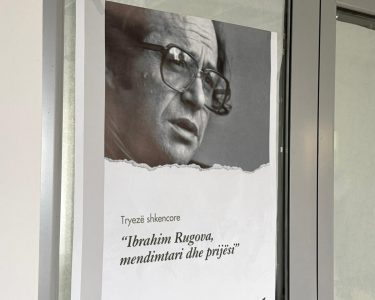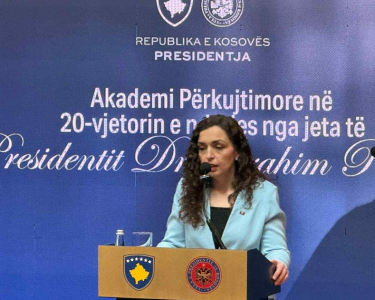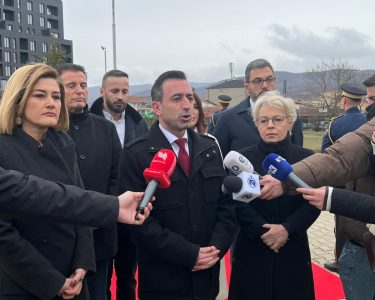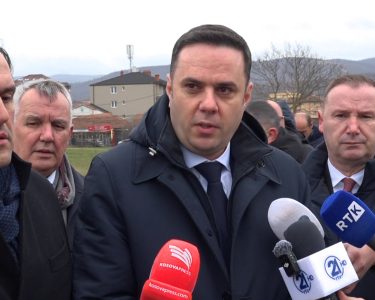

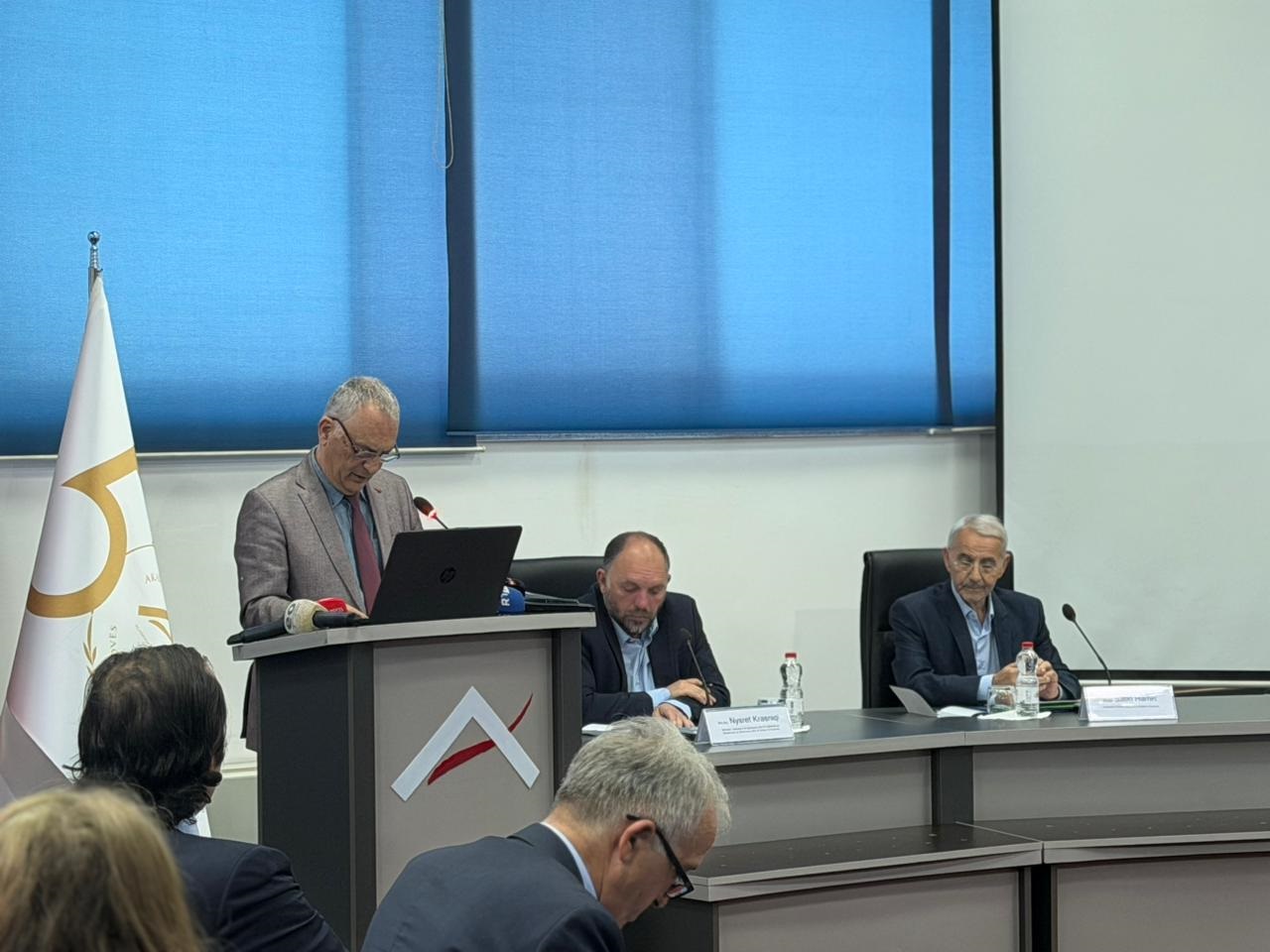
An international scientific conference dedicated to the life and work of Ibrahim Rugova was held in Prishtina, organized by the Academy of Sciences and Arts of Kosovo and the Academy of Sciences of Albania, with the participation of researchers, academics, and prominent figures from Albanian cultural and scientific life.
As stated on Thursday, the conference aims to examine Rugova’s figure in an interdisciplinary manner, shedding light on his literary, philosophical, cultural, and political dimensions as one of the most important figures in modern Albanian history.
The organizing committee of the conference is chaired by Sabri Hamiti, while its members are Gëzim Hoxha, Rexhep Ismajli, and Marenglen Verli, with Nysret Krasniqi serving as the conference secretary.
The chair of the organizing committee, academic Sabri Hamiti, said that Rugova’s life and work represent a unique intellectual journey, beginning with his family and literary formation and later moving into the political and state-building sphere.
According to him, Rugova moved from his early phases of writing and scholarly research at the Institute of Albanology in Prishtina to establishing his literary and philosophical authority, eventually becoming a leader of Kosovo’s political resistance.
Hamiti said Rugova was a personality who intertwined literature, philosophy, and politics, ultimately investing his intellectual capacity in the political project for the freedom and independence of Kosovo.
“As the founder of Kosovo’s independence, and later as his defining element, the fragile, or the Gandhi of the Balkans, these remain only at the level of comparative figures and political action. Ibrahim Rugova is the great literary critic of 20th-century Albanian literature, and further the main interpreter of ancient Albanian literature through the labyrinths of Arbëresh literature, comparable with world literature. His critical work developed over two decades, from 1971–1987: ‘Lyrical Touch’, ‘Towards Theory’, ‘The Strategy of Meaning’, ‘The Work of Bogdani’, ‘Towards the Premises of Albanian Criticism’, ‘Aesthetic Refusal’. The evolution of Rugova’s criticism depends on the corpus of literary works and phenomena he interpreted, and the internal form of his critical discourse that shapes the type of works analyzed,” Hamiti stated.
He added that Rugova’s criticism remains a structured argument and a continuous philosophical and literary inquiry, noting that after his studies in Paris in 1976–1977, Rugova was also influenced by modern theories of semiotics and European critical thought.
According to Hamiti, Rugova built a unique model of critical writing that combined knowledge and aesthetic sensibility, while in its philosophical dimension he linked ancient culture with modernity through continuous dialogue with Albanian culture.
The conference also featured historian and academic from Albania, Marenglen Verli, who praised Rugova as a figure with great influence on Albanian cultural and political life.
The conference is expected to continue with various academic sessions, where scholars from Kosovo, Albania, and other countries will address different aspects of Rugova’s life, critical thought, political philosophy, and historical role in Kosovo’s state-building processes.