
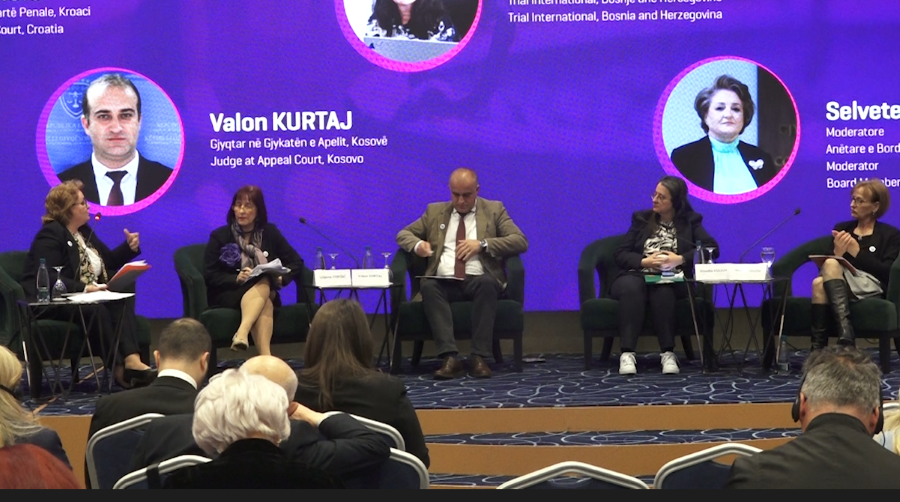
On the Memorial Day for Survivors of Sexual Violence, discussions focused on regional practices in addressing and prosecuting these crimes.
Representatives of justice institutions from Croatia and Bosnia and Herzegovina spoke, focusing on existing legislation as well as compensation for war-related trauma.
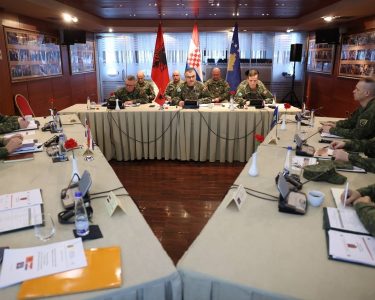
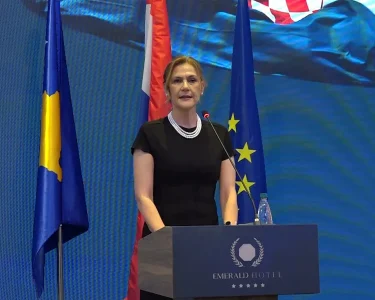
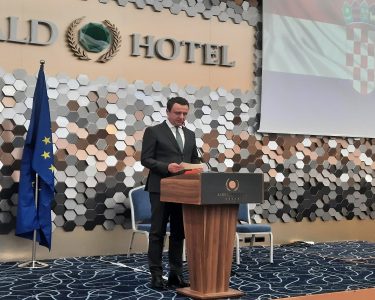
These discussions took place at the regional conference titled “Advancing access to justice for survivors of conflict-related sexual violence: Criminal accountability and the right to reparations.”
Judge at the High Criminal Court in Croatia, Ljiljana Stipisic, said that victims there are only questioned once during court proceedings.
“Victims are questioned only once. Also, the investigating judge, regardless of the fact that the prosecution leads the process, if the victim has been questioned via video link through their representative, the right under Article 6 of the European Convention is guaranteed so that the victim is not questioned a second time. There is recording, documentation, and this is used. This is something that benefits the victim, because they are not subjected to revictimization and retraumatization. The victim can be questioned via video link from another country; this can be done in criminal proceedings. For serious criminal offenses, the victim may request compensation during the proceedings; this is an opportunity for the victim to exercise their property claim,” she said.
Victims of sexual violence in Croatia also have the right to request compensation under the Law on the Rights of Victims of Sexual Violence during the Homeland War.
“The amount ranges from 13,000 to 20,000 euros, and they can also receive a monthly payment of around 414 euros. This can be done even in cases where the perpetrator is unknown, which is very important because it protects the victim. What matters most is the method of questioning, hearing, and the involvement of the person in whom the victim has trust,” she added.
Klaudia Kuljuh from Trial International in Bosnia and Herzegovina said that a large number of survivors have never shared their experiences.
“In Bosnia and Herzegovina, at Trial International, we speak with colleagues who say that stigma is increasing rather than decreasing, because over time and due to the fact that not all cases have been completed, we have a large number of survivors—both women and men—who have never disclosed what happened to them, and perhaps never will. In Bosnia, there are between 20,000 and 50,000 such cases. We have laws in both entities, where Trial International plays a major role for civilian victims and survivors of domestic violence, as well as children born as a result of wartime rape. Even entering into this legal process causes significant trauma for survivors,” she said.
Court of Appeals judge Valon Kurtaj said that handling sexual violence cases is a revolution in Kosovo’s justice system. However, he also spoke about challenges following the transfer of responsibilities to domestic institutions in dealing with war crimes.
“It is difficult to weigh the voice of the victim against time, fear, silence, and stigma. These were issues related to the personal aspect of the victim, which had a major impact on how these cases were handled. We faced professional challenges within the judiciary; a long time had passed, and testimonies began to fade. Some witnesses were no longer alive. Collecting evidence was very difficult. The court had to start from scratch after nearly 20 years. This was an extremely big challenge. However, with the work done by this department, even though with limited capacities, I believe its professional, financial, and logistical capacities must be increased to the maximum if we want to handle these cases promptly, professionally, and ensure judges are specialized in this field,” he concluded.
The exact number of people subjected to sexual violence during the last war in Kosovo is unknown, but reports estimate around 20,000 women and men.
For the first time publicly, Vasfije Krasniqi spoke about her trauma in 2018. Later, Shyrete Tahiri publicly filed a criminal complaint with the Special Prosecution regarding her case.
Ramadan Nishori from Drenas became the first man to speak publicly about sexual violence on April 14 last year, the day known as the Memorial Day for Survivors of Sexual Violence.