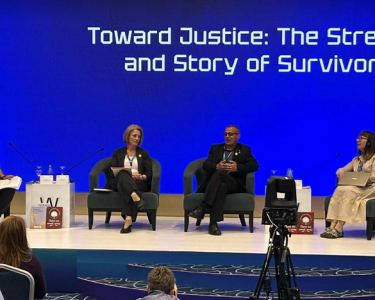

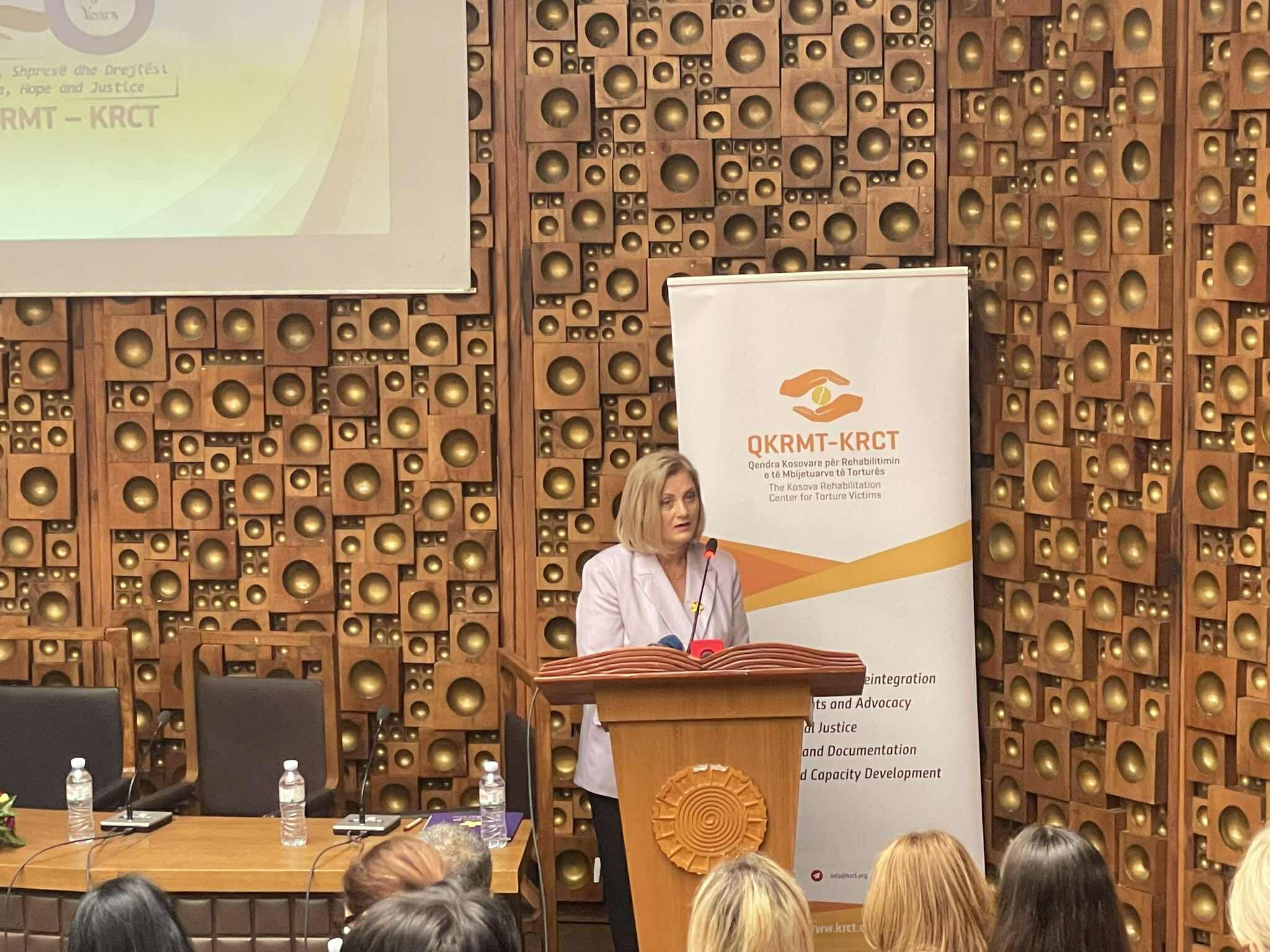
“Vasfija is our strength and courage,” said Ramadan Nishori during the 26th anniversary of the Kosovo Center for Rehabilitation of Torture Survivors (KRCT). Nishori, the first man to publicly share the horrors he endured during the Kosovo war, was honored with the “Courage Award – Vasfije.” Vasfije Krasniqi and Ramadan Nishori, both survivors of sexual violence during the war, spoke about their challenges and journeys after publicly recounting the trauma they experienced. It was also noted that over the 26 years, KCRT has provided direct services to more than 12,000 people.
The first woman to publicly share her experience in 2018, Vasfije Krasniqi Goodman, who was 16 at the time of the assault, said that today society is more willing to listen and less judgmental toward this category of war survivors.
“One day before I went public, when I met with you and Dr. Feride, I was unsure whether I could speak. It was very difficult then, and it is still difficult because we live in a society that judges a lot. I had many doubts about whether I could manage and how people would react. But, on the contrary, the reactions have been very positive, and I have received a lot of support. Even today it is a bit difficult because when people see me, they call me the heroine of Kosovo or use offensive words—not ‘the raped one,’ but…” said Vasfije Krasniqi Goodman, the first woman to speak publicly about sexual violence during the Kosovo war.
Ramadan Nishori, the first man to speak publicly this year, said that “our strength and courage is Vasfija.”
“I thought about everything I went through before coming to your organization, about all the challenges I faced, and I realized there are many other survivors going through what I went through. Let me greet our living heroine, because this is true: Vasfija is our strength and courage. I gained my strength and courage from Vasfija,” he said.
Vasfije Krasniqi Goodman, seven years ago, gave voice to her story of silence, said the director of KRCT, Feride Rushiti.
“Over these 26 years, more than 12,000 people have benefited from our direct services, over 20,000 have received support from our work, and we have documented over 1,400 cases of painful histories of women and men who experienced sexual violence, so that these stories are not forgotten by the country. These are not just numbers or statistics; each number represents tears, pain, but also changed lives. Families who have regained hope, and, above all, people who have begun to live again with dignity,” she said.
During the 26th anniversary of KRCT, Director Rushiti said, “we celebrate transformed lives, voices heard, and justice achieved.”
“In these 26 years of work and dedication, we are not just marking our days of existence; we are marking transformed lives, voices heard, and, above all, justice achieved. When we started the work and activities of the Kosovo Rehabilitation Center in 1999, we faced thousands of people broken spiritually, mentally, and physically. Kosovo had just emerged from war and left deep wounds in the body and mind of every citizen. At that time, there was no system to respond to all these wounds, but there was a team that believed these wounds could be healed and rehabilitated. And thus began our mission: to heal the wounds of war, rebuild lives, and restore dignity where it had been degraded and violated,” she said.
Clinical psychologist at KRCT, Selvi Izeti, raised concerns about time limits for recognizing the status of sexual violence victims.
“When we set time limits to recognize survivors’ pain, we send the message that your time is over. How can the pain of survivors in a war context have a deadline? Can we tell survivors that your healing has a schedule, that justice has a deadline? Certainly not. We are dealing with war crimes, which should not have deadlines, and survivors, whenever and wherever they are ready, can express their pain and be heard. Today we are gathered to honor their hearts together,” Izeti said.
Applications for recognition of survivor status began in 2018, and since then over 2,000 people have applied.
The exact number of people raped during the last war in Kosovo is unknown, but reports suggest around 20,000.
So far, four convictions for sexual violence have been issued. Zoran Vukotiq was sentenced to 13 years in prison; in another case, Vukotiq was acquitted; Zhivojin Nesiq “Zhika” was sentenced to 15 years. During this year, the first in-absentia conviction for sexual violence during the war was also issued, where Ivica Rajkoviq and Dragan Deniq were sentenced to 15 years in prison each.