Kosovo, in its period following liberation and independence from Serbia, has been led by prominent political figures, as well as some less prominent ones, who have held the office of President.
In total, seven individuals have held this position. Two of them were women, and five were men. Additionally, two of them held the office for very short periods – only a few months (Jakup Krasniqi and Behgjet Pacolli) – while the other five served for several years: Ibrahim Rugova, Fatmir Sejdiu, Atifete Jahjaga, Hashim Thaçi, and Vjosa Osmani Sadriu.
They have left different marks on the state-building processes, with each term marking significant historical moments.
Ibrahim Rugova (March 4, 2002 – January 21, 2006)
Dr. Ibrahim Rugova, considered especially by his supporters from the LDK party as the “Father of the Nation” and a central figure in the independence movement during the 1990s, was the first president of post-war Kosovo, serving from March 2002 until January 21, 2006. He was elected to this position and left it upon his death, during the period when the country was under UN administration. Rugova was known as a politician committed to building democratic institutions in post-war Kosovo. He established the Unity Group, which later faced Serbia in negotiations on Kosovo’s status, led by Martti Ahtisaari, which concluded with the 2007 proposal for supervised independence. Rugova did not live to see the declaration of independence, as he passed away on January 21, 2006, after 3 years, 10 months, and 17 days of “reigning” as president.
Fatmir Sejdiu (February 10, 2006 – September 27, 2010)
Following Rugova’s death, Fatmir Sejdiu had the opportunity to succeed him as president, a position he held from February 10, 2006, to September 27, 2010. At the same time, he continued to hold, though frozen, the position of LDK leader, which under the new post-independence legislation was prohibited. As a result, he was penalized in 2010 and removed from office by the Constitutional Court due to incompatibility of functions.
Despite this “unfortunate” act in his political career, Sejdiu can take pride that during his term, Kosovo declared independence on February 17, 2008, received widespread recognition of its statehood, strengthened its international position as an independent country, and gained confirmation of this independence from the International Court of Justice in 2010.
Sejdiu had to resign in September 2010, after serving 4 years, 7 months, and 17 days as head of state.
Jakup Krasniqi (September 27, 2010 – February 22, 2011)
His departure left an institutional gap, and as a result, the position of president was taken on an acting basis by Jakup Krasniqi, as stipulated by the Constitution, since he was the Speaker of the Assembly. The parliamentary leader, who is now at The Hague as an accused by the Specialist Chambers, served as acting president for about 4 months, from September 27, 2010, to February 22, 2011.
Behgjet Pacolli (February 22, 2011 – March 30, 2011)
The presidential crisis was thought to have been resolved when the chairman of the New Kosovo Alliance, Behgjet Pacolli, assumed the office, being elected president on February 22, 2011. However, he remained in office for just over 30 days, until March 30, 2011, as his mandate was declared invalid by the Constitutional Court due to procedural violations in the voting process. Thus, his term was among the shortest in Kosovo’s presidential history.
Atifete Jahjaga (April 7, 2011 – April 7, 2016)
Until Pacolli, all presidents elected by the Assembly came from party leadership. Her successor changed this “requirement” and “honor,” which had previously belonged only to political leaders. Since the parties could not agree on who should be the next president, increased involvement from Kosovo’s international friends was needed to appoint the next head of state.
The solution acceptable to the majority had no connection to politics. It was found in the security field leadership. Major General of the Kosovo Police, Atifete Jahjaga, was elected president in April 2011 and served a full constitutional term of 5 years, until April 7, 2016. A new term – “the envelope president” – entered political and media discourse due to claims that her name came as a proposal in an envelope from Kosovo’s international friends.
Jahjaga is remembered as the first female president of the Republic of Kosovo and the first president to complete a full five-year term.
Hashim Thaci (April 7, 2016 – November 5, 2020)
During this time, the country was in new political circumstances. Hashim Thaci, who had served as Prime Minister and Deputy Prime Minister from 2007 to 2016 as PDK leader, had shown aspirations to become president, after allowing Isa Mustafa of LDK to take the Prime Minister post in a party agreement, with the condition that Thaci would become president when Jahjaga finished her term.
Thus, on April 7, 2016, Hashim Thaci, one of the main political figures in the country since 1999, known also for reading the Declaration of Independence on February 17, 2008, was elected head of state by the Assembly. He remained in office for 4 years, 6 months, and 29 days, until November 5, 2020, when he resigned following confirmation of an indictment by the Specialist Chambers for war crimes and crimes against humanity. Thaci is still at The Hague awaiting the court’s decision. During his presidency, Thaci led negotiations with Serbia for normalization, which remain unfinished.
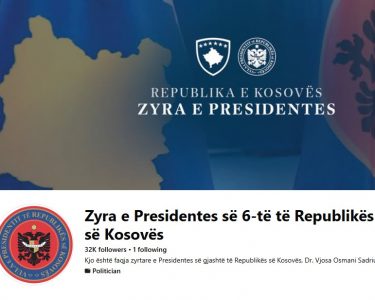
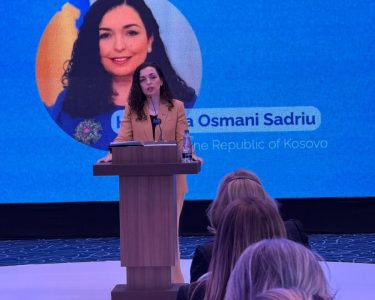
Vjosa Osmani (April 4, 2021 – present)
His resignation automatically made the then-Speaker of the Kosovo Assembly, Vjosa Osmani, acting president. She held this position for 5 months until being elected full president on April 4, 2021, as part of a political cooperation with Vetëvendosje and Albin Kurti.
She is the second female president of Kosovo. Her current term, which has lasted 4 years and 10 months, is expected to end in April 2026. Osmani, who is also the most voted woman in Kosovo’s election history, has expressed aspirations to continue in this office for another term.
According to the Constitution, the President of Kosovo is the Head of State, represents the country internationally, signs laws, and leads foreign policy under the highest legal act of the Republic. The president is elected indirectly, by the Assembly of Kosovo, and the term lasts five years.