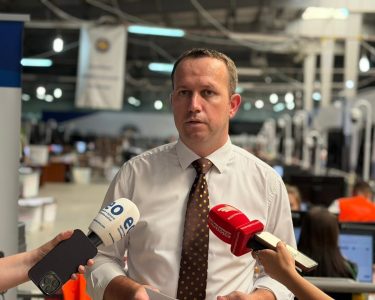
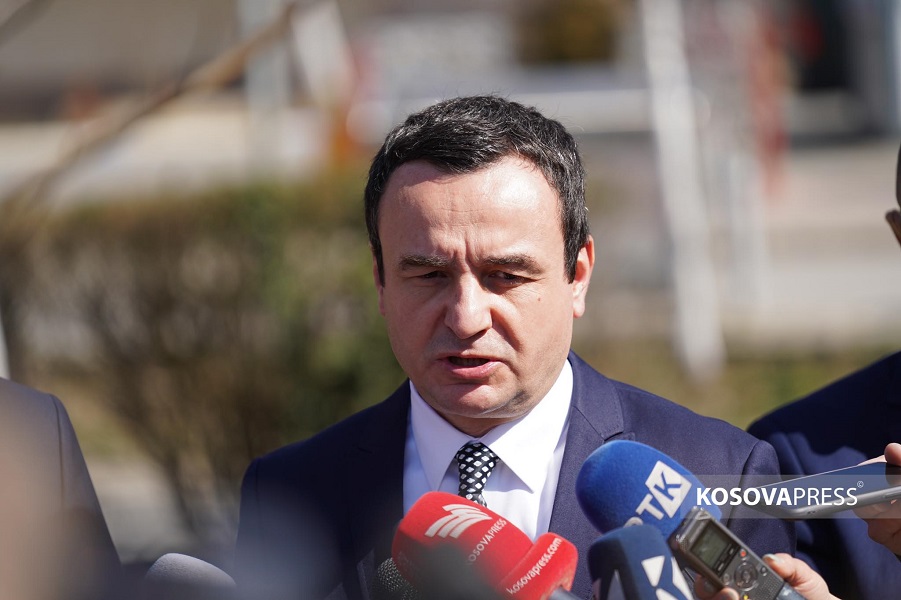
Acting Prime Minister Albin Kurti marked International Workers’ Day by criticizing the opposition for not voting in favor of the government’s anti-inflation package and for, as he said, boycotting the presidential election and sending the country to elections.
While extending his greetings to all workers, Kurti said that according to international trade union reports, workers’ rights were significantly weakened worldwide during 2025, adding that Kosovo could not be an exception to this global reality.
“In this context our workers live and work, and in this light our government decisions should also be understood. When we took office, the minimum wage in Kosovo was 170 euros. It had not changed for thirteen years. For an entire generation entering the labor market, this was the legal minimum for their work. We changed this. We approved the Law on Minimum Wage and raised it to 425 euros, directly affecting around 150,000 workers, most of them in the private sector. From July 1, it will increase to 500 euros (regardless of what happened with the Assembly).
We introduced a 13th salary for public sector workers. For the first time since Kosovo’s declaration of independence, the state concretely recognized the continued contribution of its employees. We have called and continue to call on the private sector to follow this example, because fair compensation and greater care for workers should not be a privilege reserved only for the public sector.
We launched and expanded the Superpuna program, which subsidizes wages in the private sector for six months and creates a structured pathway for young people into the formal labor market. We employed more than 23,000 young men and women aged 18 to 29, benefiting around 10,500 businesses.
For the first time under our government, child benefits and maternity allowances began to be distributed. We increased pensions from 90 euros to 150 euros. Through the ‘Government for Families’ program, we subsidized 70% of salaries for six months for families with no employed members, including around 4,000 families.
We have also supported the employment of more than 12,000 women through state policies and direct subsidies. We are continuing with the ‘Superpuna for Women’ program, which will further help increase women’s employment.
In just three and a half years of our governance, the number of employed people has increased significantly. We found Kosovo with around 350,000 employed people, while today there are around 435,000 — an increase of approximately 85,000 jobs.
We approved the draft law on health insurance. For the first time in Kosovo, this law creates a universal framework that covers both employed and unemployed citizens through individual and state contributions. The right to healthcare cannot depend on employment status.
We proposed a 200 million euro package to cope with inflation, which offered targeted support for the private sector, students, children, and families facing the rising cost of living. This package was blocked in the Assembly by an opposition that chose not to vote. The same opposition that boycotted the election of the president, sending the country to elections. The votes are recorded. Citizens will draw their own conclusions,” he wrote.
According to him, one of the main shortcomings regarding workers’ rights in the Republic of Kosovo is the lack of trade union organization in the private sector.