

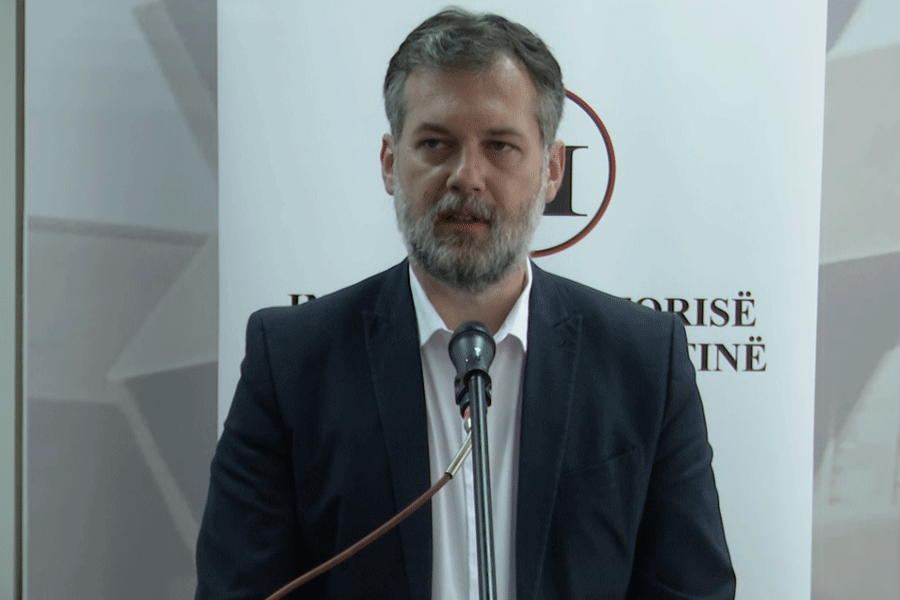
The role of heroes and martyrs in the construction of Kosovo’s freedom, the preservation of collective memory, and the need for a rigorous scientific approach to the history of Albanian resistance were highlighted at the scientific conference titled “The Eternalization of National Heroes and Martyrs for the Kosovo Cause.”
The conference was organized to mark the 27th anniversary of Kosovo’s liberation by the Institute of History “Ali Hadri” in cooperation with the State University of Tetova.
In the opening session of the conference, acting Minister of Culture Hajrulla Ceku said that honoring heroes and martyrs should not be limited only to commemorative ceremonies, but should also be supported by scientific research and institutional documentation.
He stressed that collective memory is preserved through knowledge and academic research.
Ceku assessed that the struggle for Kosovo’s freedom was multidimensional, including military, political, civic, diplomatic, intellectual, and cultural engagement.
Meanwhile, the director of the Institute of History “Ali Hadri,” Teuta Shala Peli, said that heroes and martyrs form the foundation on which the state of Kosovo was built.
She emphasized that the eternalization of their work remains both an institutional and moral obligation.
In the opening session of the conference, the secretary of the Institute of History “Ali Hadri,” Arbër Hadri, spoke about Kosovo’s historical path toward freedom, highlighting the sacrifices of generations of Albanian activists and fighters.
He said that freedom was an ideal that kept alive the hope of Albanians during the most difficult periods of repression.
He mentioned key figures of the national resistance such as Jusuf and Bardhosh Gërvalla, Kadri Zeka, Rexhep Mala, Nuhi Berisha, and Enver Hadri, assessing their impact on shaping the liberation consciousness that culminated in the Kosovo Liberation Army (KLA) war.
Hadri stressed that with the emergence of the KLA, the Kosovo issue gained greater international attention, while the sacrifice of the Jashari family in March 1998 became a symbol of freedom and resistance.
The conference also featured a presentation by historian Marenglen Verli from the University of Tetova, who addressed the developments of the Albanian National Movement in Kosovo after World War II.
He said that Kosovo Albanians, despite political differences at the time, aimed at unification with the Albanian state, while after the war their efforts were directed toward advancing Kosovo’s political status and preserving national identity within Yugoslavia.
According to Verli, Tito’s death marked a new period of challenges for Albanians, as demands for advancing Kosovo’s status were met with rising Serbian nationalism and policies that culminated in Slobodan Milosevic coming to power.
The two-day conference on June 4 and 5 is being held as part of activities marking the 27th anniversary of Kosovo’s liberation. Organizers announced that commemorative events will continue on June 6 with visits to memorial complexes of heroes and martyrs, while on June 12 a scientific roundtable will be held in cooperation with the Municipality of Kukës dedicated to the 1999 exodus.