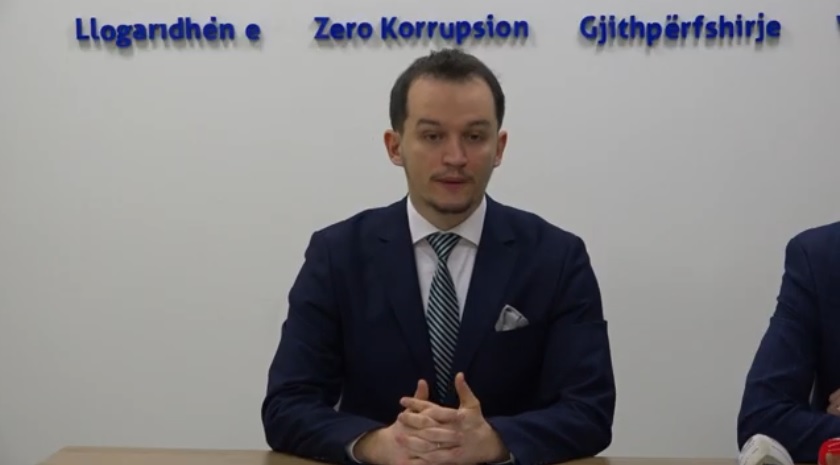
The Kosovo Democratic Institute (KDI), a branch of Transparency International in Kosovo, has published the 2025 Corruption Perceptions Index, which shows that Kosovo has recorded a decline in the fight against corruption.
According to the index, Kosovo scored 43 points and ranked 76th out of 182 countries, marking a decrease of 1 point and three positions compared to last year.
Eugen Cakolli from KDI said this decline represents a break in the gradual improvement trend that Kosovo had achieved for nearly a decade. He noted that the stagnation in the index is directly linked to the parliamentary crisis following the February 9 elections, which blocked the normal functioning of institutions and the implementation of anti-corruption reforms.
“This year, Kosovo scored 43 points and ranked 76th among 182 countries. This represents a decrease of 1 point compared to last year and a drop of three positions. Kosovo, with 43 points, ranks alongside countries such as China, Ivory Coast, and Ghana. Unfortunately, Kosovo has interrupted the gradual upward trend it had maintained for almost a decade, and this decline reflects stagnation in the fight against corruption, directly linked to the parliamentary crisis following the February 9 elections last year, which blocked the normal functioning of institutions and the implementation of key anti-corruption reforms. For the first time, a full-term government did not approve a national anti-corruption strategy, and, worse, 2025 ended without the appointment of a new state prosecutor, due to ongoing objections from the president, prime minister, and other institutional holders regarding the legally nominated candidate by the Kosovo Judicial Council. The prolonged vacancy of this key position has weakened the functioning of the prosecutorial system and created institutional uncertainty in the fight against corruption,” he said.
Speaking about electoral processes, Cakolli noted that unlike previous elections, the fight against corruption was not a central theme in the programs of major political parties.
“Unlike previous electoral processes, in the two rounds of elections last year, the fight against corruption was not among the core topics of the programs of any of the main political parties. The outgoing government continued to make decisions with budgetary consequences without transparency or parliamentary oversight, and during the electoral process, there were cases of public resources being used for purely electoral purposes,” Cakolli emphasized.
Florent Spahija, also from KDI, said that 2025 was characterized by investigations and indictments against several high-ranking government officials, including the well-known “state reserves” case, in which around €3 million in budget damage is suspected.
“2025 was characterized by investigations and indictments against several high-level government officials. In the case known as ‘state reserves,’ around €3 million in budget damage is suspected. Also notable this year was the lack of convictions by courts for corrupt individuals, including both officials and non-officials. The acting prime minister was called as a witness in this case but refused several times to appear before the Special Prosecution. This undermines trust in judicial independence and seriously damages the culture of public accountability, directly impacting perceptions of corruption. Additionally, justice system reforms were paralyzed during 2025,” he said.
KDI calls for the Assembly and the new government to act as soon as possible, without an extended transition period, placing the fight against corruption at the top of the agenda, including the approval of a national anti-corruption strategy and the finalization of the justice reform package.
Compared to the Western Balkans region, the rankings by points are as follows: Montenegro (46), Kosovo (43), North Macedonia (40), Albania (39), Bosnia and Herzegovina (34), and Serbia (33).