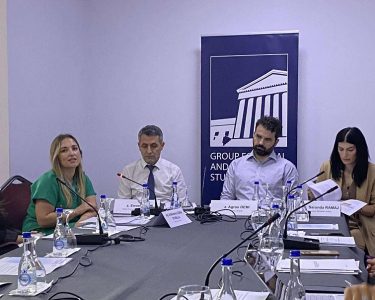
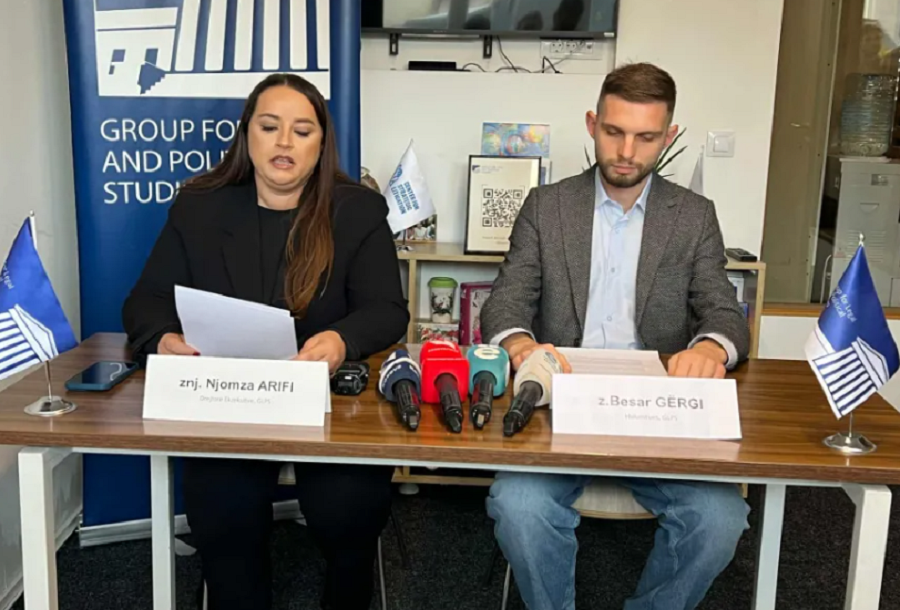
The key theme of the European Union’s report on Kosovo in 2025 is stagnation and limited progress, said Njomza Arifi, Executive Director of the Group for Legal and Political Studies (GLPS). According to her, the political crisis throughout 2025 has had significant consequences for Kosovo, and “it can be concluded that this year has been wasted for the country.”
The European Union published the Report on Kosovo on November 4. The EU prepares these reports for countries seeking membership in the European bloc.
However, during a press conference on Thursday, Arifi noted that, according to the report, Kosovo has made progress in four chapters, namely food security, transport policies, social policies and employment, and foreign relations.
“Kosovo is reported to have made improvements in four chapters: Chapter 12 on food security, Chapter 14 on transport policies, Chapter 19 on social policies and employment, and Chapter 30 on foreign relations. Nevertheless, this kind of progress does not meet the needs for deep reforms for rapid integration. Considering all the chapters in which our country is evaluated, Kosovo still remains at a certain level of preparedness. Regarding progress, this year’s report assesses that Kosovo has made limited progress in 17 chapters, some progress in 11 chapters, no progress in two chapters, and only good progress in one chapter for 2025. The consequences of the political deadlock are evident throughout the report. The key theme of this report is stagnation and limited progress. Although Kosovo remains committed to its path toward European Union integration, the political reality of this year has caused significant setbacks. It can be concluded that this has been a wasted year for Kosovo,” she said.
On the other hand, GLPS researcher Besar Gërgi highlighted that, regarding freedom of expression, the report is significantly more negative compared to previous years.
He added that the report mentions around 70 physical and verbal attacks against journalists, as well as offensive language from high-ranking officials, including the acting Prime Minister, Albin Kurti.
“Regarding freedom of expression, the report is significantly more negative than in previous years. About 70 physical and verbal attacks against journalists are mentioned. It also highlights offensive language used by high-ranking officials, including the Prime Minister. The report criticizes the lack of long-term funding for the sole public broadcaster and notes negative developments within the Independent Media Commission (KPM). Regarding the KPM, the report emphasizes that the law was overturned by the Constitutional Court because it included provisions undermining the independence of this institution. It remains very important that the new law meets EU and international standards,” Gërgi emphasized.
Regarding the Kosovo–Serbia dialogue, Gërgi stated that Kosovo is required to establish the Association of Serb-majority municipalities, while Serbia is asked to recognize Kosovo’s symbols.
According to him, the report highlights that the implementation of the Brussels Basic Agreement and the Ohrid annex, reached in 2023, has been impossible due to political instability in Kosovo and Serbia.
Concerning the lifting of punitive measures against Kosovo, he stressed that their removal depends on the peaceful transfer of power in the four northern municipalities after the runoff elections on November 9.
“Regarding the normalization of relations with Serbia, this report, like in previous years, gives particular importance to normalization. Kosovo is asked to establish the Association, while Serbia is asked to recognize Kosovo’s symbols. The report notes that dialogue has continued, but the implementation of the Ohrid agreement has been impossible due to a lack of stability in both Kosovo and Serbia. Regarding normalization, this year, the EU mediator’s language appears more balanced. Considering this fact and the new composition of the European Commission, it is important that parties find common ground and institutions are established so that Kosovo can benefit from this political setup,” Gërgi added.
The European Union report on Kosovo was also delivered on Tuesday to Kosovo’s state leaders. It was received by President Vjosa Osmani, Speaker of Parliament Dimal Basha, and the acting Prime Minister Albin Kurti.