
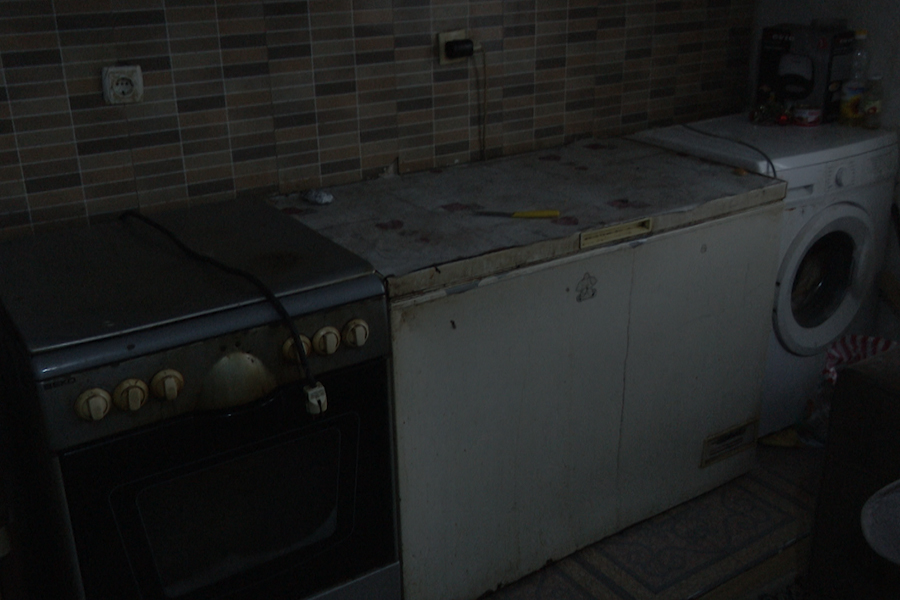
In a small house with damp walls and traces of mold, half-burned, lives the Bilalli family, a family of five who face poverty, illness, and insecurity every day, with a paralyzed and blind mother and a 10-year-old son who does not even have money for school.
The head of the family, Azem Bilalli, says their survival depends almost entirely on social assistance of 120 euros per month, which, according to him, mostly goes to medicine.
Sick and unable to work, Azem explains that the conditions they live in are extremely harsh. The house they live in was built with the help of unknown people, who, as he says, helped without asking for anything in return. Before this, the family had spent months living in a tent.
In the Bilalli family, illness has become part of everyday life. Azem’s mother is in critical health condition, and just for diabetes therapy, around 100 euros per month are needed. Azem and his wife also suffer from multiple health problems, which makes daily life even harder to cope with.
Their ten-year-old son, a fifth-grade student, attends the “Nazim Gafurri” school. Even though the books have been provided, the family struggles to afford basic school supplies. On the eve of the year-end holidays, the boy has nothing to celebrate.
“I am sick, I cannot work. You can see the conditions I live in, with a 120-euro social allowance, we barely manage. It’s little; some people helped when they could, and I thank them because this is all we have, these couches, everything we have was given to us… Some people built it for us; I don’t even know them, they didn’t tell me their names or show their faces. We also lived in a tent for six, seven months… I got this illness from the Serbian police. They beat me, with rings, with everything, they destroyed me… My mother is in critical condition, I feel so bad but I can’t do anything. Just 100 euros go for her diabetes… He goes to school, Nazim Gafurri, the government provided money for books, but for other school supplies, I had to buy pencils and such. We get no other help from the state, only from philanthropists who saw us in this condition and helped with what they could, up to here; they didn’t let me give up,” Bilalli said.
Heating and electricity remain constant challenges for the family. They use wood for heating, often provided for free by donors. Regarding electricity, any usage above the minimum limit translates into a bill they cannot pay.
“We put the stove, we have some wood, also brought for free, when we don’t have wood, we heat… No, we can’t, for electricity, since we are on social aid, the meter card exempts us, for example up to 20 euros, which the Ministry of Social Affairs deducts, but if it exceeds 20 euros, we have to pay out of pocket. We managed a bit because a neighbor had a cart nearby, they left the cart with fuel, and the heating was close by, so it exploded, the tank hit the house, I repaired it myself,” he added.
Azem’s wife describes with tears the fear that accompanies her every day. She says the house shakes in the wind, and every rain makes her feel unsafe for the family’s life.
She says she feels powerless when her child sees the lack of basic things that others have.
“One raindrop falls here, the wind blows strong, the house shakes, one day I feared the house would collapse, it has no pillars… And there is no one to buy medicine, or take care of the sick mother, paralyzed, we have to try… Everyone is sick, and if no one helps us, we would have died long ago… I have diabetes, high blood pressure, and all my other illnesses… The electricity bill comes, ‘pay it,’ how can I pay, there’s no way. One day I had to go with them, I was sick, just to show that we get 100 euros… ‘No way, mother, everyone has, I don’t, everyone has something to eat, I don’t,’ I feel sorry for him, until he grows up, he will struggle,” she said.
Anyone who can help the Bilalli family, living in Kodrën e Trimave, on “Nexhmi Llumnica” street in Pristina, can contact them at 044-799-116.