
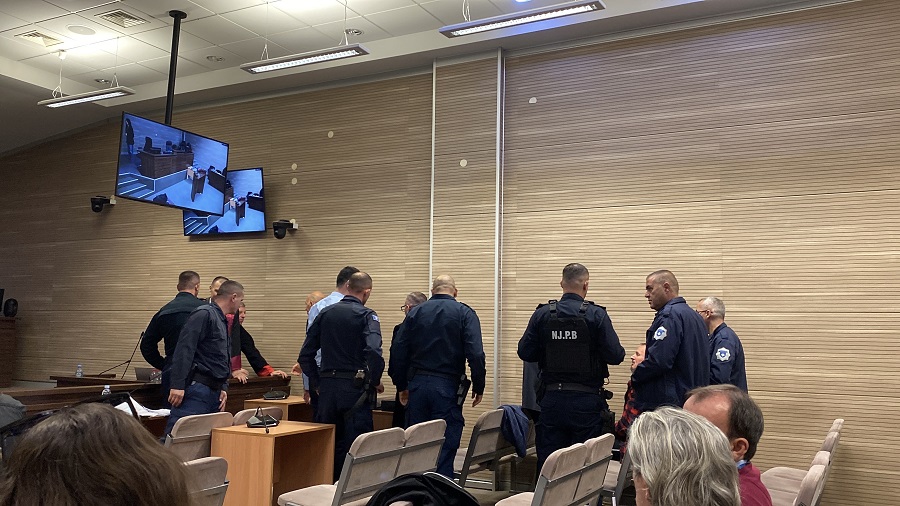
At the Basic Court of Prishtina, the defendants continued presenting their defense today in the case concerning 400 kilograms of cocaine imported from Brazil. Initially, it was planned that the defendant Kadri Sheqiri would give his defense today, but due to his health condition, it was decided that he would do so another day. Instead, it was defendant Kadri Brahimi who gave his defense before the trial panel.
In addition to the defendants Sheqiri and Brahimi, others accused of importing 400 kilograms of cocaine from Brazil include the owner of the company “MC Food,” Izet Sheqiri, as well as Faton Vrajolli and Fehmi Bytyqi.
At the beginning of the session, the presiding judge, Ngadhnjim Arni, stated that the court had been informed by the competent authorities that the defendant Kadri Sheqiri had experienced health problems prior to the hearing.
“Today before the hearing, we were informed by the responsible persons, although we have not yet received the written notice, that your client, Kadri Sheqiri, had some health problems prior to the session. In this context, the court seeks your opinion on whether today is an appropriate day for the questioning of the accused, considering his condition,” he said.
Meanwhile, the defendant, Kadri Sheqiri, himself requested not to give his defense today due to his health condition.
“By God, I’m not well at all. Judge: Are you able to continue today or not? … Sheqiri: If the other two after me could continue,” he said.
After Sheqiri left the courtroom, the next to give his defense before the trial panel was the accused Kadri Brahimi, who was first questioned by his defense lawyer, Driton Musliu.
Brahimi explained that since 2012 he had been working with “MC Food,” first as a regular worker and later, since 2015, as the main warehouse keeper.
When asked how, as the main warehouse keeper, he identifies the goods arriving at the warehouse, Brahimi said this is done through the barcode that each package has.
“My duty was only to count the goods coming in and going out, nothing else. Lawyer: Who is responsible for unloading the goods? … Brahimi: If needed, at the warehouse where the counting and unloading take place, I help if necessary so the work finishes faster… Lawyer: How do you identify one product from the pallet, do you open the pallet to see what’s inside or how do you identify it? … Brahimi: According to the barcode on the package. It’s strictly forbidden for us to open the packages; we’re not allowed because they think we might be doing something suspicious,” he said.
When asked why, on the critical day, he had separated some pallets during unloading, Brahimi said the separation was due to the barcodes, as there were two—one labeled 82 and the other 101.
“These are the procedures, as there were two barcodes, as far as I remember, one was 82 and the other 101, and these goods must not be mixed. In the indictment, you are accused of separating the pallet containing narcotic substances to prevent its identification and keep it from other workers. Did you do that during the unloading of this shipment? … Brahimi: No, that’s not true, and it was seen in the video that the procedures were the same. I heard during the sessions that there were 20 gigabytes of footage — if there’s even a millimeter of difference, I’ll take full responsibility. From 2015, when I took the position, until that day, the work was always done the same way, without any changes or issues,” he emphasized.
When asked whether he resisted arrest by the Kosovo Police, Brahimi said he did not resist but claimed he was beat
“No, and at the moment the police ordered me, I stopped, but still they beat me with their hands while I was tied like a dog. I didn’t deserve that, and it can be seen on camera,” he said.
After the questions from his defense lawyer, Brahimi answered those from the prosecutor of the case, Valdet Gashi, who asked when the truck containing the 400 kilograms of drugs had arrived at “MC Food.”
Brahimi said that the security guard had informed him that the truck had arrived, and then he himself had ordered the container to be connected to the power supply.
“Yes, the guard informed me, and I ordered to plug it in—to connect the container to electricity so that the freezer would work and the goods wouldn’t spoil. The guard informed me when the truck arrived at the company, not elsewhere. Judge: Was this truck an urgent shipment? … Brahimi: No, it wasn’t an urgent one,” he said.
During the questioning, the prosecutor confronted Brahimi with a part of his statement given to the prosecution, where he had said that only one truck had arrived that day, while now he stated there were also two others. Brahimi explained that he had thought the question referred to trucks coming from Durrës.
He also stated that on May 17, 2021, he personally unloaded the goods from the truck where the 400 kilograms of cocaine were found and operated the forklift himself that day.
When asked by the lawyer of Izet Sheqiri, the owner of “MC Food,” whether his client had ever shown any interest in the goods found in that truck, Brahimi said:
“From 2015 until May 17, 2021, Izet Sheqiri has never been interested in any truck, never mentioned one,” he said.
When asked by lawyer Florent Latifaj what would have happened to the goods if the police had not intervened, Brahimi answered:
“If the police hadn’t intervened, those goods would have likely gone to markets all over Kosovo, because we never open the packages. I don’t care whether there are stones, nuggets, or anything else inside — I only check the number and barcode on the invoice, nothing more. The moment the goods leave the warehouse, I’m no longer responsible,” he said.
In the last hearing for the case of the 400 kilograms of cocaine, the defendant Izet Sheqiri, owner of “MC Food,” had already given his defense.
It should be recalled that in this case, Hysni Sheqiri was also accused but, after reaching a plea agreement with the prosecution, was sentenced to 7 months of effective imprisonment for obstruction of justice. Another defendant, Naim Morina, also reached a plea deal and was sentenced to 6 months of effective imprisonment for obstruction of justice.