

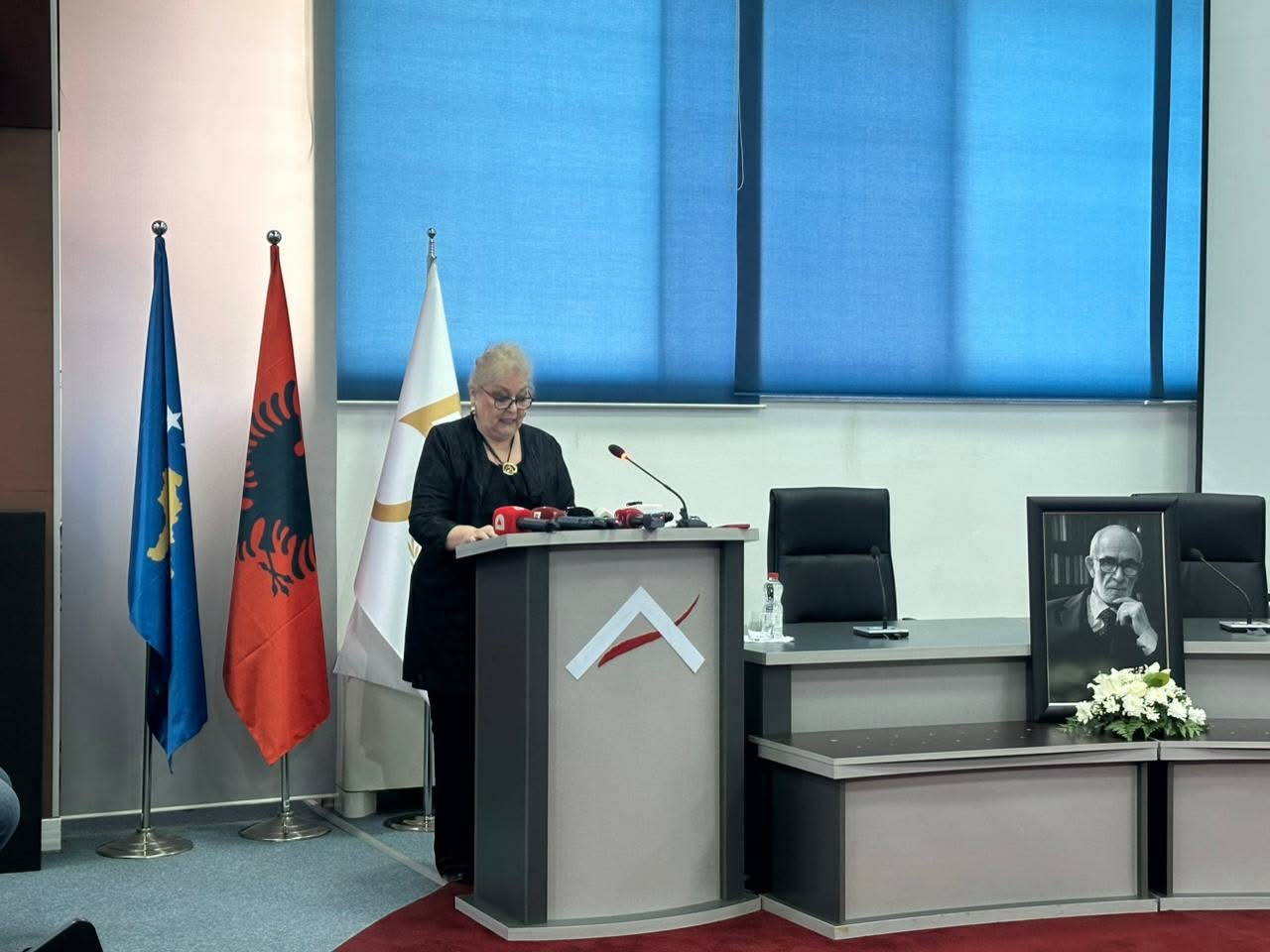
The Academy of Sciences and Arts of Kosovo (ASHAK) held a commemorative meeting on the occasion of the passing of academic Rexhep Qosja, one of the most prominent figures of Albanian scientific and cultural thought.
The meeting was attended by institutional representatives, academics from Kosovo and Albania, as well as friends and collaborators of the late scholar.
The President of the Academy of Sciences and Arts of Kosovo, Justina Shiroka Pula, described Qosja as a strong voice of critical reason and a defender of truth.
Prime Minister Albin Kurti, in his address, highly praised Qosja’s multidimensional contribution to culture, science, and the national cause.
“The work of Rexhep Qosja is one of the most important achievements of Albanian critical thought and culture in the 20th and 21st centuries. He stood out as a literary critic, essayist, and public intellectual, contributing deeply to the analysis of national identity, history, and the development of Albanian literature. He consistently defended the importance of culture as a basis of national consciousness and as an instrument of social emancipation, influencing the intellectual formation of entire generations in the Albanian-speaking areas. Qosja was a model of a public intellectual. His scientific work was inseparable from his engagement for national identity, Kosovo’s statehood, and Albanian unity. His studies on the National Renaissance figures, especially the work ‘Porosia e madhe’ dedicated to our national poet Naim Frashëri, as well as studies on Asdreni and others, greatly contributed to the national formation of Albanians in former Yugoslavia. When the breakup of Yugoslavia began and repression against Albanians intensified, Rexhep Qosja became the most prominent Albanian academic and intellectual voice. He denounced Yugoslav repression against Albanians, the lies and propaganda of Serbian intellectuals who supported the infamous 1986 memorandum of the Serbian Academy and who prepared the ground for the genocides Serbia would carry out in the 1990s. He became the voice of the silenced people, as titled in one of his works, a collection of his polemics with Yugoslav intellectuals of the time,” Kurti said.
Meanwhile, the scientific secretary of the Academy of Sciences of Albania, Anila Hoda, emphasized Qosja’s extraordinary role in Albanian intellectual life.
His colleague and friend, Ali Aliu, also recalled his life and work, highlighting his role in shaping modern national thought and defending the rights of Albanians.
“Academic Rexhep Qosja, without a doubt, with his life and work, holds a special place in national history, as one of the central figures of thought, creation, and intellectual resistance, a figure transformed into a symbol of modern national identity. His biography reflects both his individual fate and the broader Albanian fate shaped by crises and divisions of the ethnic trunk, factors that inevitably shaped and strengthened his belief in national unification, starting from linguistic, spiritual, literary, and political emancipation… Continuing his scientific research at the Institute of Albanology, in 1971 he defended his doctoral thesis on the life and work of Asdreni. After his doctorate, in 1972 Qosja was elected senior associate and later scientific advisor at the Institute of Albanology in Pristina, and simultaneously a full professor at the Faculty of Philology in Pristina,” Aliu said.
At the meeting, it was emphasized that the work and contribution of Rexhep Qosja will remain an important part of Albanian scientific, literary, and national heritage.