
In the second episode of the series “Building a Ferrari”, broadcast for EJU, Driton “Toni” Kuka returns to the darkest moment of his career—the London 2012 Olympic Games, an experience that nearly ended his journey as a coach. The unexpected defeat of Majlinda Kelmendi, amid extraordinary national and international expectations, turned into a heavy psychological blow for Kuka and his team, opening a period of isolation, self-blame, and deep reflection.
The consequences of London led Kuka to a fundamental decision: a complete break from external pressure and the construction of a closed “sporting family,” where absolute priority was given to work and internal accountability. This shift in philosophy brought immediate results. In 2013, Majlinda Kelmendi was crowned world champion—the first world title for Kosovo in judo—marking a turning point in the history of Kosovar sport.
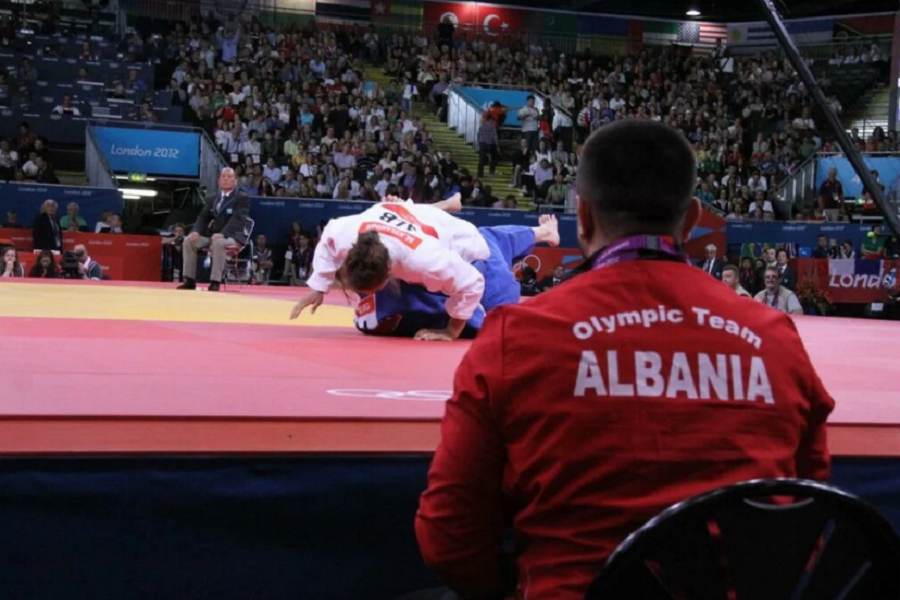
“It was at the first Olympic Games. We competed for Albania in 2012. Majlinda won the first match against the Finnish girl, who was a strong opponent. Then she faced a girl from Mauritius in a match where Majlinda was normally the favorite,” Kuka emphasizes.
What happened next still seems impossible to Toni. “In the first minute she scored a waza-ari and then became a bit euphoric. Shortly after, she fell into an ippon. For me, the whole world in my mind felt like a bad dream, something that could not happen.”
The immediate aftermath was horrific. “We went to the warm-up area. I was alone next to her. I smashed my head against the wall two or three times. ‘Why here?’ I said. She didn’t speak. She was crying. I was very desperate. I felt terribly bad.”
The weight of expectations made it even worse. “At this competition, the expectation for Albania was that she would win a medal, and imagine—the President of Albania, the Prime Minister of Albania, the President of Kosovo, the Prime Minister of Kosovo were all sitting there with President Vizer…, and we lost.”
“After that, I thought I would never be able to face all those nations, all those Albanians in Kosovo, in Albania, because Albanians live in many countries. I thought, this is over for me. I thought I would never face the media again. I thought it was the end of my life in judo.”
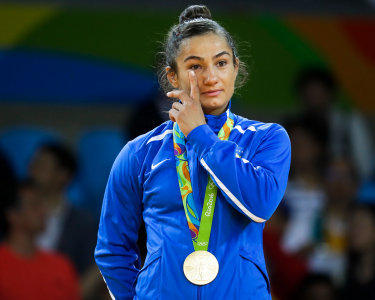
The lessons of London were reflected directly in the preparation for Rio 2016, where Kuka applied a radical approach of isolation and total control over every detail. Closed preparation, full internal responsibility, and extreme focus resulted in Kosovo’s first Olympic gold medal—a historic moment that, according to Kuka, definitively shaped him as a coach both psychologically and professionally.
Subsequently, Tokyo 2020 represented the peak of his method, with a team built to perfection, where every element—from training load to nutrition and competition calendar—was planned down to minutes and millimeters. Two Olympic gold medals in Japan and Kosovo’s positioning among the world powers of judo were considered by Kuka to be the most complete work of his sporting life.
The second episode concludes with Kuka’s reflection on personal and professional growth, acknowledging that experience, mistakes, and early failures have transformed him into a more measured, more tactical coach, and more aware of the human cost of elite success. As the new Olympic cycle toward LA 2028 presents fresh challenges, the philosophy remains the same: quiet work, maximum control, and absolute trust in the process.
In the final episode of the series, Driton Kuka will speak about the personal price of Olympic success, confronting mental exhaustion, and the reason why, despite everything, he cannot step away from the adrenaline of elite sport.