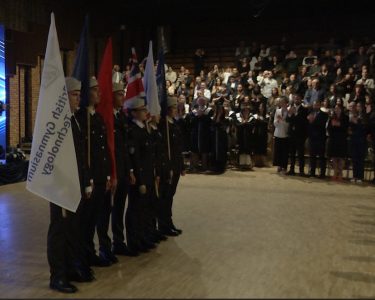

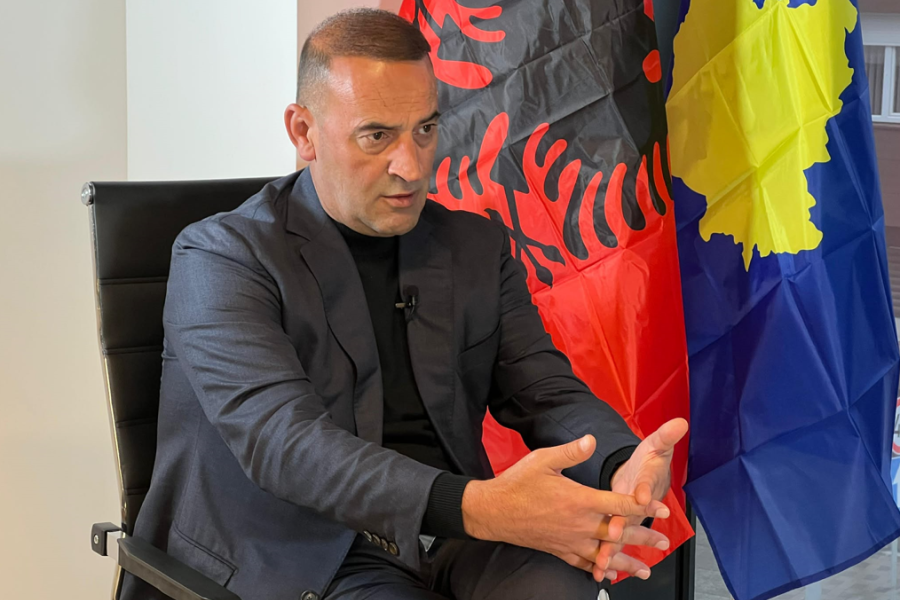
On November 28, twenty-eight years ago, together with two fellow fighters, they made history. Daut Haradinaj, Mujë Krasniqi, and Rexhep Selimi showed the world the Albanian struggle for freedom and independence.
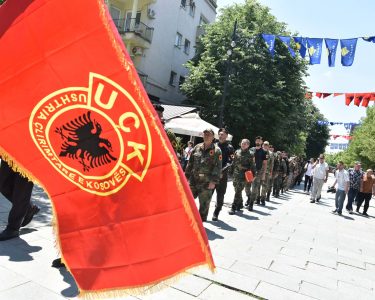
This date, now engraved in the stones of Albanian history, marks the first public appearance of the Kosovo Liberation Army (KLA/UÇK).
One of the three figures who appeared before thousands of people was General Daut Haradinaj, who told KosovaPress the details of that day.
Regarding the first public appearance of the Kosovo Liberation Army, he recalls that it had been preceded by battles in Vojnik, Skenderaj. He remembers that on the late evening of November 26, he had met with Mujë Krasniqi and ‘Dervishi’ from Klina, who had told him about the firefight they had had with Serbian forces.
“Even there, it became clearer what the situation was, because there had been a firefight in Vojnik near Abedin Rexha. Serbian forces, during their retreat, attacked the school. I was told that teacher Halit Geci had been killed even in Llaushë. That is, during consultations, the ceremony for the teacher’s funeral was discussed. There had been heavy rainfall; the weather conditions were not very favorable. But most of the people mobilized in the area, including Commander Adem Jashari and other men, many of whom are heroes today, had the idea to prepare for a firefight because a new Serbian attack was expected. However, as it seems, we had suffered heavily a day earlier and that did not happen,” he recounts.
Serbian forces had fired at the school and civilians without any provocation.
Teacher Halit Geci was buried on November 28, 1997, precisely on the day that marked the first public appearance of the KLA. Both these events mark the glorious history of the Albanian people’s struggle for liberation.
Haradinaj says he did not realize that history was being written that day.
“There was no discussion about what weight this or that event would have; the goal was to cause as little damage to your side and as much damage as possible to the Serbian forces. When the decision was made, we had to be completely transparent. No, we did not know the weight of the event. That day it was decided that Muja and Rexha would appear. Drenica personally honored me, also as a guest, perhaps also as a young man, and as someone from an area which at that time few knew much about history. There had been months when Luani had been killed, Ramushi wounded, Fehmi Lladrovci wounded. There had been a very large battle. Earlier, the case of Adrian Krasniqi being killed in Dukagjin at the police station in Klina had happened, and Halit Gjoçi from Junik had also been killed two or three days earlier. He was a man and a very strong activist of the time. My participation in the event implied that Drenica and Dukagjin were together in an undisputed war, and there was no turning back. It was clear that Serbia would not leave Kosovo without shedding blood,” Daut Haradinaj told KosovaPress.
Rexhep Selimi, Mujë Krasniqi, and Daut Haradinaj were the three fighters who delivered the news to the people that there was a liberation army.
None of them had the same KLA emblem.
“When I went to Drenica in civilian clothes, I had a jacket that was military-colored, but most of the people at Sabit Geci’s house—the vast majority—were there. And it was the first time KLA uniforms had arrived in Kosovo, and they were Swiss-made. In that photograph, video footage shows Swiss uniforms. After consultations, it was concluded who would read the statement. In this case, Rexha, they also said Dauti should participate. Musë Jashari gave me the uniform. That means I did not have a uniform myself. I wore his uniform. Then there was the beret type, which was improvised. I do not want to devalue the narrators and those who talk about the war and KLA history, but the truth is that we did not yet have KLA emblems in Kosovo. That is, even if you watch the videos and footage, the KLA emblem until that day had not been in Kosovo, and people, no matter how hard they try to claim priority as to whether it existed or not, it did not exist. I remember today when I placed a national Albanian Army flag, and at that time it was a black eagle with a red background, very red and very black. Even today, if you look at the Albanian Army emblem, it is very red and the color is very black. Which means it does not match the KLA colors,” Daut Haradinaj explains.
Twenty-eight years later, in an interview with KosovaPress, one of the three fighters who delivered the news of the KLA to the people recalls the reaction of the public when they appeared in uniform before the crowd.
“When the KLA appeared at the funeral, at first there was a silence, a clinical death-like quiet. I tell you, at that moment, people did not know whether to cheer, to rejoice, or what had happened—they probably did not fully realize that these were KLA members, because it was the first public uniform. When we arrived at the funeral, I even remember Rexha telling me, ‘put on a mask,’ and I said, ‘I didn’t bring a mask at all.’ And that is why I am without a mask. It does not mean I was braver than Rexha or Muja, but the situation happened as it did. When Rexha began to give the first speech, once it was completed, I remember some women near the coffin started to cheer and stand up. And especially after that loud voice from above shouting ‘KLA, KLA’ near a small mountain, it was like a hurricane, the crowd stood up, and the weight of the speech itself almost did not matter, what you said or the message you gave. The message was the physical presence in front of the entire crowd of people before us—they all stood up, almost forgetting even the coffin of our hero, because it was before both them and us,” Haradinaj recounts.
On the day of the burial of teacher Halit Geci, who was killed by Serbian forces, there were armed people among the crowd. Daut Haradinaj recalls that they did not return via the same route they had taken, and that Musë Jashari was in the car in both directions.
He also emphasizes that on that day, measures were taken to ensure the safety of citizens, as there were checkpoints in the Skenderaj area.
“So from that moment, I believe that Kosovo had already entered into war, perhaps not immediately on a national scale, but large families, specific areas, areas with a tradition of fighting—almost everyone was mobilized. I must also declare a fact: most families in Kosovo had weapons, meaning from the time of World War II, the time of Ranković, and later even from the diaspora. But I know that when the first units began to mobilize and expose themselves more, people had already come armed. Some with hunting rifles, some with a king’s blunderbuss, some with a pistol. There were families that even had Kalashnikovs or Yugoslav rifles. So, when I hear others say ‘the war began in 1998,’ I believe the war actually began in Llaushë on the 26th, 27th, and 28th,” Haradinaj stated in the interview with KosovaPress.
Twenty-eight years ago, he read the speech that went down in history. Today, Rexhep Selimi is being accused of alleged war crimes.
His fellow fighter, Daut Haradinaj, says that a great historical injustice is being done, adding that “if there is justice, justice is on our side.”
“I feel sorrow that today Rexhep Selimi must face such low-level slanders, under an international justice system, where the world knows the reality in Kosovo. NATO, led by the USA, precisely because of the Serbian genocide, intervened and bombed Belgrade, and even bombed the Chinese Embassy in Belgrade, in defense of dignity and human rights—in this case, defending the Albanian citizens of Kosovo, because over a million people were forcibly displaced from Kosovo. And this is our truth, and I pity these men who face such filth, while no one from the international community raises their voice for a truth, because international justice, just the word ‘international justice,’ should resonate in the European Union and the United States of America, because on their behalf this injustice is being done against my fellow fighters, in this case against Hashim and his comrades. And I do not hide it; I have called it a Racist Court, meaning the one that judges Albanians, for the 15,000 Albanians killed, disappeared, and massacred. We still have not found 2–3 thousand of our people; no indictment has been raised, nor has it been accepted, even in a case we had a few weeks ago, they did not accept the case regarding the disappeared and killed and massacred people in Kosovo,” Haradinaj concludes.
113 years ago, Independence of Albania was declared in Vlora, as the culmination of centuries-long Albanian efforts for national liberation.
November 28 is also the birthday of legendary commander Adem Jashari.