
The political crisis in Kosovo has left the country stuck between two options: the formation of new institutions or the organization of extraordinary elections. In this situation, political parties and analysts remain divided on the best path out of the deadlock.
The VV-Guxo-Alternativa coalition insists on constituting the Assembly and forming a new government, although they admit that if the current situation continues, elections may also be a necessary solution.
The other two parties, PDK and LDK, say that new snap elections are not in the country’s best interest, but state that they are ready for such a thing.
Meanwhile, political analysts consider snap elections inevitable, based on the crisis and extreme polarization between political parties.
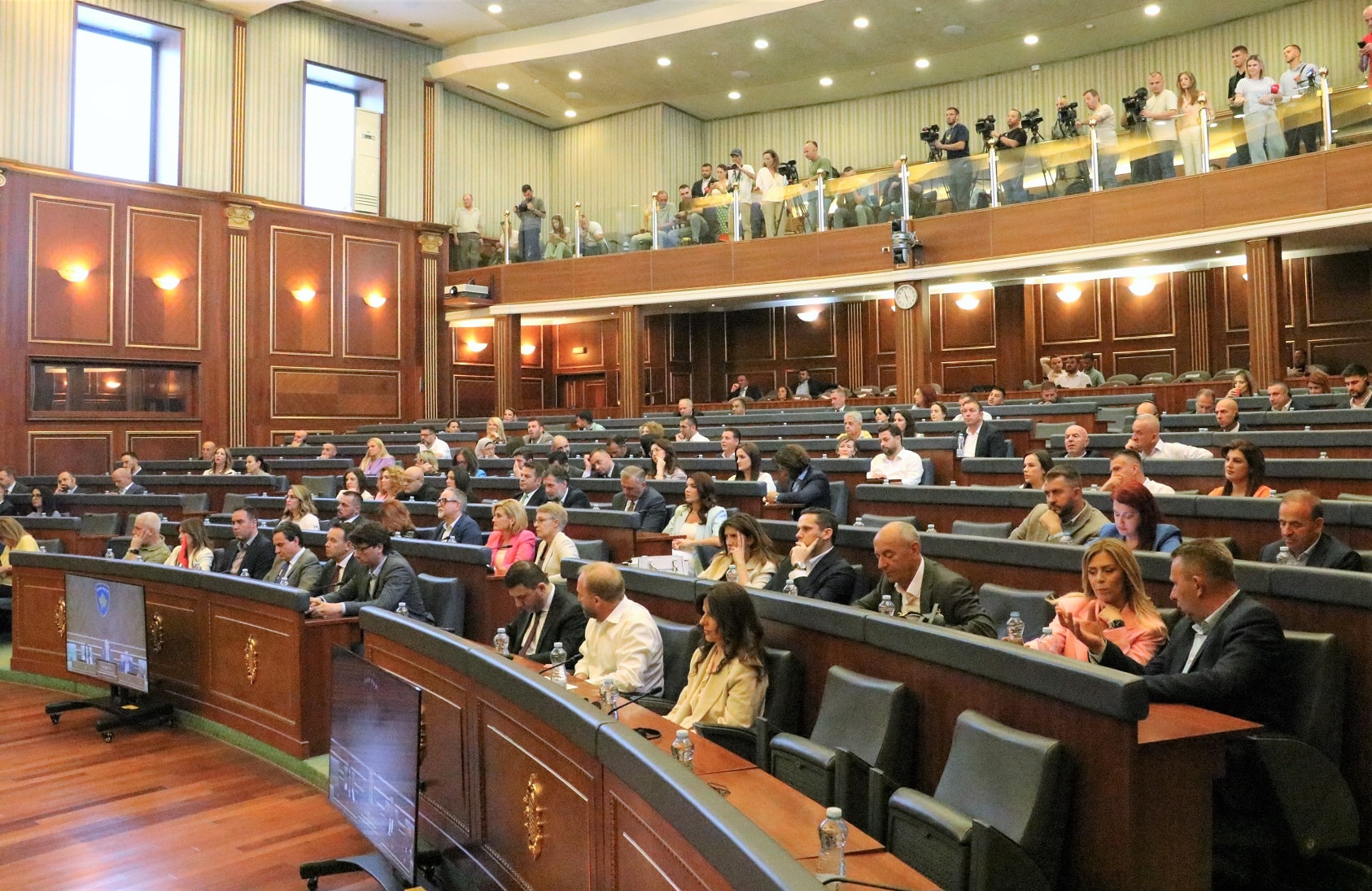
Kosovo, even five months after the parliamentary elections of February 9, has not formed new institutions. The political parties represented in the Kosovo Assembly are in no way agreeing on the election of the legislative bodies, which is the precondition for forming the government.
On Saturday, the Assembly failed for the 42nd time to constitute itself. Meanwhile, the Constitutional Court ruled on June 26 that MPs must complete the constitution of the 9th legislature by July 26 but did not specify whether failure to do so would automatically lead to new elections.
Mimoza Kusari-Lila, leader of Alternativa and an MP from Vetëvendosje, told KosovaPress that if the legislative bodies are elected — a precondition to resolving the crisis —, then the Kurti III government, according to her, will be formed, as the numbers for a simple majority exist.
However, she did not specify which other MPs would support the government, unlike the election of Albulena Haxhiu for Speaker of the Assembly, who in six votes received the support of only 57 MPs.
“In the current circumstances, I believe the formation of the Kurti III government is the likely outcome — not the dissolution of the Assembly. However, if the situation continues… As for the executive, the numbers for the Kurti III government are and it is possible to form a government with a new mandate. It remains to be seen, but this procedure for the constitution of the Assembly must be overcome, which has been unnecessarily prolonged, to the detriment of the citizens and other stalled processes. We can’t force MPs to vote, even though it is their obligation to vote”, said Kusari-Lila.
Meanwhile, Ferat Shala, an MP from the Democratic Party of Kosovo (PDK), told KosovaPress that early elections are not in the country’s interest; however, he adds that if there is no unblocking of the political crisis, the PDK is fully prepared for elections.
“Elections are not suitable for Kosovo’s economy or for its political and strategic situation. But the Democratic Party of Kosovo is ready in any situation — more mobilized and prepared than ever before,” he said.
Categorically against new extraordinary elections after those of February 9 is the Deputy Chairman of the LDK, MP Lutfi Haziri.
He told KosovaPress that he would not support the dissolution of the Assembly, arguing that Kosovo cannot afford to hold elections every three months.
“I won’t vote for dissolution. Kosovo doesn’t have the luxury to go to elections every time political leaders, in this case, the leader of the winning party, push hidden political agendas. I don’t believe there are any reasonable MPs with a legitimate mandate, except for a few who entered with manipulated and stolen votes. Others will not accept to enter into such arrangements. Kosovo is not very rich to spend around seven million euros on elections every three months,” Haziri emphasizes.
However, political analyst, Dritëro Arifi, told KosovaPress, that new elections are inevitable due to the entrenched positions of political parties, especially following the Constitutional Court’s decision.
“New elections are inevitable due to the current deadlock and especially the position of the leading party. It should be emphasized that the greatest responsibility lies solely with the leading party, both in political terms and in constitutional and legal terms. They should offer a solution, but they’ve shown they are incapable of doing so. If the prime minister-designate cannot even secure the election of an Assembly Speaker, imagine handling more complex issues. I think the elections will not change much, but they will provide an easier breath”, he said.
The Vetëvendosje-Guxo-Alternativa coalition, having won the most votes in the election, holds the right to propose the Speaker of the Assembly, but their proposed candidate, Albulena Haxhiu, in six cases in open voting, has not received the 61 votes necessary to take this position. As a result of this, the chairman of the constitutive session, the MP of this party, Avni Dehari, has decided that the election of the Speaker of the Assembly will be held by secret ballot.
This is not being accepted by the parties that were in opposition until now, saying that the agenda of the constitutive session, which foresees open voting, was voted on by the old presidency of the Assembly and Dehari has no right to change it.
These parties are also refusing to vote for the formation of the verification committee, claiming it is unconstitutional. /E.Zeqiri/