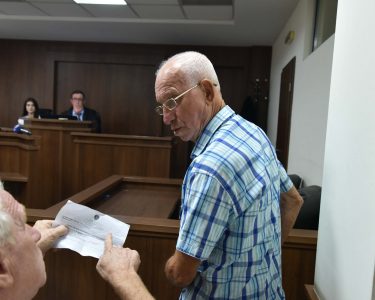

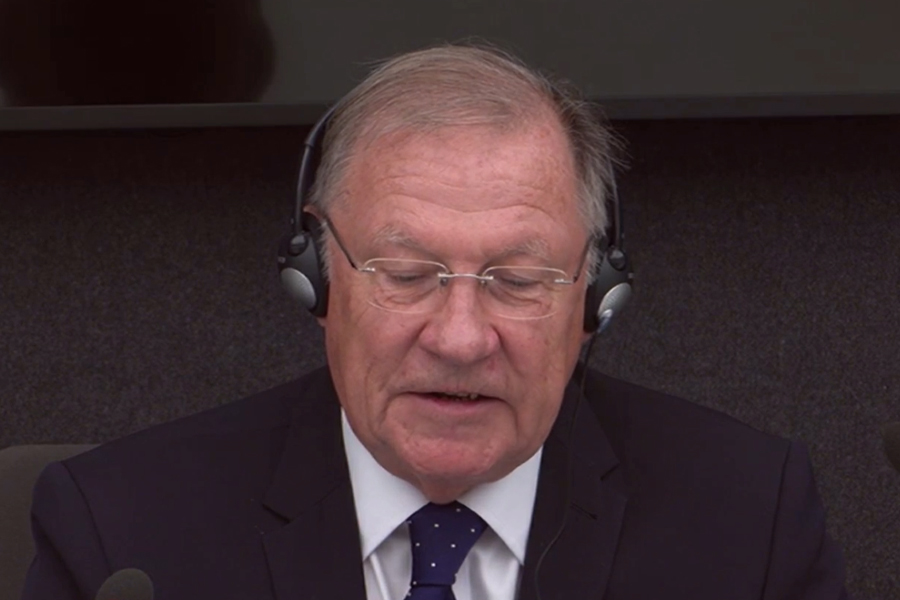
John Stewart Duncan, the third defense witness for former president Hashim Thaçi, said on Monday before the Kosovo Specialist Chambers that he had never seen Thaçi give orders.
Responding to questions from Thaçi’s defense team on the first day of his testimony in The Hague, he said that Thaçi was viewed as a politician, not as a KLA commander.
“I never saw him give directives or orders. It was clear that we were dealing with two types of people. First, there was the military man or senior officer, and second, there was the politician. That was the impression I had.”
He answered “no” when asked whether Thaçi was the supreme commander or commander-in-chief of the KLA.
Defense: Do you think that in reality Hashim Thaçi was the commander-in-chief of the KLA?
Duncan: No, because I have not seen any evidence, no proof of that.
Defense: If he had been in such a position, what evidence would you have seen? Perhaps my question is: who is a person, what duties does a person have who is commander-in-chief?
Duncan: The definitions have been given, but they are not definitions recognized or accepted by people like me. A commander-in-chief is mainly associated with command and control. Command is about the right to issue orders and directives, while control is the ability to exercise that command and to ensure that orders and directives are effectively carried out.
“The way they behaved with him [Thaçi] during negotiations was such that they treated him as the political wing, with a certain authority, but not as someone they had military respect for—it was very obvious. They respected General Çeku because he was a professional military officer, and they saw him as such. But when Hashim Thaçi arrived, there was a kind of tension, the typical tension that arises when a politician is present in discussions involving military officers. I think they saw Thaçi as an important politician for their cause but not as a military commander, and that was my impression based on how they behaved toward him,” he said.
The former political adviser to General Wesley Clark stressed that in wartime, inflated titles are often given that do not reflect reality.“In my opinion, this was an inflated title. From my personal experience, I recall that in African revolutionary movements, where I grew up, guerrillas were given titles such as generals. Even in France, where I lived for several years, resistance leaders would say this is battalion X or Y, but in reality, it wasn’t a battalion at all. There was a tendency to exaggerate titles. So, I didn’t take it seriously and wasn’t surprised at all. I don’t know, maybe it comes from the American model where the president has the title of commander-in-chief. But in reality, the situation was different. In my view, it was an exaggeration, an inflation—a grandiose title with a big name given to someone, but it didn’t correspond to reality,” he said.