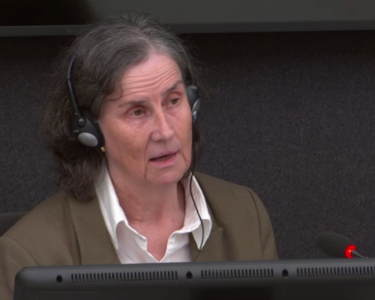
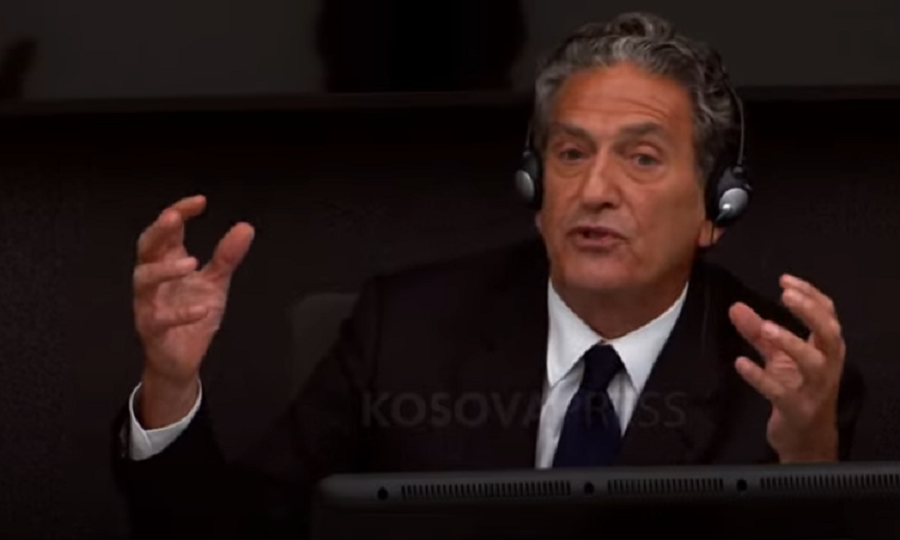
At the Kosovo Specialist Chambers in The Hague, James Rubin, who served as U.S. Assistant Secretary of State during the Kosovo War, is testifying in defense of former Kosovo President Hashim Thaçi. He is accompanied in court by two U.S. representatives. Rubin told the court that from 1997 to 2000, he served as Assistant Secretary of State for Public Affairs and as the chief spokesperson, reporting directly to Secretary of State Madeleine Albright. During his involvement in the Rambouillet Conference, Rubin said he met several times with Thaçi, who expressed concern that he would not have full authority or permission to sign the Rambouillet Agreement.
During his testimony, Rubin is accompanied by two U.S. representatives.
The defense has allocated four hours for his testimony, four hours for the Office of the Specialist Prosecutor, and three and a half hours for other parties.
At the start of the witness hearing, Thaçi’s lawyer, Luka Misetić, said Rubin reported directly to Secretary of State Madeleine Albright.
“From 1997 to 2000, James Rubin served as Assistant Secretary of State for Public Affairs and as the chief spokesperson reporting directly to Secretary of State Madeleine Albright. When the Contact Group decided to convene for a peace process in January 1999, Mr. Rubin was instructed directly by Ms. Albright to engage with the Kosovo Albanian delegation during the Rambouillet Conference in Kosovo, and later joined the negotiations as a special envoy on behalf of the Secretary of State to ensure the demobilization of the KLA. In this context, Mr. Rubin had numerous meetings with Hashim Thaçi and other KLA members, which allowed Mr. Rubin to understand that Mr. Thaçi was concerned that he would not have the authority or full permission to sign the Rambouillet Agreement on behalf of the KLA, without approval from the military aspect of the KLA,” he said.
Furthermore, the defense said that during the negotiations leading to the signing of the agreement, Rubin “noticed that Thaçi’s role was limited because he was not involved in technical discussions.”
“Mr. Rubin noticed that Mr. Thaçi’s role was limited because he was not engaged in technical discussions. He also noted that Mr. Thaçi personally expressed from the start that he wished to secure a future democratic, free Kosovo, without interethnic violence, functioning under Western democratic values to the greatest extent possible,” he added.
The first defense witness, James Rubin, said he worked for U.S. Senator Joseph Biden from 1989 to 1993. During this period, he said he also met leaders of Kosovo, including President Ibrahim Rugova.
Misetić: Did you have the opportunity during these trips to meet with Kosovo leaders?
Rubin: Yes. During the wars at that time, first in Croatia and Serbia and then in Bosnia, these were the focus of those trips, meaning the respective countries. However, being aware that such conflicts could spread further, we understood that what was happening in Kosovo was also very important. So I believe I visited Pristina at that time, two or three times. During that period, I met at least once or twice with Ibrahim Rugova. I also met other Albanians from Kosovo, and other influential persons in Kosovo at that time,” they said.
In questions from former President Hashim Thaçi’s lawyer, witness Rubin explained whether he was involved in the establishment of the United Nations International Criminal Tribunal.
Misetić: Were you involved in the creation or establishment of the ICTY, the UN International Criminal Tribunal for the former Yugoslavia in 1993?
Rubin: Yes. Madeleine Albright, former U.S. ambassador, together with the United Nations and one of her advisers, David Scheffer, was a very strong advocate for the creation of that tribunal. I personally worked closely, very closely, with David. Madeleine Albright was very proud, and consequently, I was very proud to have contributed my modest help to the creation of this first tribunal of its kind for the former Yugoslavia. I believe it took some time for the institution of the tribunal to be established. We started in 1993 or 1994, I don’t remember the exact year, but I remember we called it the “mother of the tribunal,”* he added.
James Rubin, the first witness for Thaçi’s defense, also explained when he last met the former president.
“He had passed from being a young man working under difficult circumstances to suddenly becoming prime minister. So several years had passed, four or five years if I remember correctly. This happened in a restaurant in New York, the first time. I believe the last time must have been around 2018 when I was working in Washington and he was the President of Kosovo at the time.”
Misetić: Why did you meet this time?
Rubin: I left London in 2018, and I may have met him in 2019, actually. In 2018, I returned to Washington to work for a well-known lobbying firm, and when I returned there, I had a contract with the Kosovo Government to arrive there. When the partners realized I knew the situation very well, they thought it made sense for me to work with him regarding this contract. This contract involved representing him in efforts to make peace with Serbia. We worked closely during that period to try to end the conflict and bring final peace between Kosovo and Serbia. I was very happy to see him,” Rubin added during his testimony in The Hague.
James Rubin is the first witness for Thaçi’s defense, which plans to call about 11 witnesses in court.
Afterwards, the trial will continue with witnesses summoned by the defense of former Kosovo Assembly Chairman Jakup Krasniqi.
Along with Thaçi and Krasniqi, former Assembly Chairman Kadri Veseli and former MP Rexhep Selimi are also on trial. Their lawyers do not plan to present defense witnesses. The Specialist Prosecutor’s Office has charged them with alleged war crimes, claiming they were part of a “joint criminal enterprise.”
Thaçi, Veseli, Krasniqi, and Selimi have pleaded not guilty to all charges.
The defense’s submission of evidence comes four months after the Specialist Prosecutor’s Office concluded with its witnesses and closed its case. The prosecution had called 125 witnesses in court and relied on over 130 written statements.
The defense of the four former KLA leaders denies the charges and has argued that the KLA did not have an organized command structure.
The indictment against the former KLA leaders was made public in the fall of 2020. Since then, they have been held at the detention center in Scheveningen, The Hague. The trial against them began in April 2023.
Judges at the Specialist Chambers expect the defense of the former KLA leaders to submit their final written submissions by December 22 of this year.