
The way media in Kosovo report on dealing with the past remains one of the biggest challenges for journalism, despite the large number of stories published. The lack of specialized journalists, superficial reporting, lack of context, and dominance of one-sided narratives were among the main topics discussed during the presentation of a paper on the role of media in transitional justice.
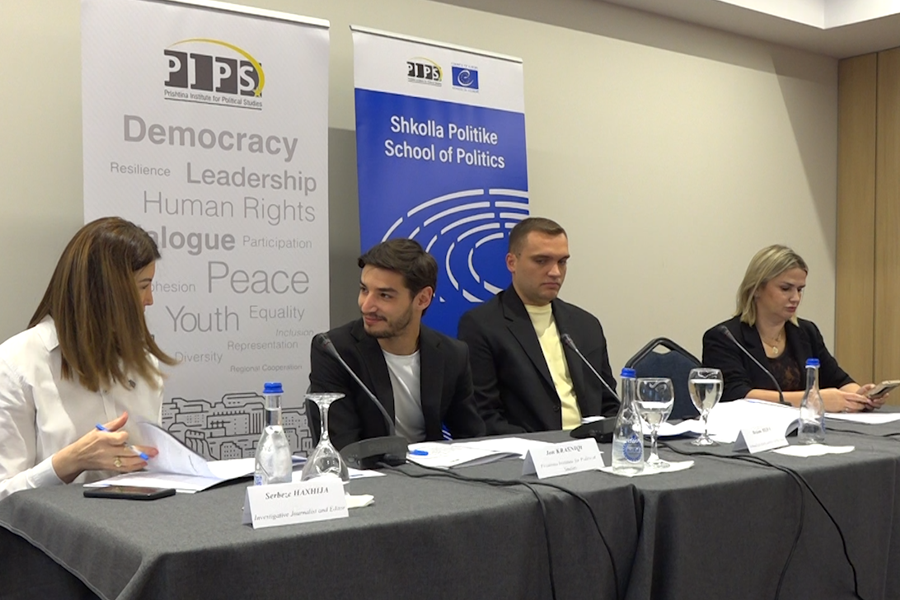
The author of the paper, journalist Besian Beha, said during the roundtable titled “Responsible Reporting on Dealing with the Past and the Challenges of Media in Kosovo,” organized by the Prishtina Institute for Political Studies, that the responsibility of media is much greater when covering sensitive issues such as war crimes, victims, and missing persons. He also raised concerns over the lack of official data, which he said makes professional reporting more difficult.
“The state does not have a concrete database with information on how many people were killed in the last conflict and how many remain missing. All of this data is provided by civil society. Of course, an important effort has been made by the Institute for War Crimes, which is currently working on creating such a database, because it may sound as if media have no responsibility. In many cases, I mention for example that when reporting on the consequences of the 1998-99 conflict, the focus is only on Albanians, while there have been extremely few stories about victims from other communities, including Roma, Ashkali, Egyptian, and Serb communities. Media have also not done enough to influence how communities in Kosovo are perceived. For example, when speaking with people, there is often a prejudice that Roma, Ashkali, and Egyptian communities supported the regime or the occupier. Media have not shown that there were Roma, Serbs, and Ashkali who were civilian victims, but also members of the KLA,” Beha said.
Investigative journalist Serbeze Haxhiaj said that reporting on the war in Kosovo is dominated by political and nationalist narratives, which, according to her, has impoverished journalism.
Haxhiaj said that Serbia, by denying crimes and pursuing policies aimed at undermining Kosovo’s statehood, is also maintaining a highly nationalist discourse in Kosovo, and that media have become “armed” with this discourse.
“In fact, it is a deeply rooted narrative that is often profoundly political and nationalist, and it is becoming increasingly stronger because the entire public debate in Kosovo is shaped by a kind of imitation of Serbia, or by the way Serbia influences us. By denying crimes and pursuing a policy of undermining Kosovo’s statehood, Serbia is also keeping the political discourse in Kosovo highly nationalist, and consequently the media are also influenced by this discourse. This has created a comfort zone for media in Kosovo. What is reported in Kosovo is often based on repeated themes: criticizing the Specialist Chambers, discussing who was the victim and who was the aggressor, which is relatively clear given the NATO intervention in Kosovo. However, what we see in Kosovo media is reporting that is often confused and deeply political, as the war has become a subject used for political gain. We have had two types of narratives about the war: narratives of merit related to the KLA and armed resistance, as well as peaceful resistance. A very comfortable discourse has been created around the war, victims, and the Specialist Chambers,” she said, KosovaPress reports.
Meanwhile, Blerta Dalloshi from the Association of Journalists of Kosovo said that specialized training programs for journalists covering transitional justice have already begun.
She called for universities to include more content related to reporting on the past in their curricula.