Kosova is entering a new stage of development, where securing financing alone is no longer sufficient; what becomes decisive is the ability to turn it into concrete projects that improve citizens’ lives.
With nearly €400 million in investments across key sectors such as energy, transport, and business support, the European Investment Bank (EIB) is becoming one of the country’s main development partners. However, according to the EIB, the real challenge remains the preparation of high-quality projects, strengthening institutions, and creating a predictable environment for investors.
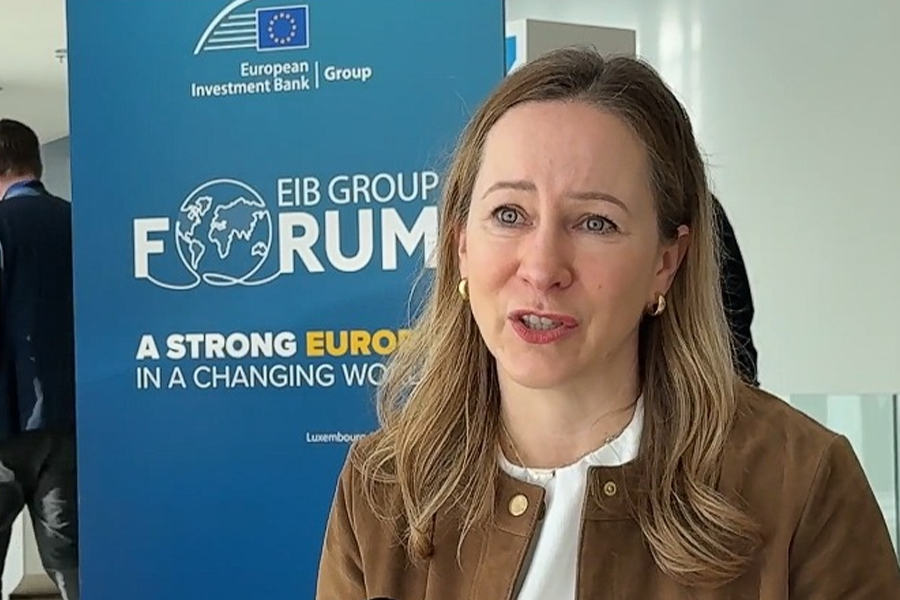
In an interview for KosovaPress, Kristina Kanapinskaite, Head of Division at the EIB for the Western Balkans and Turkey, speaks about the challenges, priorities, and concrete opportunities for Kosovo at this crucial stage of development.
From building new clean energy capacities and modernising railways, to supporting hundreds of small enterprises and thousands of jobs, Kosovo has real opportunities for faster and more sustainable development — but this requires a higher pace of reforms and more efficient implementation on the ground.
In particular, for Kosovo, the EIB sees the greatest potential in the energy transition and sustainable development, where concrete projects are already taking shape. The construction of one of the country’s largest solar plants and the expansion of district heating in Pristina are expected to directly reduce pollution and increase energy security.
At the same time, investments in railways, digitalisation, and support for around 690 small enterprises with tens of millions of euros in financing show an integrated approach aimed not only at economic development, but also at improving quality of life and creating new jobs in the country.
The full written interview can be read below:
KosovaPress: What is the main message you aim to convey at this year’s Kosovo Financial Forum? What is the importance of capital mobilization for sustainable growth in the region, and what are the main challenges?
Kristina Kanapinskaite: Financing instruments and EU alignment frameworks are increasingly in place, but success now largely depends on the region’s capacity to prepare, procure and deliver complex, sustainable projects in line with EU standards. This makes institutional strength and implementation capacity as important as access to funding. In this context, institutional reforms are crucial for the Western Balkans. Through strong institutions, good governance, and transparent and predictable legal and economic systems, reforms help attract investment and support sustainable growth.
Key obstacles remain for some projects such as missing feasibility studies, solid cost–benefit analyses, and well‑developed procurement and permitting frameworks. At the same time, investors need regulatory predictability, particularly in permitting, public procurement and regulation. Simplification, digitalisation and transparency are essential to reduce delays. Finally, fiscal constraints and business readiness also matter. Limited fiscal space can restrict governments’ ability to borrow or provide guarantees delaying investments in sustainable infrastructure, a backbone for the economies.
KosovaPress: What are the main projects that the EIB has financed in Kosovo so far, and what concrete impact have they had? In which sectors do you see the greatest potential for new investments in Kosovo?
Kristina Kanapinskaite: The European Investment Bank is the EU’s bank, owned by its 27 Member States and one of the biggest multilateral financial institutions in the world. In the Western Balkans region, we operate through our dedicated arm for activities outside the EU – EIB Global to provide favourable financing and technical assistance for key infrastructure projects and support for small and medium-sized enterprises (SMEs). As a long‑term partner for *Kosovo’s development, we have enabled 10 projects in Kosovo, with total investments approaching €400 million. These funds are helping modernise transport, improve energy security, water supply and sanitation services, and strengthen small business and job creation.
One of the priorities going forward will remain energy transition and more secure supply. We are financing a major renewable energy project, while preparing an important energy efficiency project. Investing in people is equally critical. We work with the authorities to identify priority investments in education and healthcare, including modernising higher education facilities and financing medical equipment for public hospitals. These projects improve public services today while strengthening productivity and social resilience for the future.
Climate resilience and environmental protection are growing investment priorities. Under the Western Balkans Investment Framework, we support Kosovo in strengthening flood‑risk management across all river basins, in line with EU legislation, with the next phase focused on building flood protection infrastructure. At the city level, Gjilan and Ferizaj are receiving EIB advisory support to develop modern recycling and waste‑treatment solutions, reducing landfill use and improving environmental standards.
Finally, transport and digital connectivity offer strong potential for future investment. Our support for rail modernisation and digital feasibility studies is improving regional connectivity, encouraging a shift from road to rail and laying the groundwork for faster broadband and secure data infrastructure.
KosovaPress: How is the EIB supporting small and medium-sized enterprises (SMEs) in Kosovo and the region? Do you plan new financial instruments to facilitate SMEs’ access to financing? How can entrepreneurship and innovation be accelerated in Kosovo?
Kristina Kanapinskaite: Supporting SMEs is central to EIB Global’s role in Kosovo and across the region, as small businesses drive innovation, exports and job creation. Despite progress, many SMEs here and in the region are still looking to advance in terms of digitalisation, energy efficiency and decarbonisation, which can affect their competitiveness. At the same time, Kosovo’s innovation scene is dynamic and growing, with young, emerging start‑ups and increasing interest in green and digital solutions. Yet access to long‑term, affordable finance remains a key bottleneck.
The EIB Group addresses this gap through targeted financial instruments delivered via local banks and investment partners. In this way, we enable SMEs to access favorable financing for investing in innovation, modernisation and energy efficiency, boosting competitiveness while creating quality jobs. Through the European Investment Fund, part of the EIB Group, we are unlocking nearly €40 million in new lending for around 690 small businesses and supporting some 9,500 jobs in Kosovo, under the EU’s Guarantees for SME Resilience Initiative. This reduces risks for banks and translates directly into better loan conditions for companies.
Looking ahead, our new Innovation and Green Transformation Facility will continue serving companies in the region. It combines a €170 million EIB loan channeled through commercial banks, a €17 million EU grant supporting SMEs investing in research, innovation and green sectors, as well as €5.8 million in technical assistance. This blended approach ensures that financing reaches innovative companies where it is most needed, while also strengthening the broader SME and start‑up ecosystem.
To accelerate entrepreneurship and innovation in Kosovo, finance must go hand‑in‑hand with skills, digitalisation and climate‑smart investment. By combining funding, guarantees and advisory support, we help SMEs to scale up, integrate into EU value chains and turn innovation into sustainable growth.
KosovaPress: What are the EIB’s priorities for the energy transition in the Western Balkans? How does the EIB support the green transition in Kosovo, and which concrete projects are in focus? How can the transition to renewable energy in Kosovo be accelerated
Kristina Kanapinskaite: The energy transition is one of the EIB’s top priorities in the Western Balkans, and it is particularly urgent for Kosovo that is currently reliant on coal, while facing rising demand, ageing infrastructure and growing exposure to price and supply shocks. Accelerating the shift to renewables, improving energy efficiency and modernising grids are therefore essential not only for climate goals, but also for energy security and competitiveness. Investment must also be paired with reforms and project readiness. Clear permitting processes, predictable regulation and strong institutions are essential to attract private capital and scale up renewables.
Our flagship project is the construction of one of Kosovo’s largest solar photovoltaic plants near Pristina. Once operational, it is expected to generate around 170 GWh of electricity per year and reduce CO₂ emissions by over 170,000 tonnes annually. The project also benefits from a €32 million EU grant, making clean energy affordable and bankable. We are also advancing energy efficiency and cleaner heating solutions. The planned expansion of Pristina’s district heating network will connect both new and older buildings to clean, reliable and affordable heating, without increasing fuel consumption. By replacing polluting individual heating systems, the project will significantly reduce air pollution and ensure full alignment with EU standards, while strengthening economic resilience.
KosovaPress: What are the EIB’s plans for investments in the transport sector in Kosovo and the region? How can these investments contribute to regional and European economic integration?
Kristina Kanapinskaite: Transport is a cornerstone of the EU’s investment strategy in the Western Balkans because it directly enables regional and European economic integration. In Kosovo, EIB extended €80 million to modernise 148 km of Rail Route 10, a key international corridor linking it with neighbouring markets and the wider Trans‑European Transport Network (TEN‑T). The upgrade will result in increase in speed, boost passenger and freight capacity and encourage a shift from road to rail, making transport greener, safer and more efficient.
This investment is part of a broader, coordinated regional approach. Through EIB Global, we are financing strategic rail, road and waterway links across the Western Balkans. Together, these projects remove cross‑border bottlenecks, improve logistics chains and reduce transport costs, helping businesses integrate into regional and EU value chains. By building EU‑standard connections on the ground, our investments help turn political integration into practical economic opportunity.
KosovaPress: Given that Kosovo is the host of the Mediterranean Games Prishtina 2030, is there a possibility of financing sports infrastructure (e.g. the national stadium), and in what form?
Kristina Kanapinskaite: In April 2025, EIB Global approved a €500,000 grant to support the preparation of the reconstruction, conservation and restoration of the Palace of Youth and Sports in Prishtina. The grant provides technical assistance to ensure the project meets the highest EU technical, environmental and social standards, while preserving the building’s cultural heritage.
The project aims to transform the site into a modern, multifunctional facility that will serve the community and act as a key competition and training venue for the XXI Mediterranean Games in Prishtina in 2030, contributing to sustainable urban development and improved cultural and sports infrastructure in Kosovo.
We will be looking forward to seeing the Games in the state-of-the-art Palace of Youth and Sports.
KosovaPress: How does the EIB contribute to bringing Kosovo closer to the European Union? How important is the alignment of Kosovo’s projects with EU standards in order to benefit more from financing?
Kristina Kanapinskaite: Bringing Kosovo closer to the EU starts with aligning investments , institutions and reforms with EU standards and this is where EIB Global plays a central role. For every project we finance, we apply EU environmental, climate, social and governance standards from appraisal phase throughout implementation. This ensures investments deliver long‑term value for people, while preparing Kosovo to operate fully within the EU regulatory and policy framework. This alignment is not merely a formality, but a gateway to better living standards. Projects that meet EU requirements are more transparent, attracting both public and private capital. A strong reform agenda, covering governance, public administration and procurement are equally essential.
KosovaPress: How does the EIB measure the impact of its investments on the economy and citizens’ lives?
Kristina Kanapinskaite: We measure the impact of our investments through a result‑based framework. Expected outcomes, such as improved healthcare services, safer transport, new jobs, cleaner environment, CO2 savings, amongst others, are clearly defined and tracked through contractual indicators. For railway projects, for example, we assess tangible impacts such as increased passenger and freight capacity, reduced travel time, improved safety, energy efficiency gains, emissions reductions and economic or trade impact to local populations.
Employment effects are another key dimension of impact. Large construction projects typically generate both temporary employment during implementation, as well as permanent jobs. When it comes to SMEs, the analysis done by the EIB Economics Department show that on average, every €1 million of our lending to companies in the Western Balkans is associated with the creation of some 15 jobs, while firms report an increase in total assets of 20%.
KosovaPress: What message would you give to institutions and businesses in Kosovo to better benefit from EIB support and attract investment?
Kristina Kanapinskaite: My key message to the institutions and businesses in Kosovo is to continue investing in sustainable projects being it in the sphere of infrastructure, manufacturing or services – sustainability, innovation and strong institutions are key pillars for economic growth. Kosovo has made solid progress in strengthening its market economy and maintaining macroeconomic stability, but the next phase requires accelerating reforms and investment readiness to respond to new challenges. To fully benefit from EU support and attract private investment, predictability, project maturity and implementation capacity are key. Clear regulatory frameworks, transparent procurement, timely permitting and well‑prepared projects significantly reduce risk and unlock financing.
As the EU bank, EIB Global stands ready to support Kosovo with both financing and technical expertise, particularly in the green transition, digital connectivity and human capital development.