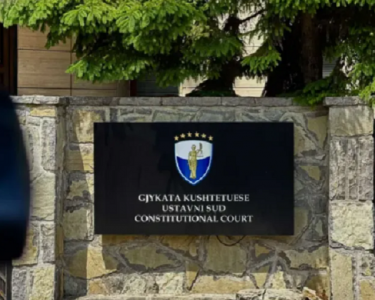

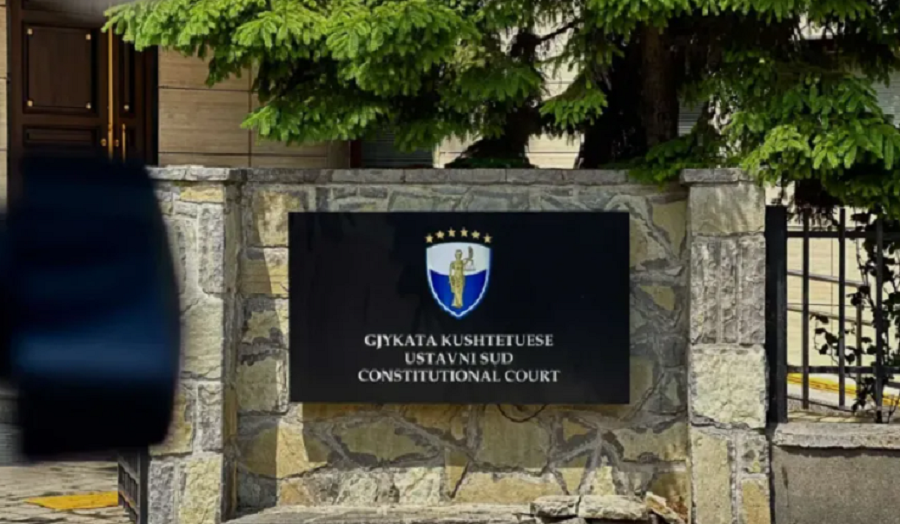
Three days before the expiration of the temporary measure, the Constitutional Court is still reviewing the requests concerning the constitution of the Assembly. The highest legal institution in the country has stated that, before publishing its ruling, it will address all constitutional aspects of the claims rose in the submitted requests, reports KosovaPress.
While the Court is expected to be clear and precise in its upcoming decision to avoid any ambiguity, legal experts have presented possible scenarios regarding how the Court may resolve the deadlock in the Assembly.
Kosovo has yet to establish new institutions, despite holding parliamentary elections on February 9.
The Constitutional Court imposed a temporary measure halting the constitutive session, prohibiting MPs from making decisions or taking actions from July 27 to August 8, when the full ruling on the deadlock in the Assembly will be announced.
This measure was imposed ex officio, even though it was not requested in the submission by PDK and LDK MPs, who challenged the constitutionality of holding the constitutive session after June 26, when the Court’s first decision was published.
Despite the Court obliging MPs to constitute the ninth legislature within 30 days, this had not happened by July 26. To address the legal consequences, President Vjosa Osmani also submitted a request to the Constitutional Court.
The spokesperson for the Constitutional Court, Veton Dula, told KosovaPress that all parties and the public will be informed in due time about the Court’s decision regarding these requests.
“The latest requests regarding the constitution of the Assembly of the Republic of Kosovo are currently under review by the Court. A decision will be made once the Court has addressed all constitutional aspects of the claims raised in the submitted requests. All interested parties and the public will be notified in due time about the Court’s decision,” his response states.
Researcher at the Kosovo Democratic Institute, Vullnet Bugaqku, told KosovaPress that the Constitutional Court must first determine whether the procedure carried out in the constitutive session after June 26 was in accordance with the Constitution.
According to him, if it is determined that the chairman of the constitutive session, Avni Dehari, violated the Constitution by insisting on a secret vote for electing the Speaker, then one possible outcome could be for the Court to rule that the 30-day deadline was not exhausted, resetting the process to the moment of an open vote.
In addition, he said that one possible scenario is for the Court to rule that the right of the first party in elections to nominate the Speaker is not absolute, permanent, and without limits, but that it must be exercised under certain criteria to prevent the Assembly’s constitution from being blocked.
Based on these parameters, Bugaqku noted that the right to propose the Speaker could be transferred to other parliamentary groups to find a candidate who can secure 61 votes.
However, in 2014, the Constitutional Court ruled that the first party in parliamentary elections has the right to propose a candidate for Speaker.
On the other hand, political analyst Artan Muhaxhiri told KosovaPress that the Constitutional Court has a vital obligation to issue a clear and precise ruling, leaving no room for misinterpretation or distortion, as happened with the first decision on June 26.
According to him, the Court’s latest ruling included general and euphoric statements, lacking clarity.
Since the constitutive session began on April 15, MPs have failed 54 times to elect the legislative bodies of the Assembly.
The process has stalled at the election of the Speaker, for which VV, in coalition with Guxo, and Alternativa, has nominated MP Albulena Haxhiu. However, she failed to secure the necessary 61 votes in six open votes, while in 48 attempts there was no quorum to proceed with forming a verification committee for a secret vote for Speaker. /E.Zeqiri