

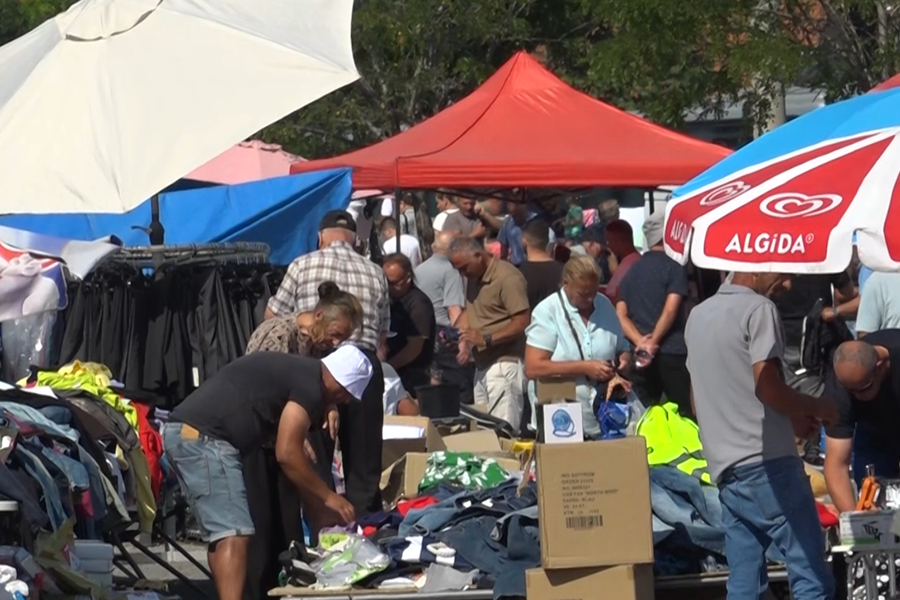
Mostly used clothes and footwear.
Old technology is also on display.
This is how the Tuesday market in Bresje of Fushë Kosovë looks like. The only fresh things here are the fruits and vegetables, as well as the buildings that are being constructed every day.
However, this neighborhood has something very old: the symbol of coexistence between citizens of different ethnicities.
Precisely for this reason, sellers from the area and from other places gather here.
“Yes, yes, we get along well, we get along well. We have no problems, no troubles, nothing. No, no, there are no problems, no, no. We have no problems, no troubles, nothing,” he said.
These sellers trade second- and third-hand goods – items that are useful for citizens with lower incomes.
Therefore, the profit is not only small, but also not guaranteed.
“I have been coming here for about 7-8 years, but there are no sales, it’s difficult… Sometimes there are sales, sometimes there aren’t… People only take the good items; they don’t take the bad ones, for example. It depends. Sometimes you sell, sometimes you don’t, it depends on the people,” he said.
Among the sellers at the market there are also pensioners, who come out to earn additional income but also to escape the monotony of everyday life.
“Since I retired, this is what I have been doing. There is a little work, sometimes there is, sometimes there isn’t… Yes, yes, people come, but they look for cheaper prices, I don’t know what else to say except that they almost want things for free… I have all kinds of good items, the things my daughter brings me to sell… She is married and lives in North Macedonia, and she says that she sells them better there than when she throws them away,” he said.
At his age, a large part of his money also goes toward buying medicine.
“I have my pension… If it wasn’t for these things, I wouldn’t be able to make ends meet because I have expensive medication. These diabetes medicines alone cost 28 euros, and I have to buy them. That is what is exhausting me the most,” he said.
However, the interethnic harmony offers him peace of mind.
“Good, good, good. We have no problems whatsoever,” he said.
For Faton Tahiri as well, selling shoes is his main source of income.
Although, as a city, they face common problems, and as traders they struggle with unsatisfactory sales, the friendly atmosphere at the market helps overcome all of life’s difficulties.
“I only sell shoes, mostly sneakers. They come to us from abroad. They all come from Germany… There is work; I sell both wholesale and retail. All the traders know me… We are residents of Neighborhood 29 in Fushë Kosovë, but we get along well. No, we have no problems. We get along well. We live together well,” he said.
The same spirit of coexistence is being carried beyond the market, into the institutions of Fushë Kosovë.
Communities are taking an increasingly greater role in local institutions, and according to the Deputy Mayor for Communities, Gëzim Gara, their inclusion in the administration and public services has already increased.
“We now also have employees from the community in the municipality, which we did not have before. The community now has qualified people; we have educated young men and women. We are expecting more employment opportunities in the future, and the mayor supports the community… We have one in the ambulance, we have hired a nurse for the first time, and also in the municipality. Over time, we are directly expecting good and major projects that will come for the community,” Gara said.
Fushë Kosovë, a town that due to its proximity to Prishtina has, over the past two decades, turned into a construction site and a place of population growth from all parts of Kosovo, continues to preserve its multiethnic character.
Uglare is a neighborhood where the Serbian population is present in significant numbers.
Ivan Bojko, a member of this community, has spent three decades working alongside Albanians.
“As far as our neighbors are concerned, we get along very well with them. Here, my neighbors are an example. Moreover, I worked with Albanians for 30 years. I never had any problem with them. We worked together, we lived together,” Bojko said.
He has a simple motto when it comes to relations with people.
“We live like all normal people. You know very well that there are good people and bad people. For me, it is like that, and that is how I see things,” he said.
Uglare is the village that connects Fushë Kosovë with Graçanica, another multiethnic municipality in the heart of Kosovo.
The village of Shushicë represents a miniature example of this coexistence.
At its entrance, there is a small market that has become a meeting point for residents from different communities.
On its shelves, Serbian and Albanian residents of the village find their daily supplies, but beyond bread, food, and basic necessities, this place carries a much greater story – that of everyday encounters between people.
Precisely there, among ordinary shoppers and brief conversations, a part of Shushicë’s reality can be seen – a village where neighborly relations are often stronger than differences.
“This village is remembered because, until now, there have been no incidents of any kind. It is a place where people lived best, where Serbs and Albanians did not ask who was what, but helped one another. Even today, we continue to live well here. My father was born here, and I was born here as well. So, it has been 100 years that we have lived here, even more than 100 years. We came here from Shtërpcë, from Brezovica up there, and moved here,” he explains.
For him, this is not only a memory of the past. It is also the daily reality of people who still meet, work, and live together in the same space.
“Until now, there was an Albanian man here, Gafur, who comes here. He used to be a police officer, and he would stay here, drink a beer; he is also a pensioner like me. And he… Arben comes here every day… Otherwise, this is the only shop in the village that operates, and Albanians also come here, young people come and buy everything,” he said.
In this village, where many residents have left over the years, relations between those who remain continue to be maintained through small things – a greeting, shared work, or buying supplies from the village’s only market.
“Good, good, generally good… We deal with agriculture and other things… Yes, sometimes we go out together… We work with them in agriculture, as you can see. We work the land, we cultivate these fields and other things,” he said.
The continued communication over the years between neighbors from different communities is also highlighted by the village’s Deputy Head, Jeton Krasniqi.
“Personally, because I also speak Serbian well, they call me when they need to go to Prishtina or somewhere else. In fact, just yesterday I was with a Serb here, a waiter. He had some kind of complaint about some colleagues… I have been here since 2006 and I visit Gracanica; I have not had any problems. They have accepted me into their circle, and I have not had any problems… Older generations do communicate when they meet on the street… or in the fields while working the land,” he said.
Alongside these contacts between residents, institutional initiatives aimed at bringing different communities closer together have also been developed in Gracanica.
Serbs, Roma, Ashkali, and Albanians live in this municipality, and Leutrim Ajeti, the Deputy Mayor for Communities, is from the Albanian community. He says that in recent years there has been noticeable improvement in cooperation between them.
“Different communities live here, including Albanians, Serbs, Roma, and Ashkali. I believe that in recent years, especially during the last 10 or 15 years, coexistence has improved, and this can be seen both when we are in institutions and outside institutions, within the town or in the center of the Municipality of Gracanica… When the interest of everyone is at stake, they come together for the benefit of the community or that settlement. We also have one of the restaurants here where Serbs and Albanians work together, and there are also Roma employees. This is a success story for us as residents of this municipality,” he said.
Young people from different communities in Gracanica are seen as a new bridge of cooperation. Through joint activities, they have created opportunities to get to know one another better and overcome barriers that may separate them.
“We have had initiatives where we sent Albanian, Serbian, and Roma young people to different camps. They had a great time, socialized with one another, and talked about the future of the municipality as well as the future of Kosovo in general… I will mention two or three cases that happened. These activities took place around 2023-2024. I was personally present as well; I visited the young people in Prevallë, where camps were organized twice, for two nights, if I am not mistaken, or three days. There was also another activity through hiking… Young people welcomed this, cooperated, and today they know each other, although the language barrier was perhaps an obstacle. However, through English or in other ways, they managed to understand each other and had good experiences,” Ajeti said.
According to the latest population census, Gracanica has more than 18,000 residents, almost double the around 10,000 it had in 2021. The same applies to Fushë Kosovë, where the population has nearly doubled, from 34,800 to 64,000 residents.
As a result, these two municipalities have recorded the largest increase in the number of residents between the two censuses.
