
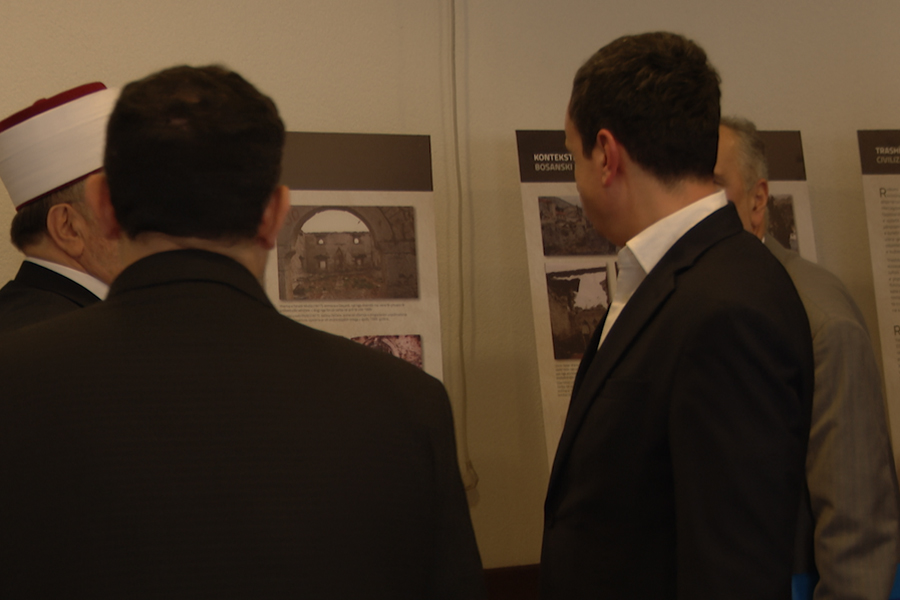
The Islamic Community of Kosovo (BIK) and the Islamic Community of Bosnia and Herzegovina organized the photo exhibition “Memory in Photographs – Mosques Destroyed in Bosnia and Herzegovina and Kosovo During the 1990s – Planned Sacralocide.”
At the exhibition, it was stated that during the most recent war in Kosovo and Bosnia and Herzegovina, a total of 832 mosques were destroyed. Of this number, 218 mosques were destroyed in Kosovo, while 614 were destroyed in Bosnia and Herzegovina.
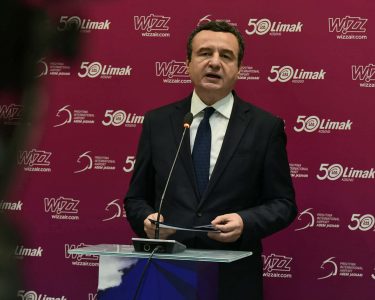
During his address, Acting Prime Minister Albin Kurti said that the deliberate destruction of cultural heritage has been classified as a crime against humanity in the judgments of the Hague Tribunal.
Kurti emphasized that during the period 1998–1999, 1,788 cultural heritage monuments were destroyed, more than 3,700 museum objects were looted, and 175 public libraries were destroyed.
According to him, this exhibition clearly documents the destruction of religious and cultural heritage as part of a strategy aimed at erasing the cultural and historical identity of the Albanian people.
“In the judgments of the Hague Tribunal, the deliberate destruction of cultural heritage during this war has been classified as a crime against humanity. At the end of 2021, the Government of the Republic of Kosovo undertook concrete steps to seek justice for the destruction of cultural heritage monuments. A commission composed of local and international experts officially documented the damages and losses, paving the way for our request for justice and compensation. Based on this report, during the period 1998–1999, 1,788 cultural heritage monuments were destroyed; more than 3,724 museum objects were looted; and 175 public libraries with over 1.7 million books were destroyed… This exhibition, organized by the Islamic Community of Kosovo and Bosnia and Herzegovina, has particular importance because it clearly and convincingly documents the destruction of religious and cultural heritage as part of a deliberate strategy to erase the cultural and historical identity of our people,” Kurti said.
Meanwhile, the Mufti of the Islamic Community of Kosovo, Naim Tërrnava, added that Serbia, in addition to violence, killings, executions, and expulsions, also carried out a broad campaign of destruction of cultural and religious heritage.
According to him, mosques of extraordinary historical, architectural, and identity value were destroyed.
“We are witnesses to what happened both in Bosnia and Herzegovina and in Kosovo. In this criminal undertaking, carried out by our neighbors, the Serbian forces, in addition to physical violence, killings, executions, expulsions, and the destruction of human life, also launched a broad campaign of destruction of cultural and religious heritage. As part of this project of genocidal proportions, Islamic religious buildings also became specific targets. Thus, Serbian forces, with the aim of erasing every trace of Albanian presence in Kosovo and every trace of Bosniak presence in Bosnia and Herzegovina, demolished and destroyed sacred and monumental buildings of extraordinary historical, architectural, and identity value,” Tërrnava said.
The envoy of the Riyasat of the Islamic Community of Bosnia and Herzegovina, Remzija Pitic, added that the mosques were destroyed by groups with the purpose of destroying the most powerful religious symbols.
“Those enemies of beauty and goodness, especially in our regions, destroyed that beauty whenever we did not prevent them, both during aggressions and wars and in times of peace. We know that our mosques were not destroyed by drunken individuals, small groups, or administrations for various purposes. We know that it was an integral part of the system, a policy from the highest levels, aimed at destroying our most powerful symbols,” he added.
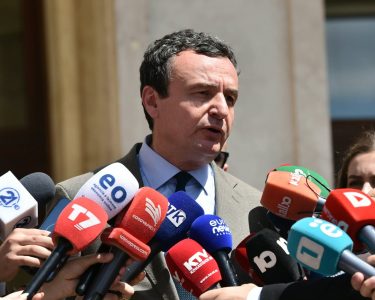
After the conclusion of the exhibition, Acting Prime Minister Albin Kurti was asked by the media how he viewed the withdrawal of the northern municipalities from the Association of Kosovo Municipalities, but he did not respond.