
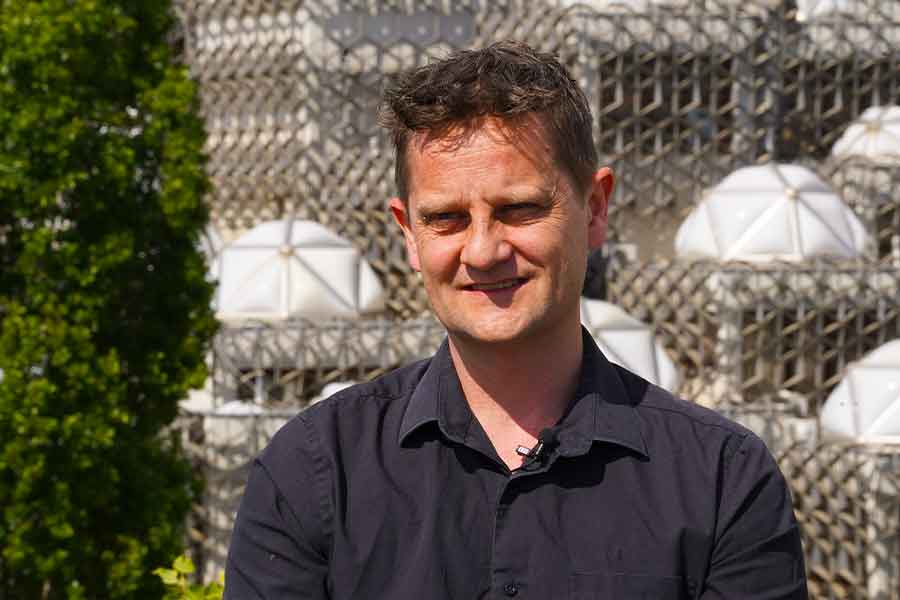
Kosovo needs political and economic stability more than ever, says Aidan Hehir, professor of international relations at the University of Westminster in England. He emphasizes that the formation of new institutions in Kosovo should happen as soon as possible by political parties that, as he says, must put national interest above party interests. In an interview with KosovaPress, Hehir also talks about Serbia’s destructive role regarding Kosovo, while criticizing the European Union’s approach.
Kosovo, which held parliamentary elections on February 9, is in a political crisis due to the failure to form new institutions.
The deputies have been sworn in, but the process of constituting the Assembly has stalled because the Vetëvendosje Movement — the leading party from the February 9 elections, in coalition with Guxo and Alternativa — has not been able to secure enough votes to elect their candidate for the Speaker of the Assembly
“What is important for Kosovo at this moment is to understand that, while the United States and the European powers in general are reviewing their foreign policy commitments, this has major implications for Kosovo. Therefore, Kosovo needs a strong and stable government to be able to nagivate the nextt four years, which will be very difficult. As long as [Donald] Trump is in power in the US, the situation will be very tricky. God knows what he will wake up tomorrow and decide. So, from this international perspective, a strong government is needed. But from the perspective of relations with the European Union, I do not see that there is any real impact. The European Union has disgraced itself in Kosovo. The sanctions imposed by the EU on Kosovo are an absolute front to democracy, a front to decency — the last thing Kosovo deserves. I think the people in Kosovo are rightly very skeptical about the EU’s priorities. And this will affect, I think, future decisions both of the citizens and political parties. But it certainly does not look good. A long period without a government does not look good. It only strengthens the position of Kosovo’s enemies, particularly Serbia. So, the sooner this issue is resolved, the better,” he says.
Meanwhile, calls for the rapid formation of new institutions have increased from the international community.
The head of EU diplomacy herself, Kaja Kallas, on May 22 called on politicians in the Assembly to cooperate to unblock the situation. In a press conference in Prishtina, Kallas recalled that forming new institutions is “essential for the stability and European future of Kosovo.”
Kallas also announced that the removal of punitive measures against Kosovo, imposed in summer 2023, has begun.
Professor Aidan Hehir tells KosovaPress that these measures should never have been imposed.
According to him, there is “only one culprit in this region that should be sanctioned — Serbia.”
“This is one of the most shameful episodes in the history of the EU — the imposition of these so-called emergency measures, or whatever they call them. There was no justificaion for them. They should be removed tomorrow. They can be lifted as soon as tomorrow. The idea that they will be lifted gradually is ridiculous. There is a real potential for conflict in the Western Balkans at the moment — both in Bosnia and in Kosovo. And the common cause of this conflict is aggressive Serbian nationalism. Kosovo is facing this aggressive nationalism — both from Belgrade and in the northern municipalities of Kosovo. Kosovo does not need sanctions. Kosovo needs international support. Kosovo should be seen by the EU, the US, and Great Britain as an important ally, as a source of stability in the region. An independent Kosovo threatens no one. An independent Kosovo is in the interest of regional stability. What threatens regional stability is aggressive Serbian nationalism. And what the EU, the US, Britain, and other powers have done in the last 10 years is a policy of appeasement toward Vučić — allowing him to create a captured state, an authoritarian regime internationally recognized as such — and to foster instability, sow tensions in Bosnia, Kosovo, but also in Montenegro and North Macedonia. There is only one clear culprit in this region that should be sanctioned and toward whom the EU should take a much tougher, more consistent approach — and that is Serbia. Kosovo should be nowhere near the list of sanctioned countries. These measures are a disgrace and must be removed immediately,” he says.
While speaking about Serbia’s actions, Professor Hehir says the bloc is letting Serbian President Aleksandar Vučić get away without consequences.
“It is not surprising that this [the attacks in the north] has happened again. The collapse of Yugoslavia was caused mainly, not exclusively, but mainly by aggressive Serbian nationalism. The people involved in the 1990s are still involved today in Belgrade. So, it is nota surprise, that they continue to engage in this kind of rhetoric, continue to align themselves Russia. Vučić recently went to Moscow for the Victory Day parade, and was warned in advance by the EU not to go. He went, and what happened? Not much. He has been able to get away with that kind of behavior for so long. And at each point, in 2012, 2013, 2014, he pushed the limit a bit further, a bit further, to see what he could get away with. And at every stage, the EU allowed him to get away without consequences for these actions. And certainly, this meant that the situation would inevitably escalate toward a full-scale armed uprising, which is what he tried to do and continues to do. Arms depots are continually being uncovered among Serbian nationalists in northern Kosovo,” says Hehir.
Serbia has created tensions in northern Kosovo, especially in recent years, by attacking Kosovo Police and critical state infrastructure.
Since 2023, when tensions increased in the Serb-majority north, there have been no rounds of dialogue in the Kosovo-Serbia talks in Brussels. Only talks at the chief negotiators’ level have taken place.
“I hope that the threat represented by Serbia can awaken the economic instinct of US President Donald Trump,” says Professor Aidan Hehir, when asked if he expects changes during the new US administration.
“I do not think Kosovo is at the top of his [US President Donald Trump’s] agenda. I don’t know if the Balkans as a whole is at the top of his agenda. But I do know one thing he clearly values above all else: money, trade, a functioning economy. And a war or instability in the Balkans is bad for that. If he can be convinced that the prospects for war in Europe mainly come from the Balkans and that the main source is aggressive Serbian nationalism, then I hope he will understand that what needs to be done is to stop this policy of appeasement toward Vučić and say, let’s make a deal, move forward, ensure stability in the region. Not because he is some moral actor, not because he cares about human rights, but because he cares about profit. And the economy of the Western Balkans will take a big hit if there is conflict. So there is some hope there. We know that last time when he was president, he had Richard Grenell as his envoy — if we can call him a diplomat — to the Balkans. And he was clearly pro-Serbia. So there is reason to be concerned. I don’t think he has said anything substantial about Kosovo since he returned to power, but as I said, my hope is that the threat represented by Serbia can awaken his economic instinct. And he may think about finding a solution to prevent economic instability. But as I said, who knows? With a person like that, you never know what will happen, and Kosovo must be prepared for that. The old days when we could fully rely on America are over,” says Professor Hehir.