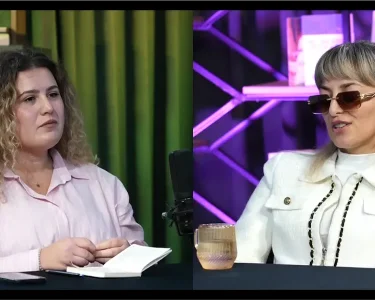

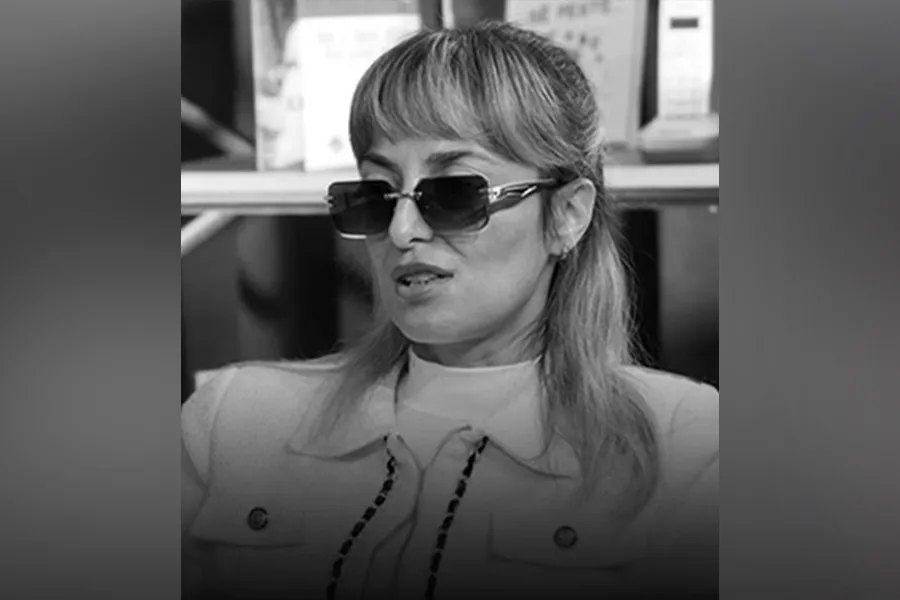
“The year of darkness” is how she describes the time when she last saw the colors of the world. Those were the twelve months of 2012 for Mimoza Zejnullahu, the year she completely lost her sight.
What happened as a result of an unexpected health problem did not entirely destroy her hope. A year later, she rose again—much stronger. Today, at 44, she continues to see the rest of the world in her own way, brightening her days every morning.
Art, poetry, music, acting… she stopped all of it in the year she lost her sight.
Mimoza’s story—she was 31 at the time—is truly unique, just like the days she endured, filled with challenges and hardship.
“I call 2012 the year of darkness for me, because during that time I was completely and practically blind. My eye health problems started in 2010, in 2011 I continued treatments, but I didn’t get better, and 2012 found me almost 100% blind. It was the hardest time of my life, because I had been an extremely active girl, doing many things at once with many dreams ahead of me, and suddenly being left in total darkness was incredibly difficult. I stopped then and asked myself, ‘Where do I stand now? Should I give up or continue?’ It was an extremely difficult year for me, a deep period of reflection. Many things I did then were only for the sake of others—for my family, to show people that one must keep going.”
Since the eighth grade she had done volunteer work. Last year she was named “Volunteer of the Year” in the city of Viti.
But during the year she lost her sight, she became passive, almost isolated—time felt frozen for her.
“For a while, I needed to accept myself. I paused and didn’t engage in activities because I had been such an active person. I didn’t feel secure enough to participate in anything, unsure what I could do in this new condition. I paused until I started feeling isolated. I missed my active life. When you’re blind, you need someone to accompany you everywhere—to pick you up by car, take you to work, bring you back. I felt like a prisoner taken from home to work and back. My social life was shrinking, and that made me feel isolated. I started telling myself: ‘Are you going to put yourself in motion? Are you going to help yourself and others, or are you going to make things worse?’”
Gradually, she began returning to the activities she once loved.
After the war, Mimoza, from Viti, could not continue university due to economic reasons. A year after losing her sight, she joined the organization of the blind in Gjilan and then decided to pursue a degree in General Psychology at the University of Prishtina.
Before starting her studies, she had worked as a nurse at the Main Family Health Center in Viti. Ironically, she pursued her long-awaited dream of university after becoming blind. She has recently been licensed as a clinical psychologist.
She also leads the organization “You Can Do”, which aims to empower young people with disabilities.
She links her “return to life” with enrolling in university and fulfilling an old dream.
“I enrolled in university in 2013, and in a way, that was my reawakening. It pulled me out of that lethargy and fulfilled an old dream I had long been waiting for. It became an enormous emotional pillar for me. The decision to continue my studies strengthened me immensely and pushed me to work with the abilities I had. Later, I achieved excellent results in university, got involved in organizations for the blind as an activist, always helping others—being the model I once needed myself.”
Difficult years full of challenges on the path to her academic dream. Lack of literature, discrimination, anxiety about not having someone to accompany her to class…
“I was never worried about how to learn a thick book, but rather who would read it aloud to make it accessible. At that time, I didn’t know books could be scanned. With time, meeting other blind students, I realized scanning was possible, and studying for my master’s became much easier because I had all my books digitally. But during my bachelor studies, it was extremely difficult—finding someone to accompany me from the dorm to the faculty was a challenge of its own. I always had anxiety: what if my companion left me—how would I go or return from class? And the problem of literature—who would read it to me?”
She never thought of giving up. With “iron will,” Mimoza completed her studies—with distinction.
“If someone read me a text for two hours, I had to listen to all two hours again to find one detail, while another student could skim through pages in minutes. It was challenging—I spent hours listening and re-listening just to locate missing information. But I had an iron will. I never thought of quitting. My goal was to learn, no matter how many hours it took. I woke up at 3 a.m., continued studying until I found what I needed because I refused to give incorrect answers to my professors.”
She also had to retrain at work, because at the time she lost her sight, she was employed as a nurse.
“When I lost my sight, I had to requalify myself to find a new role or contribute differently. As a blind nurse, you can still do some tasks, but your opportunities are limited. At the health center, there are counseling rooms where I could still contribute.”
Despite her accomplishments, Mimoza still faces daily challenges. Mobility is extremely difficult because the state does not provide adequate social services for the blind.
“If no one can accompany you, you become passive. My family helps me—my parents, my father, brother, sister-in-law, whoever is free. The state offers ridiculous support. With the support given, none of us could have completed our education—not me, nor anyone else. When I was a student, I received €100, then €125, and another €125 for a companion. No companion will give you their whole day for €125. Today we receive €300 total—€150 for me and €150 for the companion. That is still extremely low. A companion must spend the entire day with you. They can’t survive on €150. This is why the blind in Kosovo can’t be independent; if you want to work, you must pay a companion or a taxi.”
She spent many sleepless nights pursuing her goals, and still feels that society has low expectations of people with disabilities.
“Society’s biggest problem is very low expectations. When you show up with a disability, they immediately see you as a burden until they know you personally. Once they know you, they may change their perception. But at first, if you say ‘I can do this job,’ they say ‘No, you can’t’ instead of saying, ‘I’m here to support you.’ Here, the opposite happens—you must prove yourself constantly, and they still say, ‘Maybe you can’t.’”
Mimoza Zejnullahu from Viti says parents of children with disabilities live with constant worry about their future.
“People need to believe more in these individuals and give them opportunities. I know the stress and anxiety mothers of children with disabilities carry—they are never calm. They will die with the fear of who will take care of their children. We need to remove that anxiety from them and assure them that if they are gone one day, their child will be okay. That someone will care. That the state stands behind them. As a society and institutions, we must reach that point.”
Mimoza Zejnullahu
July 2025