
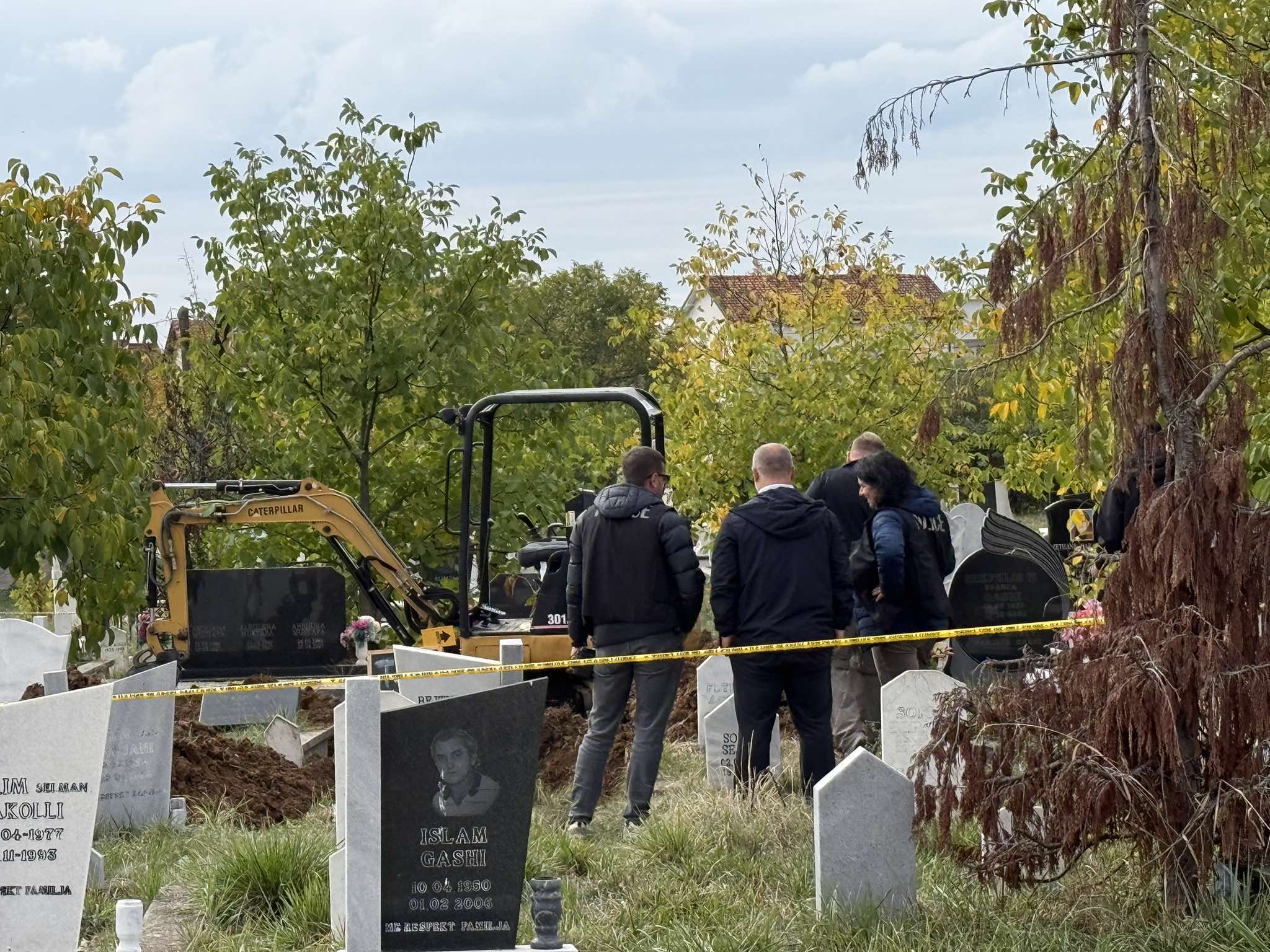
Human remains of four individuals, suspected to be victims killed during the 1999 Kosovo War, have been found. Excavations are still ongoing at the Hajvali cemetery in Prishtina, where a total of seven sets of remains are suspected to be present.
From the Government Commission for Missing Persons, chairman Andin Hoti reported that excavations have been conducted at 24 locations so far, and at 12 of them, human remains potentially belonging to missing persons have been found. He emphasized that not every excavation site necessarily contains missing persons, so the families of the missing should not be alarmed.
“During this year, we have excavated or investigated 24 locations across the territory of the Republic of Kosovo, excluding Serbia, as you know we are in Kozhle. Out of these 24 locations, we have found human remains at 12 locations that could potentially belong to individuals on the list of missing persons. This does not necessarily mean that these remains are from missing persons; that can only be confirmed when the DNA report is completed in The Hague and then sent to Kosovo. At this location, so far, we have found the remains of four individuals,” Hoti said.
Meanwhile, Kushtrim Gara from the Government Commission for Missing Persons noted that this location had been excavated earlier, in the months immediately following the war, when eight bodies were found. This time, seven additional remains are suspected.
“We have returned to this location, which means it was previously investigated during the early post-war months, October 1999. Based on this information and international archival data, we concluded that we should return here. In October 1999, eight bodies were found and exhumed, identified at that time. It remains a priority to continue efforts to locate and exhume the seven other bodies, some of which may potentially be on the list of missing persons. So far, we are talking about finding four bodies,” he said.
Director of the Institute of Forensic Medicine, Ditor Haliti, emphasized that the excavations began yesterday and that the remains have been taken to the institute for forensic examination.
“We have been here since yesterday under an order issued by the Basic Court of Prishtina, based on a request from the War Crimes Prosecutor’s Office. The human remains will be sent to the Institute of Forensic Medicine, where they will undergo forensic examination and identification processes. Once all procedures are completed, if there is a positive identification through scientific DNA methods, the families will be notified, and with their agreement, the remains will be handed over for burial ceremonies,” Haliti said.
The Government Commission for Missing Persons stated that the main challenge remains the lack of reliable information and highlighted Serbia’s unwillingness to cooperate.