International reports show that around 40 percent of the Gross Domestic Product is fiscal evasion or informal economy in Kosovo, while about 25 percent are tax revenues and Customs revenues when compared to the gross product. This means that roughly 150 percent is the informal economy in comparison to what is actually collected.
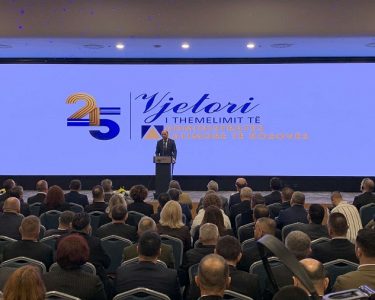
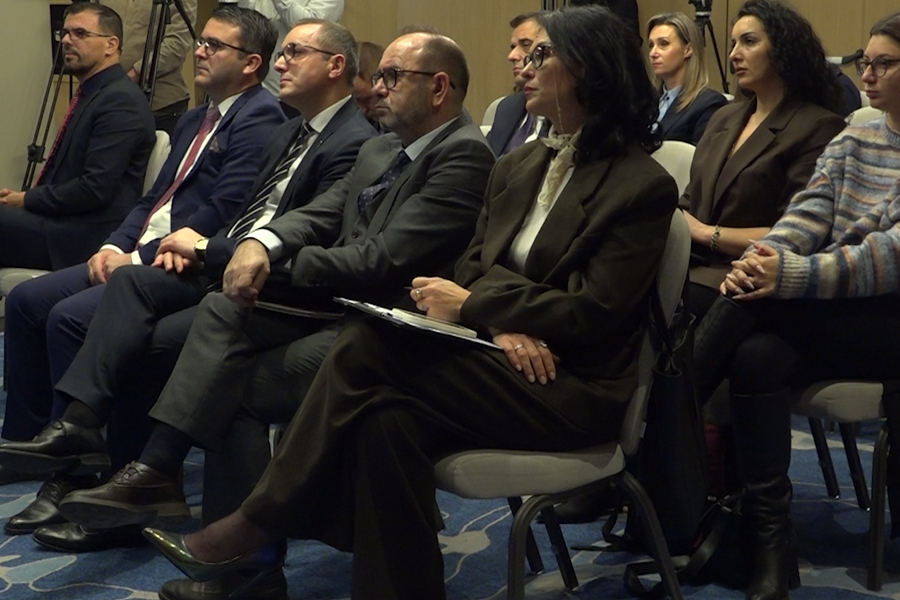
This was stated at the opening of the Week of the Formal Economy and Fair Trade, focused on transparency, fair competition, and sustainable development, which began today.
The Director General of the Tax Administration of Kosovo (TAK), Mentor Hyseni, stated that tax revenues have been increasing over the last three years by around 12 percent each year.
He also said that there is single-digit economic growth, which according to him indicates that TAK and Kosovo Customs are showing progress in reducing the informal economy.
“International reports show that about 40% of the gross product is tax evasion or the informal economy. Around 25% are tax revenues and Customs revenues compared to the gross product, which means that roughly 150% is the informal economy compared to what we collect. When you look at the tax revenues — because numbers are stubborn and do not lie — we have seen an increase of about 12% annually over the last three years. Meanwhile, we have single-digit economic growth, which means TAK and Customs are showing that they are reducing the informal economy, as tax collection is increasing faster than economic growth. This is another indicator which shows that there is much more room to reduce informality. This cannot be done only by Customs, by stopping uncustomed or smuggled goods, nor only by the Competition Authority, which tries to uphold legal rights to prevent businesses from creating monopolies, nor only by TAK itself,” he said.
The Director General of TAK, Mentor Hyseni, also said that requests for VAT refunds have increased by 136%, which according to him is an indicator of growing trust in the institution.
Hyseni said that, in order to increase transparency within TAK, they have begun publishing appeal decisions.
“For fair trade, we also need businesses — those businesses that choose the honest path, not those that choose shortcuts which can cause problems… There is an increase of around 136% in requests for VAT refunds. No other indicator correlates with this. VAT has not increased by 136%, but requests for refunds have increased, which means people have begun to trust the institution, that TAK functions properly when there are refund requests… 20:01 We are trying to create a mix between the staff TAK has built over these 20 years and a combination of new structures and new people who will play a mentoring role… 21:00 The new vision contains a key point: before punishing businesses, to educate them,” Hyseni said.
The founder of Kapitali Online, Astrit Panxha, emphasized that the main pillar for a successful economy is trust between suppliers and clients.
“To have a successful business, there must be trust in suppliers and in the client. Trust is one of the main points. This means that the economy has made a drastic shift from the assumption of a rational human to an emotional human, where trust plays the biggest role as a factor… 07:20 There is optimism that in Kosovo we are on the right path… 10:10 Is there social trust in Kosovo? We have an institution that has developed over centuries — the institution of ‘besa’ (the pledge of honor). And in Kosovo, Albania, in places where Albanians are present, ‘besa’ is still spoken of. It is an institution that for centuries enabled people to travel safely during the 18th, 19th, and 20th centuries,” he said.
The informal economy in Kosovo has for years been considered one of the biggest obstacles to sustainable economic development, increasing fair competition, and strengthening the rule of law. Reports from international organizations emphasize that a significant portion of economic activity takes place outside the formal system of taxation and legal regulation.