
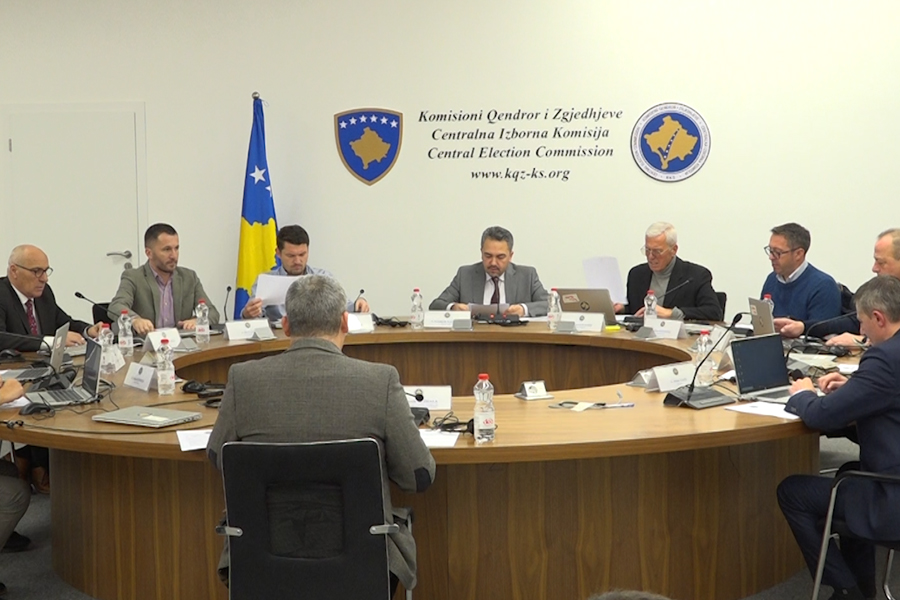
The Central Election Commission (CEC) has decided that citizens with the right to vote who are over the age of 80 and who apply to register as voters with special needs in order to vote through mobile teams on election day will not be required to submit a medical certificate or diagnosis.
Initially, the proposal was that persons over the age of 75 would not be required to provide medical proof, but after discussions at the meeting of the Central Election Commission, the age threshold was set at 80.
Based on data from the voter list certified by the CEC, the number of citizens with the right to vote who are over 80 years old is 48,977 voters.
Arianit Elshani from the Council for Electoral Operations said that through this proposal the aim was for persons over the age of 75 not to be required to attach medical documentation to their application to register as voters with special needs.
“Persons over 75 years of age, when applying to register to vote in their homes, should not be obliged to attach health documents regarding their status to justify why they want to vote from home. Therefore, this would constitute a bypass of the regulation, and in this case persons aged 75 and above would be obliged to upload to the CEC platform a valid identification document and a photograph of the voter holding the identification document in their hand,” Elshani said.
The Director of the Office for Registration, Certification and Financial Control of Political Entities, Besnik Buzhala, said that if there is a large number of applications for voting from home, it would affect the number of ballot papers available.
He stated that there are over 100,000 voters who belong to the age group above 75.
“This is an aspect that makes it difficult if we have a large number of applications, as it affects the electoral materials that we have planned and are in the process of finalizing and receiving. This concerns the ballot papers that were printed in Slovenia, for which the CEC has made a decision on the number of ballots to be printed. The category with special needs votes through reserve ballots that we have foreseen for this category of voters,” he said.
Meanwhile, CEC member from the Vetëvendosje Movement, Alban Krasniqi, declared that the change is not problematic if institutional obligations are respected.
“I think there is nothing wrong with bypassing the regulation in order to ensure the inclusion of citizens, but without bypassing the rights and obligations of both institutions and citizens,” he said.
Meanwhile, Sami Hamiti, a CEC member from the Democratic League of Kosovo, agreed that the best solution is to set the age at over 80.
“I think that after analysis, this time the age of 80 may be appropriate, and then we can review it in future elections,” he said.
At the same meeting, the Central Election Commission accredited the first group of 283 observers to monitor the early elections for the Assembly of the Republic of Kosovo, which will be held on December 28, 2025.
Besnik Buzhala, Director of the Office for Registration, Certification and Financial Control of Political Entities, said that 17 observer organizations have applied and meet the legal criteria.
Of these, three are non-governmental organizations, three are embassies, and 11 are media outlets.
“The Office has prepared a recommendation for 17 observer organizations that meet the legal criteria as defined in the Law on General Elections and the relevant electoral regulations. I will recommend them one by one. The first is the Institution of the Ombudsperson, which has submitted a request for accreditation as an observer organization and its individual observers, a total of 66 observers. … Within the category of observer organizations that are diplomatic representations in the Republic of Kosovo, there are two in total: the British Embassy in Prishtina, which has applied for accreditation with seven observers… Likewise, the Embassy of Japan in Kosovo has applied for observation with three observers… Within the category of non-governmental organizations, the Balkan Investigative Reporting Network (BIRN Kosovo) has applied with a total of 46 observers, etc.,” he said.
Regarding clarifications on whether or not the Kosovo Law Institute (KLI) will be accredited as an observer in the December 28 elections, Elshani said that the request is still under review.
“In the statute of this organization, the areas of activity are specified, but none of them directly relate to elections and human rights as defined in the election law and regulations. On the other hand, what we have seen with this organization is that it has extensive publications related to justice in elections, and in this regard the Office is seriously reviewing its application because we see publications related to elections and the field they deal with regarding elections is justice in elections. This has led us to review the request. We are still in the process of review and believe that at the next meeting the Office will come with a recommendation. However, within the framework of the statute, the Office has correctly assessed the application of this non-governmental organization,” he said.