
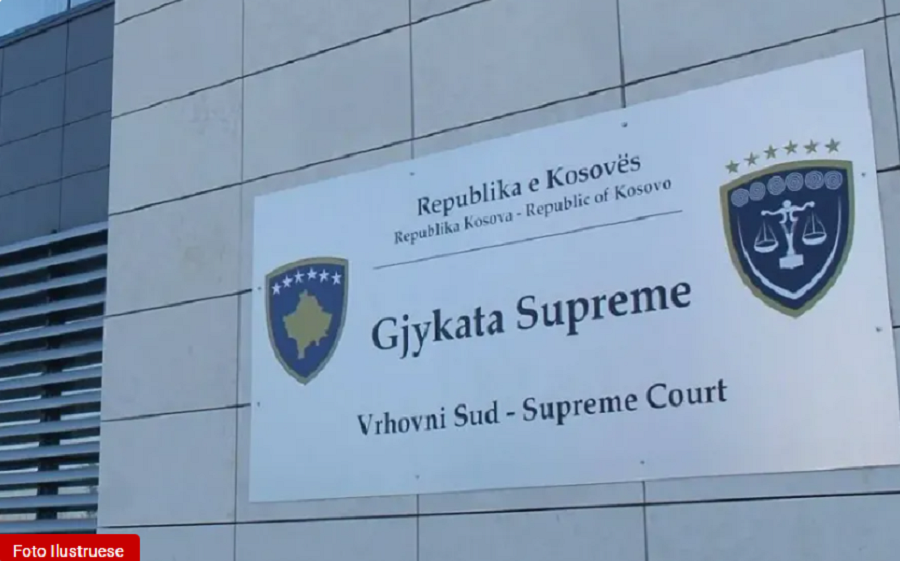
The Supreme Court of Kosovo, in an administrative dispute between the plaintiff Ipko Telecommunications L.L.C and the defendant, the Government of Kosovo, namely the Ministry of Finance, Labour and Transfers, has issued a judgment approving the plaintiff’s claim as well-founded.
According to the announcement, the Supreme Court declared unlawful and annulled sub-paragraph 1.2 of paragraph 1 and sub-paragraph 3.3 of paragraph 3 of Article 61 of Administrative Instruction MF-No. 03/2015 on the implementation of the Law on Value Added Tax (VAT), published in the Official Gazette on September 18, 2015.
According to the Court, the case is related to the legality of sub-legal provisions that provided for the obligation to calculate VAT on compensation received from insurance in cases of property damage.
“In this context, the plaintiff had presented a legitimate legal interest in the annulment of the contested provisions, emphasizing that on July 3, 2025, an accidental fire had broken out in one of its warehouses in the Industrial Zone, causing significant material damage to goods for sale, business assets, and the company’s building. These assets had been insured with Triglav d.d., headquartered in Ljubljana, and the plaintiff was expected to receive compensation for the damage,” the statement said.
According to the plaintiff’s claims, in the event of receiving this compensation, it would have been unlawfully required—based on the contested provisions of the Administrative Instruction—to pay VAT on the amount received as damage compensation.
In this regard, the plaintiff had notified the Kosovo Police about the case, while officials from the Tax Administration of Kosovo, after visiting the scene, informed the company that the insurance compensation would be considered income for tax purposes, both for Corporate Income Tax and VAT, determining that the taxable value would be calculated based on the compensation amount.
In its reasoning, the Supreme Court assessed that these provisions created a new tax base not предусмотрed by law and therefore exceeded the competencies of the authority that issued them.
According to the Court, the Law on VAT clearly stipulates that only supplies of goods and services made for consideration are subject to taxation, while insurance damage compensation does not constitute an economic supply but has a compensatory nature aimed at restoring the previous situation.
The Court found that the contested provisions contradict the fundamental principles of the VAT system, including the principle of legality, the hierarchy of legal norms, and tax neutrality. Sub-legal acts, according to the Court, cannot create new tax obligations that are not defined by law.
The Court also relied on international standards and European judicial practice, emphasizing that payments of a compensatory nature, such as insurance indemnities, cannot be considered as consideration for a supply and therefore are not subject to VAT.