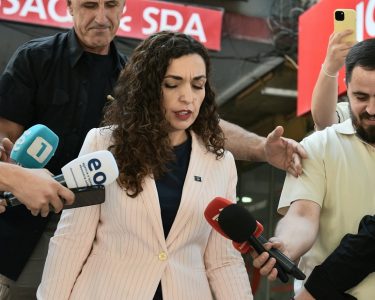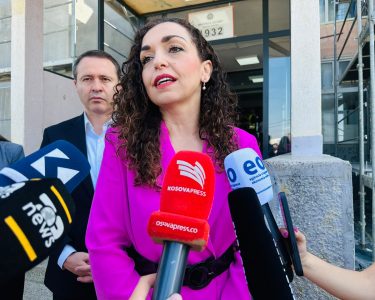
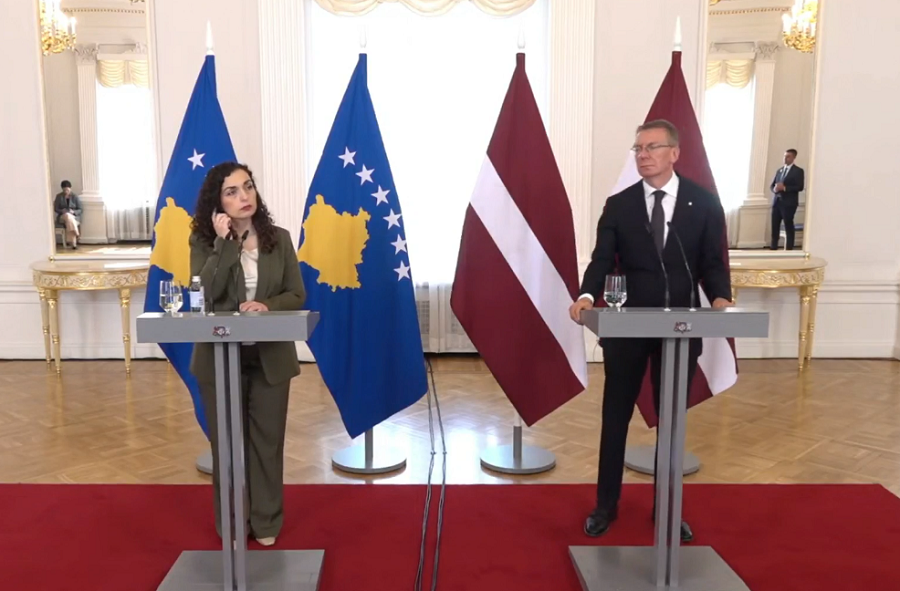
President of Kosovo, Vjosa Osmani, stated that Serbia has turned into a proxy state of Russia, which aims to create a destabilizing effect in the region. However, Osmani said that Kosovo will work closely with NATO and the European Union to ensure that these destabilizing tactics do not succeed.
Osmani made these remarks during her visit to Latvia — the first ever by a President of Kosovo — where she later honored her Latvian counterpart, Edgars Rinkēvičs, with a presidential military medal.
She emphasized that Latvia’s voice has been crucial in supporting Kosovo’s membership in international organizations. Meanwhile, the President of Latvia noted that “the day when Kosovo becomes a candidate country for EU membership is near, although more work and commitment are still required.”
“I propose the creation of a Kosovo–Latvia Economic Forum to deepen our economic ties and bring our investment and innovation agencies closer together. Business-to-business connections are always an important step forward in bringing countries and people together. I emphasized Kosovo’s readiness to finalize key bilateral agreements between our two countries, and I hope that the relevant ministries will continue the talks starting today. Latvia’s voice has been decisive in supporting Kosovo’s membership in international organizations – in the Council of Europe, as I mentioned, in Interpol, UNESCO, and in international financial institutions,” Osmani said during a joint press conference in Latvia.
In her meeting with the Latvian president, she also said that they discussed “Russia’s dangerous imperialist ambitions.”
Osmani stated that Kosovo stands on the front line of defending Euro-Atlantic values in the Western Balkans.
“We believe in the transformative power of the European Union and remain committed to reforms and meeting the necessary criteria, but this path must be guided by justice, equal treatment, and credibility on the part of the EU. So, dear President Rinkēvičs, as we speak, 140 Latvian soldiers are still serving within NATO’s mission in Kosovo, contributing to the peace, stability, and security of our citizens. They join the thousands of Latvian troops who have served in Kosovo over the past two decades. This is a testimony to Latvia’s commitment to our shared values, and I sincerely hope this support will continue even after December of this year,” Osmani added.
When asked in Latvia about Russia’s influence on “tensions between Kosovo and Serbia,” Osmani replied that Serbia has become a satellite state of Russia.
“Serbia continuously tries to destabilize our country, including through acts of aggression, while we continue to defend ourselves. In the history of our state, we have never invaded or attacked even one centimeter of our neighbors’ territories. What we have always done – and will continue to do – is defend our independence, our territorial integrity, the peace and the freedom we achieved through great sacrifice… In my country, Russia’s influence is zero. Unfortunately, I cannot say the same for our neighboring country, because Serbia has become a proxy state of Russia – politically, economically, and militarily. Through Serbia, Russia seeks to create a chain reaction of destabilization in the region, because the more destabilization there is in Europe, the more it serves Russia’s interests. That’s what they want — but we will work closely with our allies in the EU and NATO, through deterrence and resilience, to ensure that none of Russia’s destabilizing tactics carried out through Serbia will succeed,” Osmani said.
On the other hand, Latvian President Edgars Rinkēvičs called Osmani’s visit historic and added that during their meeting, he reaffirmed Latvia’s support for Kosovo on its path toward the European Union and deeper European integration.
“I visited Kosovo myself this year, actually in March, during the spring, when I also visited our soldiers deployed under KFOR. Currently, we have around 140 soldiers deployed in Kosovo. At that time, together with Madam President, we discussed bilateral relations, regional security, and I believe we are like-minded countries — we are on the same wavelength, on the same page regarding many different issues. I also confirmed that Kosovo’s foreign and security policy is fully aligned with that of the European Union. We also discussed issues important for strengthening security in the Western Balkans, and the situation in Ukraine, the Russian aggression against Ukraine, which requires clear positions from the entire international community,” he said.
In his meeting with President Osmani, he added that they also discussed economic cooperation, emphasizing that there has been growth in trade exchange between the two countries.
“I expressed my support for the EU’s High Representative, Kaja Kallas, and Mr. Sorensen – who is the EU’s mediator in the Pristina dialogue, which is very important. It is also essential that this dialogue is supported by both parties, not just one. From this perspective, it was very interesting for me to hear from my colleague, Madam President, her thoughts on the progress of this dialogue and how regional issues are being addressed… I think we will reach a point where we will mark significant progress in Kosovo’s European integration. We know what our friends in Kosovo want, but we also know there is still a lot to be done – both in terms of internal reforms and in foreign policy – to secure the support of all EU member states. But the day when Kosovo becomes a candidate country is near, even though much work remains,” he emphasized.
Later today, President Vjosa Osmani is also expected to visit the “Stratcom” Center of Excellence, which plays an important role in promoting information integrity and resilience.