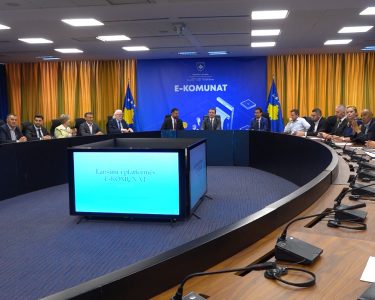
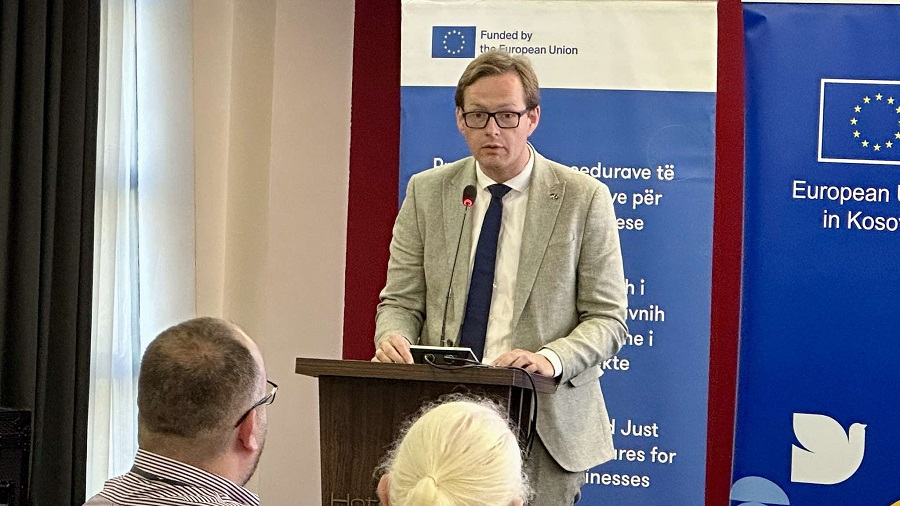
At the regional conference organized by Demokraci Plus under the theme “The Power of Participation: Reducing Administrative Burden Through Engagement of Citizens and Businesses in the Western Balkans,” it was emphasized that Kosovo has made significant progress toward digitalization and simplifying several public services.
Speakers highlighted the importance of systematic reforms and the active participation of citizens, civil society, and businesses to ensure a more efficient, transparent, and inclusive public administration.
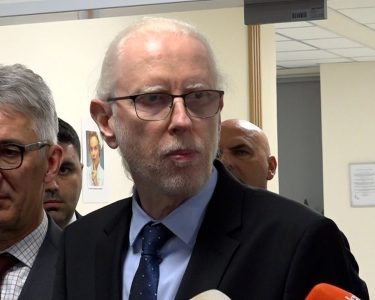
The Chief Technology Officer in the Prime Minister’s Office, Lulëzon Jagxhiu, said Kosovo has made meaningful steps in digital transformation and reducing administrative burdens.
He emphasized that currently, citizens and businesses have access to over 250 services on the state portal e-Kosova, while more than 750 services have been simplified at both central and local levels.
“In recent years, we have seen, I would say, significant progress and meaningful achievements in digital transformation and reducing administrative burden. Today, on e-Kosova, which is our main government portal for services for citizens and businesses in Kosovo, we have more than 250 services. At the same time, through the Administrative Burden Reduction Program, more than 750 services have been simplified at both central and local levels. This progress is also recognized in the latest OECD Sigma report — in the 2024 report, we see that Kosovo is now well above the Western Balkans average in the component of service delivery and digitalization, which is a significant improvement compared to two years ago when we were below that average,” Jagxhiu said.
Jagxhiu stressed that digital transformation is not merely about numbers or statistical comparisons but a deep reform process.
He explained that for this transformation to be sustainable, secure, and inclusive, systematic reforms are necessary in how public administration operates.
According to him, these fundamental changes are the core of the success of digitalization in Kosovo.
“But when we talk about digital transformation, it is much more than numbers, comparative indicators, or visible results. It is fundamentally about reform because to make our digital transformation sustainable, secure, and inclusive, we must also undertake very systematic and deep reforms in how our public administration functions,” Jagxhiu said.
The Head of the Media and Communications Department at the German Embassy in Kosovo, Christian Böttcher, highlighted the increasing pressure on Western Balkan governments to provide faster, more transparent public services tailored to citizens’ needs.
Böttcher emphasized that reducing administrative burdens is an important step, but as he said, sustainable change happens only when reforms are led by citizens, civil society, and businesses.
According to him, active participation is the key to identifying these obstacles and successfully addressing them.
“Governments throughout the Western Balkans and beyond are under increasing pressure to provide public services that are faster, more transparent, and responsive to real needs. Reducing administrative burden is a step forward. But real and sustainable change happens when reforms are shaped by those who experience them — citizens, civil society, and businesses. This is where participation becomes not only important but essential… Often, administrative burdens are invisible — in long queues, unclear procedures, and ultimately in silent decisions to forgo a service that seems too complicated. These obstacles affect the most vulnerable groups the most. Participation brings these to light and gives us an opportunity to fix them,” Böttcher said.
Laura Fallavollita from the EU Office, Good Governance and Human Capital Team, said reducing administrative burden is not merely a technical issue but a process with direct impact on citizens’ and businesses’ lives, as inefficiencies reduce trust in public administration.
Fallavollita praised Kosovo’s progress in this field, particularly mentioning the program for reducing and digitizing services.
“Reducing administrative burden is not just a technical exercise, as previous speakers have said, because burdens that weigh on citizens and businesses have a real cost, and they hinder not only opportunities but ineffective services can create limitations on opportunities, inefficiency, and ultimately erode transparency and trust in public administration… And Kosovo is indeed making good progress with this program for reducing and simplifying services, for digitizing services… Let me also say that reducing administrative burden and digitalization are also keys within the reform framework and growth mechanism for Kosovo. Some steps, and consequently the disbursement of some funds, are linked to the implementation of these reforms. And this is also evidence of the importance you attach to this and how we want to support and encourage the fulfillment of this progress in reducing administrative burden,” she said.
Senior Policy Analyst at Demokraci Plus, Albana Rexha, emphasized the important role of civil society in improving the quality of public services.
Rexha said that the focus should first be on simplifying services before moving to digitalization, so that the transition is not from traditional bureaucracy to digital bureaucracy.
“Civil society has the capacity to contribute in many ways to the quality of public services. If we look at the SIGMA reports, we see there are four or five elements where civil society can get involved, starting with the design of these services themselves. Initially, from simplifying procedures, from accessibility to these services. Then digitalization — it is very important that bureaucracy does not turn into digitalization but first simplifies certain services, then moves to their digitalization. And finally, user satisfaction or monitoring those services as well as monitoring the implementation of these plans,” Rexha emphasized.
Reducing administrative burden and digital transformation are among the top priorities of governments in the Western Balkans, given the need to improve public service efficiency and ease the lives of citizens and businesses.