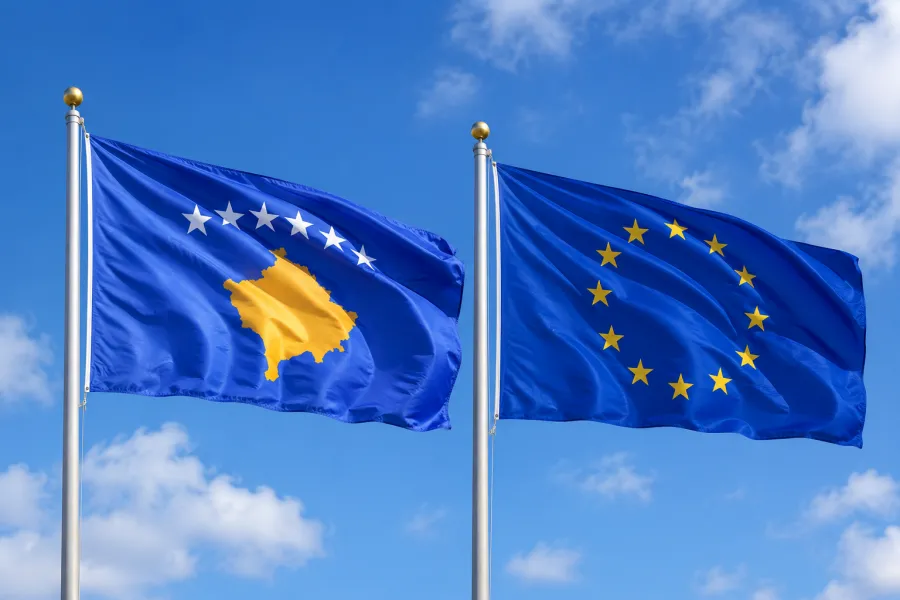
Kosovo is seeking to benefit from the new geopolitical momentum within the European Union to advance its request for candidate country status. While Brussels on Tuesday will host four intergovernmental conferences between the European Union and four candidate countries — Albania, Montenegro, Ukraine, and Moldova — Kosovo’s institutions view this as an important moment highlighting that the bloc’s enlargement process is now taking on a political and strategic dimension.
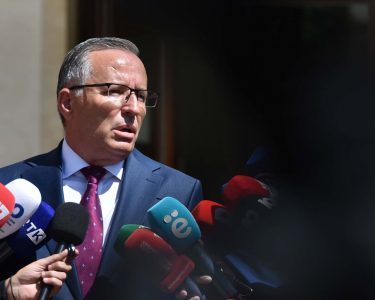
Kosovo’s Chief Negotiator with the European Union, Jeton Zulfaj, told KosovaPress that the current moment also represents an important opportunity for Kosovo. He said enlargement is no longer being treated only as a technical process, but also as a geopolitical necessity, while the progress of countries in the region, particularly Albania, is in the interest of the entire Western Balkans.
He called for Kosovo’s progress to be measured based on reforms and achieved results, arguing that the country has recorded advancement in democracy and the rule of law indicators. According to him, Kosovo should not be conditioned by developments in the dialogue with Serbia or by Serbia’s progress on its path toward European integration.
Speaking about Ireland’s presidency of the Council of the European Union, Zulfaj said Kosovo’s institutions are intensifying diplomatic efforts to secure support from member states, with the aim of placing Kosovo’s request for candidate status on the European agenda. According to him, although the country is making maximum efforts, the final decision remains in the hands of EU member states.
“We are in a more dynamic phase of the process. We are trying to push forward EU consensus and are working in this direction. As a state with limited capacities, in terms of the lobbying dynamics required with all EU countries and EU institutions, where a lot of energy, capital, and people are needed, we are doing our maximum. At this geopolitical moment of enlargement, we are also trying to use Ireland’s presidency, which is pro-enlargement, to push candidate country status forward on the agenda. How far we will get depends greatly on the overall positive image we create as a state and society regarding the reform and enlargement agenda. There must be both state and societal reflection, as well as reflection from the EU, because they are the ones who must make the decision,” he added.
Meanwhile, European integration expert and former diplomat Alma Lama assessed that Ireland’s presidency represents a positive development for Kosovo, given the continuous support Ireland has provided for its statehood.
Despite this, she added that the EU’s enlargement policy toward the Western Balkans remains unchanged and that the progress of each country will depend on fulfilling standards and reforms, rather than on any preferential approach.
She emphasized that Ireland could help Kosovo’s membership application be reviewed faster, but warned that the internal political crisis and the failure to establish new institutions could negatively affect the process.
“It is good news for Kosovo; it is a country that recognizes and is friendly toward Kosovo. From what I have seen, the priorities of this presidency will be a continuation of EU policies in almost all areas. Regarding the Western Balkans, it is evident that the EU’s policy has not changed and countries will move closer to the EU based on fulfilling standards. There will be no bloc enlargement or preferential treatment. Regarding Kosovo, there has been no movement or review of its membership application. Of course, Ireland, with good diplomacy from the Kosovo side, could push the issue forward, at least to have Kosovo’s application reviewed. However, if the institutional crisis continues, as we have seen, and Kosovo does not have legitimate representatives of institutions, but only a caretaker government and no functioning parliament, then I do not believe there will be any change in relations with the European Union,” she said.
The six-month presidency of the Council of the European Union passed from Denmark to Ireland on July 1 and will last until December 31, 2026.
Under the motto “Strength With Unity,” Dublin has placed EU enlargement among the main priorities of its mandate. Ireland aims to advance negotiations with candidate countries, working toward concluding talks with Montenegro and advancing negotiations with Albania, Moldova, and Ukraine, while continuing support for Ukraine.
Meanwhile, Kosovo applied for EU candidate country status in December 2022, but the application has still not been reviewed by the European Union. /E. Zeqiri/